


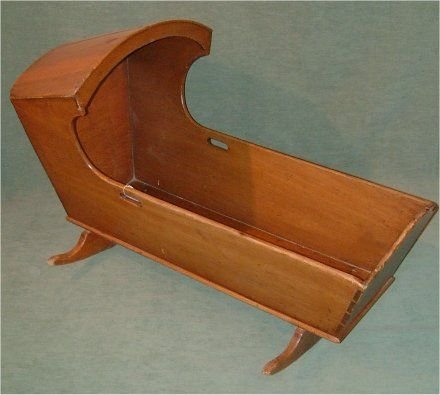
Victorian Hooded Cradle
A victorian hooded cradle offers a wonderful piece of nineteenth-century nursery history that works well as a practical child's bed or a distinctive fireside log basket today.
Victorian Hooded Cradle
A victorian hooded cradle is a traditional rocking bed designed for infants, featuring a protective canopy or hood over the head end to shelter the sleeping child from drafts. These nursery pieces turn up in various forms across the nineteenth century, reflecting both simple country utility and more formal domestic styles.
The versions most commonly met on this page are sturdy timber rockers fashioned from native woods like oak and pine. Many examples incorporate panelled construction or woven cane panels into their design, resting on curved rocking feet built to soothe a baby to sleep.
Makers occasionally drew on earlier historical design languages, producing pieces styled in the Jacobean Revival or Victorian Gothic Revival taste. Beyond their original nursery use, today's buyers often repurpose these sturdy wooden frames as decorative storage containers in the home.
How they were made
Cabinet makers built these nursery beds using traditional timber framing techniques, selecting durable hardwoods like oak and mahogany alongside more accessible softwoods such as pine. Panels were frequently fitted into solid frames using pegged joints or simple tongue and groove methods to withstand the constant motion of rocking.
Many examples incorporate flexible natural materials into their hoods and sides, employing woven cane and rattan alongside fitted upholstery or protective metal hardware. Sturdy brass fixtures and hinges were often added to secure the canopy structures and support the rocking mechanisms.
One robust oak cradle comes with a dealer suggestion that it would make a very good log basket.
What varies in quality
The overall standard of a victorian hooded cradle rests heavily on the quality of its timber selection and the competence of its joinery. Superior examples display carefully figured grains, tight panel fitting, and robust rocking runners that have survived centuries of movement.
Design ambition also separates ordinary pieces from finer work, as seen in the depth of carved ornamentation, the neatness of cane weaving, and whether the maker incorporated decorative historical revival details.
The Victorian Hooded Cradle Glossary
- Canopy top
- A projecting hood or cover built over the head of a cradle to shield the infant from draughts. This architectural element defines the silhouette of the piece.
- Rockers
- The curved wooden feet attached to the base of a crib that allow it to sway gently. They provide the necessary movement for lulling a child to sleep.
- Rattan
- A slender climbing palm used in strips for weaving panels on furniture sides and hoods. It offers both flexibility and decorative texture.
- Jacobean Revival
- A nineteenth-century design style that deliberately imitates seventeenth-century English furnishings. Pieces in this taste feature dark oak and heavy geometric panelling.
Victorian Hooded Cradle: Frequently Asked Questions
What is a victorian hooded cradle?
A victorian hooded cradle is a nineteenth-century infant bed featuring a protective canopy over the head end and curved runners for rocking. These pieces were essential items in period domestic nurseries.
Today, buyers acquire them both as historical artefacts and as versatile household objects suitable for alternative domestic uses.
How were these cradles used?
These beds were kept in bedrooms or nurseries to hold sleeping infants, with the curved base allowing parents to rock the child easily. The overhead hood protected the baby from cold air currents in period houses.
Modern owners frequently adapt these sturdy wooden structures to serve as distinctive decorative containers for logs by the hearth.
What woods were used?
Cabinet makers utilised a range of timbers depending on the intended quality and cost of the piece. Oak and mahogany appear alongside softer pine in many surviving examples.
Secondary materials like cane and rattan were often introduced to lighten the hood and side panels.
How do I spot a revival style?
Revival pieces draw inspiration from earlier historical periods, such as seventeenth-century Jacobean design or Gothic architecture. They employ traditional motifs and heavy timber construction while retaining nineteenth-century manufacturing methods.
Examining the construction joints helps distinguish these deliberate historical revivals from authentic earlier furniture.