


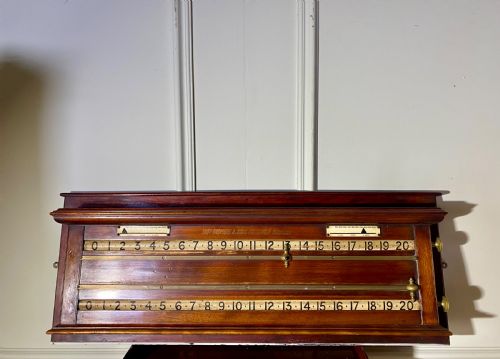

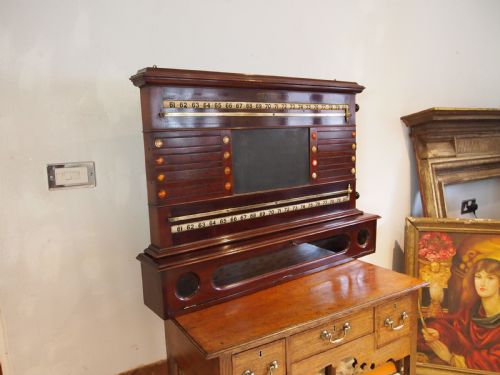
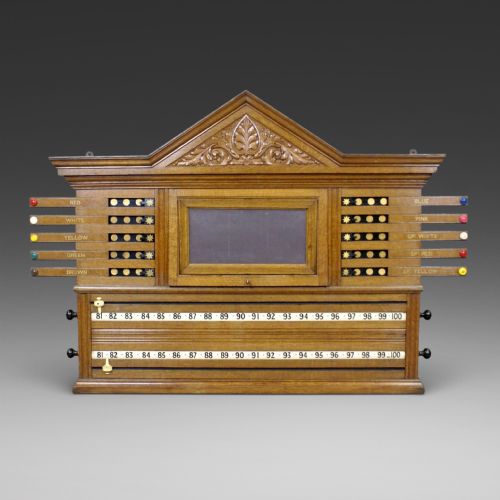
Victorian Game Counter
These Victorian game counter pieces are parlour and gaming room accessories designed for keeping score during nineteenth-century pastimes.
Victorian Game Counter
A victorian game counter sits at the centre of nineteenth-century social gaming, serving as a token or marker for pastimes such as whist, cribbage, and backgammon. Buyers searching for a victorian game counter encounter various forms, including individual ceramic tokens, oversized markers, and complete boxed sets.
Most examples date from the nineteenth century, spanning periods like the 1860s, 1890s, and 1900, reflecting the popularity of indoor parlour games during the era. These pieces range from simple horn cribbage boards to elaborate Black Forest carved boxes and substantial snooker scoreboards.
Materials and construction
These items utilise traditional materials such as mahogany, walnut, pale oak, brass, and glass, alongside ceramic, porcelain, bone, and stag horn. Woodworkers and artisans shaped these substances into dovetailed boxes, turned counters, and fitted scoreboards.
Surface decoration involves carving, gold leaf application, and hand-painted porcelain details, particularly seen on ceramic gaming tokens and Black Forest game box sets. Leather boxes lined with fitted compartments house delicate items like whist counters.
Victorian Game Counter Retail Price Guide 2026
Typical asking prices for victorian game counter among the pieces listed under this phrase on Sellingantiques today, from the lower quarter to the upper quarter. They describe what is for sale here now, not the wider market.
Stag horn cribbage boards bring a touch of woodland fauna directly into the Victorian card-playing routine.
What separates the tiers
Quality in these gaming accessories depends on the crispness of the carving, the integrity of the timber, and the presence of original fitted housings like leather boxes. Pieces produced by established makers demonstrate superior joinery and more refined finishing compared to utilitarian workshop output.
The survival of complete sets, original components such as distinct counters and sliding markers, and untouched patination elevate certain examples. Material selection, from plain woods to figured walnut and stag horn, marks the distinction between standard parlour items and high-end cabinet work.
Orme and Sons Manchester·Cox and Yeman London
The Victorian Game Counter Glossary
- Whist counter
- A mechanical or token-based device used to keep track of tricks won during a game of whist.
- Cribbage board
- A board featuring tracks of small holes used with pegs to score points in the card game cribbage.
- Black Forest style
- A decorative wood-carving tradition originating in central Europe, characterised by realistic depictions of animals and foliage.
- Snooker scoreboard
- A wall-mounted wooden frame featuring sliding markers and dials to tally points during cue sports.
Victorian Game Counter: Frequently Asked Questions
What were Victorian game counters used for?
These counters and scoreboards were utilised during nineteenth-century parlour games to keep accurate tallies of scores for pastimes like whist and cribbage. They provided a functional and decorative method for players to track points during social evenings.
Beyond simple scoring, many items served as decorative accessories for the home, housed in polished wooden boxes or displayed on games room walls.
What materials are common in these gaming antiques?
Common materials include hardwoods like walnut, mahogany, and pale oak, alongside bone, stag horn, porcelain, and ceramic. Brass fittings and glass components frequently appear on scoreboards and token sets.
Many delicate ceramic tokens and counters survive within their original leather-covered or wooden storage boxes.
How should I care for a wooden games box?
Maintain wooden games boxes and scoreboards by keeping them away from direct sunlight and fluctuating heat sources that might split the timber. Regular dusting with a dry cloth preserves the polished surface without damaging historic patination.
Leather-covered cases benefit from minimal handling and stable indoor humidity to prevent the material from drying out.