

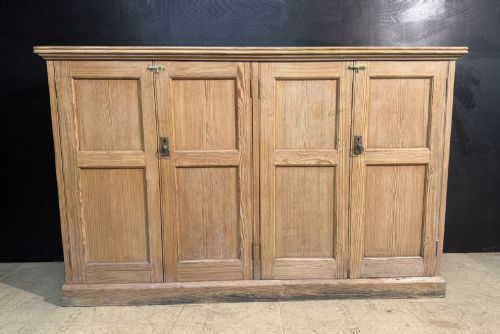
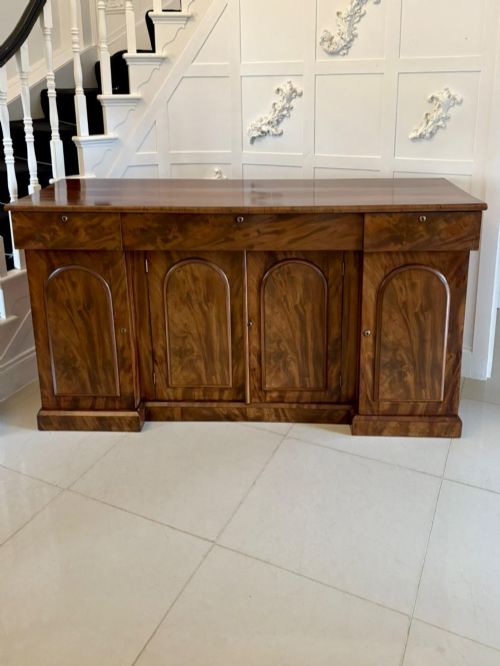
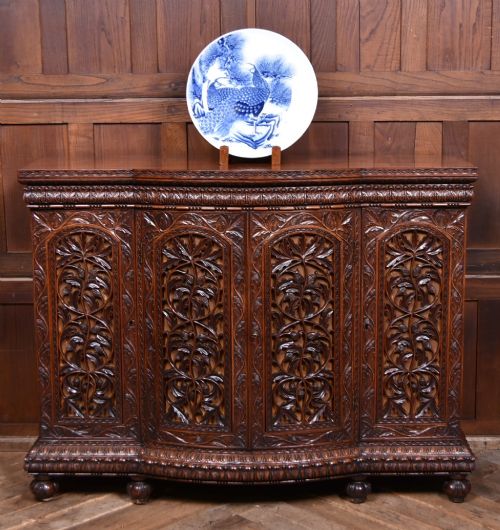


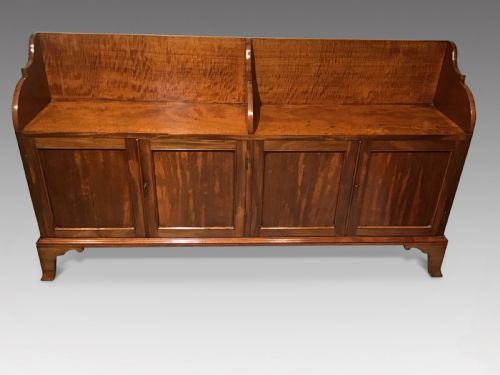


Victorian Four Door Buffet
A victorian four door buffet offers substantial storage and formal presence, bringing deep timber grains and grand proportions to a dining room.
Victorian Four Door Buffet
A victorian four door buffet is a substantial sideboard or credenza designed for dining rooms and large reception spaces during the nineteenth century. These pieces provide deep cupboards behind four doors, often accompanied by drawers, offering practical storage for serving ware and linen.
The versions met most frequently on this page date from the nineteenth century, including specific years such as eighteen-fifty, eighteen-sixty, and eighteen-eighty. Forms vary from breakfront sideboards to serpentine credenzas and chiffoniers, reflecting the diverse tastes of the period.
Makers drew upon styles ranging from classical revival to rustic English country and Anglo-Indian colonial traditions. This variety ensures that buyers encounter both formal urban cabinetwork and simpler provincial interpretations.
How they were made
Cabinetmakers utilised dense hardwoods such as mahogany, flame mahogany, rosewood, walnut, and padouk wood for the primary structures and show surfaces. Pine often served as a secondary timber for internal carcases and drawer linings, ensuring structural stability.
Surface decoration relied heavily on figured veneers, marquetry inlay, and the natural grain patterns of flame mahogany and burr walnut. Brass hardware provided functional mounts and handles, while occasional glass panels appeared in cabinet doors.
Victorian Four Door Buffet Retail Price Guide 2026
Typical asking prices for victorian four door buffet among the pieces listed under this phrase on Sellingantiques today, from the lower quarter to the upper quarter. They describe what is for sale here now, not the wider market.
What varies in quality
The calibre of a victorian four door buffet rests upon the selection of timber veneers and the precision of the cabinet construction. Exceptional examples display continuous grain matching across all four doors and intricate marquetry work.
Subtlety of carving and the integration of secondary woods reveal the hand of skilled workshops. Pieces designed for exhibition or formal drawing rooms command attention through superior proportion and heavier, more resolved classical detailing.
The Victorian Four Door Buffet Glossary
- Credenza
- A low cabinet or sideboard, frequently featuring four doors and sophisticated marquetry inlay. These pieces originated in Italy and gained immense popularity in formal nineteenth-century drawing rooms.
- Chiffonier
- A low sideboard or cabinet equipped with shelving and doors, often used for storing tableware or displaying decorative objects. The form evolved during the nineteenth century to suit smaller reception rooms.
- Breakfront
- A cabinet design where the central section projects forward from the flanking outer cupboards. This architectural arrangement creates dynamic shadows and breaks the visual mass of large sideboards.
- Serpentine
- A curved shape featuring a convex centre flanked by concave ends, creating a gentle wave effect along the front of the cabinet. This contour requires advanced woodworking skill to execute cleanly.
- Flame Mahogany
- A prized mahogany veneer cut from the branch junction, displaying a distinctive flamed or feathered pattern resembling flickering fire. Cabinetmakers reserved this timber for prominent drawer fronts and doors.
Victorian Four Door Buffet: Frequently Asked Questions
How do I clean my sideboard?
Clean nineteenth-century wood surfaces using a soft, dry cloth to remove dust without harming the traditional polish. Avoid modern liquid polishes containing silicone, which can penetrate and degrade old finishes.
Maintain low humidity in the room to prevent timber movement and keep veneer secure over the pine or hardwood carcase.
Where were these pieces used?
Nineteenth-century households placed these large cabinets in dining rooms, entrance halls, and formal drawing rooms. They acted as functional workstations during dinner parties and permanent storage hubs.
In modern homes, they function well as dining room servers or media consoles, provided the room dimensions accommodate their substantial depth.
How do I distinguish walnut from mahogany?
Mahogany displays a warm reddish-brown hue with straight or figured grain patterns that darken gracefully over the centuries. Walnut exhibits a richer chocolate-brown tone with more pronounced contrasting grain swirls and darker streaks.
Both timbers received extensive use across the nineteenth century, sometimes enhanced with decorative veneers like flame mahogany or burr walnut.