

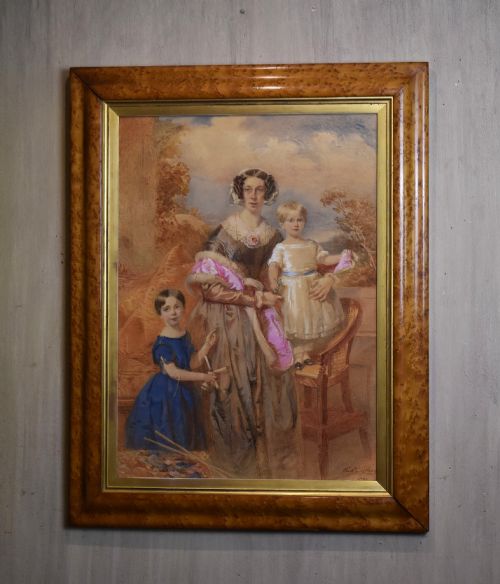


Victorian Family Group Art
Victorian family group art captures domestic life through watercolours, oils, silhouettes, and Staffordshire figures.
Victorian Family Group Art
When you search for Victorian family group art, you encounter a range of domestic depictions from the nineteenth century that capture households and children. These works span watercolours, oil paintings, mixed media, and silhouettes, often recording specific family members in garden settings or intimate domestic interiors.
The pieces you meet most frequently on this page include framed silhouette art and detailed watercolours from the nineteenth century. These range from informal silhouette conversation pieces to formal painted group portraits associated with the Victorian era.
Works on this page extend from the early nineteenth century through to the year nineteen hundred, incorporating styles such as Victorian folk art and late Victorian aesthetics. Subjects include named individuals like Louisa Cooke's daughters, alongside anonymous groupings and memorial portraits.
Materials and methods
Artists and makers utilised traditional media including watercolour, ink, and oil paint applied to paper, canvas, and framed supports. Silhouette artists worked with cut paper and ink, frequently presenting their output in maple veneer frames with gilt accents.
Framing forms an integral part of the construction, utilising wood and giltwood to house paintings and silhouette portraits. Staffordshire figures represent ceramic production methods of the period, shaped and painted in three dimensions.
Victorian Family Group Art Retail Price Guide 2026
Typical asking prices for victorian family group art among the pieces listed under this phrase on Sellingantiques today, from the lower quarter to the upper quarter. They describe what is for sale here now, not the wider market.
Listings feature works in watercolour, oil, and mixed media alongside silhouettes and Staffordshire figures from the nineteenth century.
Judgement of quality
The integrity of the framing and materials contributes to the overall standard of the object. Original maple veneer frames and well-preserved giltwood enhance the presentation of paper works and paintings.
The Victorian Family Group Art Glossary
- Silhouette
- A portrait profile filled in with a solid colour, usually black, cut from paper or painted in ink. These profiles often record family groups and conversation pieces.
- Conversation piece
- An informal painting or silhouette showing a group of figures engaged in conversation or shared activities, typically set in a garden or interior.
- Staffordshire figure
- A ceramic figurine produced in the potteries of Staffordshire during the nineteenth century. These pieces depict people and animals for domestic display.
- Mixed media
- An artwork combining more than one medium, such as watercolour and ink used together on a single support. This approach appears in portraiture from nineteen hundred.
- Giltwood
- Wood that has been treated with gold leaf or a gold-coloured finish. This material frequently frames nineteenth-century paintings and silhouettes.
Victorian Family Group Art: Frequently Asked Questions
What is victorian family group art?
These pieces comprise historical visual records of households, featuring paintings, watercolours, and silhouettes produced during the nineteenth century. They depict relatives together in domestic or garden settings.
Such works range from formal portraiture by known artists to folk art silhouettes and Staffordshire pottery figures. They offer a direct window into nineteenth-century domestic life.
How were silhouettes made?
Silhouettes were produced by cutting profile portraits from black paper or painting them directly in ink onto a pale background. Artists often mounted these inside wooden frames with gilt accents.
Many examples function as conversation pieces, grouping multiple family members into a single framed composition. They required steady hands and precise knife work or brush control.
How do I display these pieces?
Framed works on paper and canvas require hanging away from direct sunlight to protect watercolours and inks from fading. Wall placement should also account for moisture levels in rooms.
Staffordshire figures and ceramic pieces suit stable surfaces such as mantelpieces or cabinets. Their three-dimensional form benefits from even ambient lighting.
How do I date these works?
Dating relies on inscribed dates, artist signatures, clothing styles, and framing materials characteristic of the nineteenth century. Period markers include specific painting techniques and Victorian aesthetic conventions.
Reference to named sitters or known makers helps narrow the timeline. Stylistic shifts between early works and late Victorian output provide further clues.