

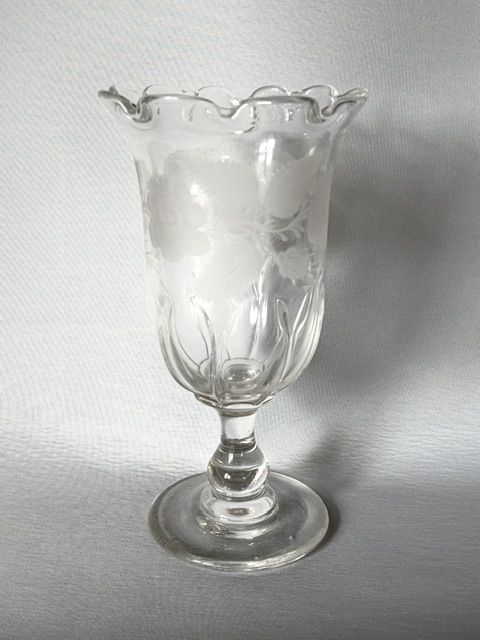


Victorian Etched Glass Vase
These Victorian etched glass vase examples bring brilliant nineteenth-century handwork to a table, offering crisp botanical and geometric wheel-cuttings on clear or flash glass.
Victorian Etched Glass Vase
A Victorian etched glass vase brings nineteenth-century decorative craft directly to a mantelpiece or side table. When searching for a Victorian etched glass vase, buyers encounter versatile vessels spanning from early nineteenth-century table pieces to late Victorian decorative centrepieces.
The selections appearing here include various nineteenth-century interpretations, ranging from early Victorian celery jars to Bohemian flash glass and amber flash vessels. These objects combine utilitarian nineteenth-century domestic function with elaborate surface decoration executed by period artisans.
Forms vary from straightforward baluster shapes to elaborate épergnes fitted with brass, silver plate, or gilt bronze mounts. Each Victorian etched glass vase reflects the specific taste of its decade, shifting from restrained mid-century floral motifs to bolder late-century aesthetics.
Materials and methods
Makers utilised high-quality glass, sometimes layered as flash glass or mercury glass, shaped by blowing or moulding before cooling. Artisans then applied wheel-cutting, acid-etching, or cameo techniques to create frosted and clear contrasts across the surface.
Many examples incorporate secondary structural materials including silver plate, brass, and gilt bronze for mounts, bases, or detachable trumpet inserts. These metal elements were cast and chased to support heavy crystal and glass bodies securely.
Victorian Etched Glass Vase Retail Price Guide 2026
Typical asking prices for victorian etched glass vase among the pieces listed under this phrase on Sellingantiques today, from the lower quarter to the upper quarter. They describe what is for sale here now, not the wider market.
Assessing quality
The finest pieces demonstrate exceptional depth in the wheel-cut or cameo decoration, where frosted motifs stand out with sharp relief against polished clear or coloured backgrounds. Lesser examples show shallower surface marking with less defined borders between the clear and opaque zones.
Proportion and weight also dictate the standard of execution, particularly in pieces featuring heavy silver plate or gilt bronze mounts. Superior items display balanced mounting where metal fittings integrate seamlessly with the blown glass body without obscuring the decorative engraving.
Walker & Hall·Baccarat
The Victorian Etched Glass Vase Glossary
- Flash glass
- Glass composed of a thin layer of coloured glass cased over a thicker layer of clear glass. This technique allowed artisans to cut through the outer colour to reveal the clear glass beneath.
- Mercury glass
- Double-walled blown glass silvered on the interior with a liquid mercury amalgam and sealed at the pontil. It creates a reflective, mirror-like sheen popular in the nineteenth century.
- Épergne
- A large table centrepiece featuring a central bowl with multiple detachable arms or trumpets for holding fruit, flowers, or small vases. They frequently combine glass vessels with silver-plated or bronze frames.
- Celery vase
- A tall, footed vessel specifically designed to display upright stalks of celery on nineteenth-century dining tables. These pieces often feature deep etched or cut glass decoration.
- Cameo glass
- A luxury glass technique involving at least two fused layers of contrasting colours carved away to create a raised design. It requires immense skill to achieve uniform thickness in the outer layer.
Victorian Etched Glass Vase: Frequently Asked Questions
What is a Victorian etched glass vase?
A Victorian etched glass vase is a nineteenth-century decorative vessel featuring surface ornamentation applied through acid-etching or wheel-cutting.
These pieces range from tall celery jars to elaborate centrepieces designed for nineteenth-century dining and drawing rooms.
Where were these glass pieces made?
These decorative vessels originated in British, Bohemian, and French glassworks during the nineteenth century.
Regional workshops utilised distinct colour palettes and cutting styles, from Bohemian flash glass to English table wares.
How can you tell the age of etched glass?
Age is determined by examining the pontil mark on the base, the weight of the glass, and the style of the cutting.
Nineteenth-century pieces often exhibit hand-finished pontils and wear consistent with age on the unglazed resting rim.