




Victorian Etagere Bookshelf
These victorain etagere bookshelf examples combine tiered display space with practical shelving, offering character and storage for any room.
Victorian Etagere Bookshelf
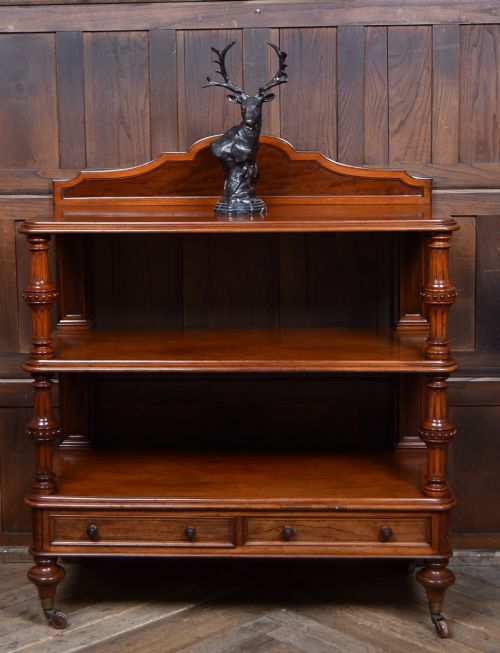
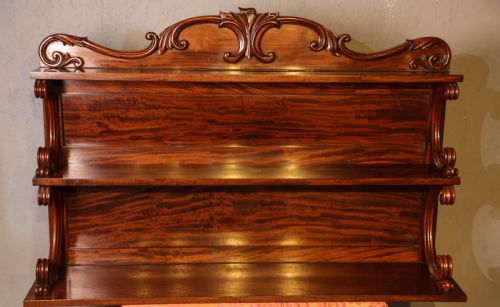
When you search for a victorian etagere bookshelf, you encounter freestanding whatnots, multi-tiered shelving units, and wall-hanging cabinets spanning the nineteenth century. These pieces serve primarily to display ornaments, books, and small collections across multiple open platforms.
Freestanding four-tier whatnots and serpentine fronted designs dominate the selection, often incorporating lower cupboards or small drawers. Wall shelves and hanging etageres provide compact alternatives for smaller spaces without sacrificing timber character.
Materials and Construction
Cabinetmakers utilised dense hardwoods such as mahogany, rosewood, walnut, and burr walnut, alongside lighter satin birch and cherry wood. Selected pieces incorporate brass mounts and carved details, reflecting the diverse regional styles of the period.
Tiered platforms link via turned or carved upright supports, creating stable vertical structures designed to carry weight across multiple levels. Veneers appear on larger surfaces, paired with solid timber framing for structural integrity.
Ship's teak whatnots survived rough ocean transit to hold steady on dry land.
Judging Quality
Quality rests in the choice of timber grain, particularly the depth of burr walnut figures and the rich warmth of figured mahogany and rosewood. Superior examples demonstrate meticulous joinery in the upright supports and crispness in hand-carved elements.
The integration of functional additions, such as a mirror, a drawer, or a lower cabinet base, distinguishes standard tier units from more ambitious exhibition pieces. Proportion and stability across multiple tiers define the success of each individual build.
Samson and Son London
The Victorian Etagere Bookshelf Glossary
- Etagere
- A piece of furniture consisting of a set of open shelves for displaying small objects. They appear in freestanding and wall-hanging formats.
- Whatnot
- A multi-tiered shelving stand popular in the nineteenth century for holding books, ornaments, and display items. These units range from three to four tiers.
- Burr walnut
- A wood prized for its swirling, intricate grain patterns formed from tree growths. It frequently covers prominent surfaces of better furniture.
- Serpentine front
- A furniture front characterised by a curved outline that dips inward and bows outward. This shape adds visual movement to cabinet bases.
- Padauk
- A dense, heavy tropical hardwood showing deep reddish-brown tones. It is encountered in Burmese and Anglo-Indian carved pieces.
Victorian Etagere Bookshelf: Frequently Asked Questions
What is a whatnot?
A whatnot is a set of open shelves supported by upright pillars, designed for displaying ornaments and holding books. Victorian examples typically feature three or four distinct tiers.
Makers built these pieces to be portable and versatile, placing them in drawing rooms and parlours where extra surface space was needed.
How do I use an etagere?
An etagere provides multiple horizontal surfaces for organising books, ceramics, and decorative objects. Wall-hanging versions save floor space in compact rooms.
Freestanding models anchor corners or sit against walls, letting you layer collections by height and visual weight across the tiers.
What woods were used?
Cabinetmakers relied on rich hardwoods including mahogany, rosewood, walnut, and burr walnut. Lighter alternatives like satin birch and cherry also appear.
Exotic timbers such as padauk feature in specific Anglo-Indian and overseas pieces imported during the period.
Are these pieces stable?
Freestanding units utilise sturdy upright supports and heavy base timbers to maintain balance across multiple shelves. Heavier items sit safely on lower tiers.
Wall-mounted versions require secure fixings to support the weight of the timber frame and any books or objects placed upon them.