

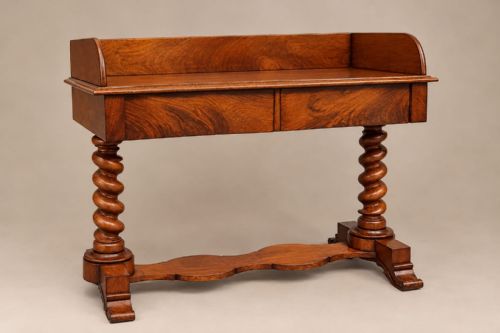

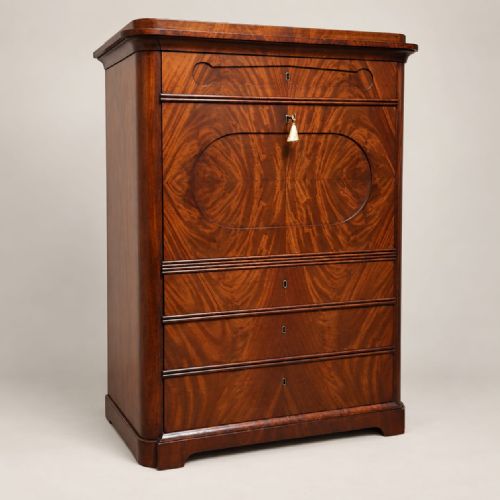
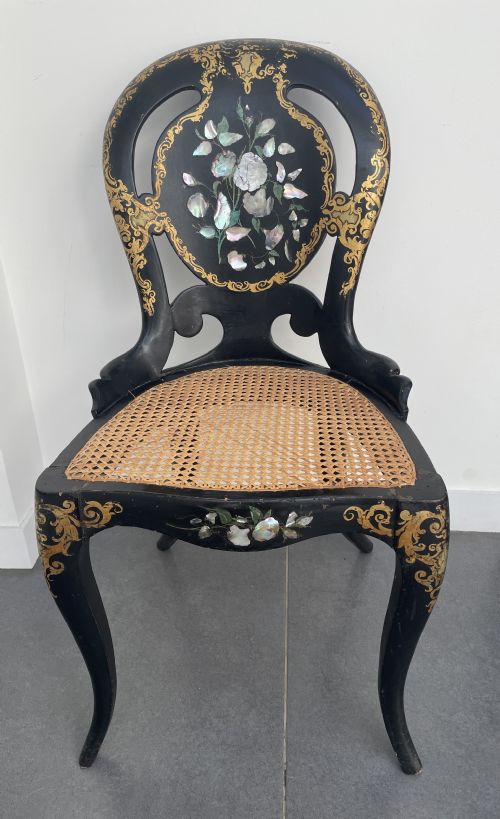
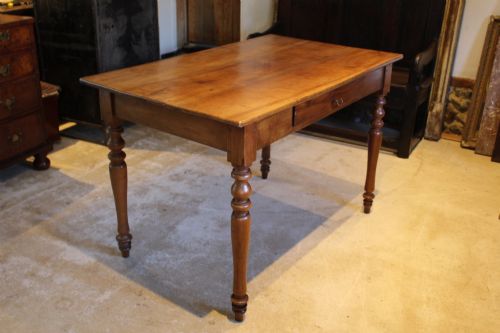
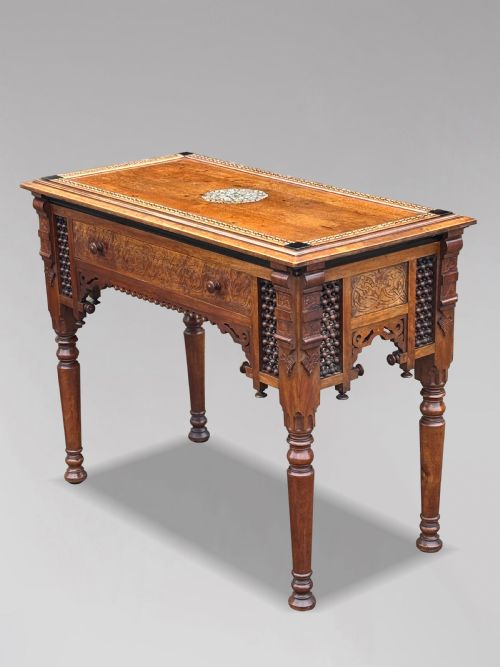
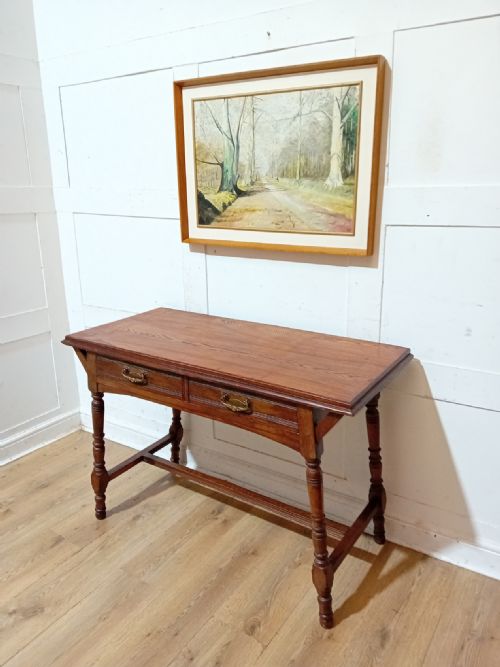
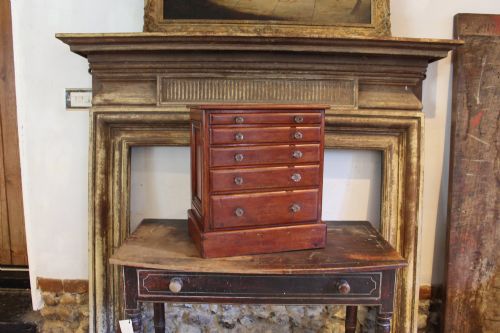


Victorian Desk C1880
A victorian desk c1880 brings sturdy timbers and careful joinery together to anchor a study with practical workspace.
Victorian Desk C1880
A victorian desk c1880 encompasses writing tables, bureau bookcases, partners desks, and kidney desks produced during the late nineteenth century. These pieces serve daily study and correspondence needs while displaying the proportions typical of the period.
Buyers will encounter mahogany, oak, walnut, and rosewood forms bearing stylistic influences from the Victorian era alongside Arts and Crafts and Aesthetic Movement interpretations. Many examples integrate leather writing surfaces or specialised storage compartments tailored for nineteenth century paperwork.
Materials and construction
Cabinet makers utilised dense hardwoods such as mahogany, oak, walnut, and rosewood, often pairing them with brass hardware and tooled leather inserts. Secondary timbers provided internal framing for drawers and pigeonholes.
Joinery relied on traditional dovetailed drawer construction and mortise and tenon frames. Surfaces display polished wood grains or inlaid details rather than synthetic finishes.
Victorian Desk C1880 Retail Price Guide 2026
Typical asking prices for victorian desk c1880 among the pieces listed under this phrase on Sellingantiques today, from the lower quarter to the upper quarter. They describe what is for sale here now, not the wider market.
Object forms span large pedestal partners desks, kidney shaped writing tables, and compact bureau bookcases.
Judging quality in these pieces
Quality rests in the selection of timber grain and the precision of the underlying joinery, visible in tight drawer dovetails and smooth runners. Superior examples maintain original brass fittings and intact leather writing surfaces.
The refinement of carved details and inlaid decoration distinguishes standard utilitarian furniture from finer cabinet work produced by notable firms of the period.
Harris Lebus·Liberty of London
The Victorian Desk C1880 Glossary
- Partners desk
- A large double sided desk designed for two people to work opposite one another, typically featuring banks of drawers on both pedestals.
- Kidney desk
- A writing table shaped with a curved front resembling a kidney bean, allowing the user to sit closely within the recess.
- Bureau bookcase
- A combination piece comprising a slanted writing flap above shelving enclosed by doors.
- Dovetail
- A joint formed by interlocking wedge shaped fingers, used primarily in drawer construction to ensure structural strength.
- Inlay
- A technique where pieces of contrasting wood, metal, or shell are inserted into the surface to create decorative patterns.
Victorian Desk C1880: Frequently Asked Questions
What defines a victorian desk c1880?
A victorian desk c1880 is a nineteenth century writing table or pedestal desk built from timbers such as mahogany, oak, or walnut.
These pieces reflect the design standards of the period, often incorporating leather surfaces and integrated drawer storage.
How do partners desks function?
Partners desks are built to be used from both sides simultaneously, offering matching sets of drawers and cupboards.
They were originally placed in the centre of a room rather than against a wall to accommodate two working occupants.
What woods were used?
Cabinet makers relied primarily on dense hardwoods including mahogany, oak, walnut, and rosewood for exterior surfaces and structural frames.
Secondary softwoods often appeared inside drawer boxes and internal partitions.
How do I care for leather?
Leather writing surfaces require gentle cleaning with a dry or slightly damp cloth to prevent drying and cracking.
Avoid harsh chemical cleaners that can strip the original tooling and colour from the hide.