


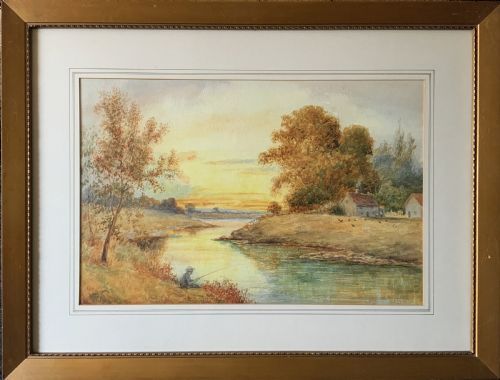


Victorian Countryside Watercolour
These Victorian countryside watercolour paintings record nineteenth-century rural life through delicate pigment on paper.
Victorian Countryside Watercolour
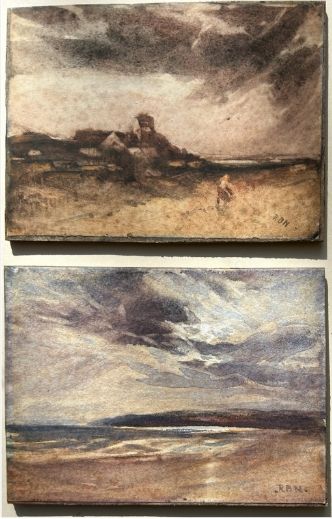
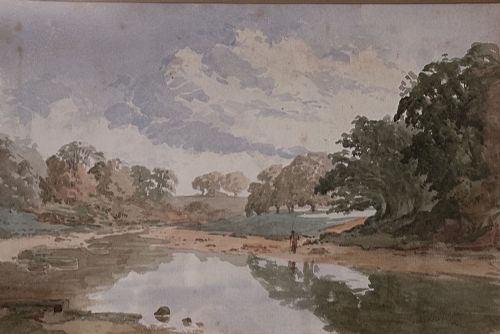
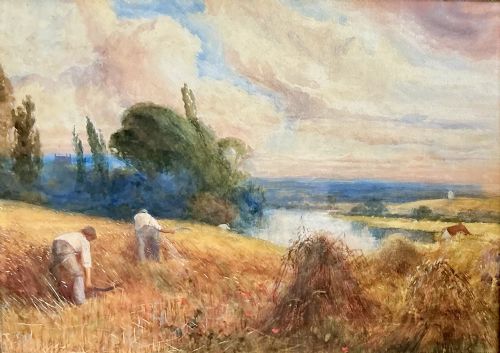
A victorian countryside watercolour captures pastoral scenes, riverscapes, and agricultural labour across nineteenth and early twentieth-century Britain. The works on this page frequently portray harvested fields, thatched cottages, and grazing livestock framed within regional landscapes from Yorkshire to Sussex.
The dominant forms span framed paintings on paper produced by artists working in both Victorian pastoral and naturalism styles. Most examples date from the nineteenth century into the early twentieth century, reflecting a period of sustained artistic interest in rural topography.
How they were made
Artists applied watercolour pigment onto paper supports, often building translucent washes to construct atmospheric depth in sky and landscape. Finished pieces were typically protected behind glass and housed within wood and gilt frames.
The technique relies on the natural luminosity of the paper shining through thin layers of pigment to illuminate rural subjects such as rivers, evening skies, and woodland clearings.
Victorian Countryside Watercolour Retail Price Guide 2026
Typical asking prices for victorian countryside watercolour among the pieces listed under this phrase on Sellingantiques today, from the lower quarter to the upper quarter. They describe what is for sale here now, not the wider market.
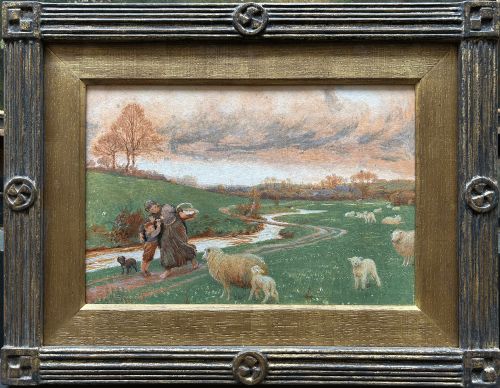
Several cows and sheep populate these pastures, quietly observing the countryside alongside diligent shepherds and haymakers.
What varies in quality
Quality rests upon the artist's handling of light, atmospheric perspective, and the precise rendering of topographical detail within the landscape. Works that demonstrate confident brushwork and nuanced colour gradation stand apart from more formulaic topographical sketches.
The condition of the paper pigment and the integrity of the original frame also influence the overall standing of an individual painting.
Frederick Walker·Frederick Hines·Alfred George Morgan·Charles Gregory·Arthur Tucker·James William Booth·Thomas Hunn·James Orrock·Robert Thorne Waite·Henry Bailey·Robert Winchester Fraser·George Arthur Fripp·Harold Lawes·William Joseph Boyes·John Edward Bale·Bernard Walter Evans·Harry Sylvester Stannard·Will Anderson·Robert Hollands Walker·Basil Bradley·Thomas Sydney Cooper·Alfred W Parsons·John Sowden·William Bradley·Harold Swanwick
The Victorian Countryside Watercolour Glossary
- Watercolour
- A painting method in which fine pigment is suspended in a water-based solution and applied to paper. This medium allows for luminous washes and delicate detail.
- Pastoral style
- An artistic genre depicting idealized rural life and agrarian scenes. These compositions typically feature shepherds, cottages, and livestock in tranquil countryside settings.
- Gilt frame
- A wooden protective border coated with gold leaf or metallic paint. Such frames complement the tones of nineteenth-century watercolours.
- Topographical art
- Representations of specific real-world locations and landscapes. These works serve as visual records of British countryside architecture and geography.
Victorian Countryside Watercolour: Frequently Asked Questions
How should I hang these watercolours?
Keep framed pieces away from direct sunlight to prevent the pigment from fading over time.
Position them on interior walls where room temperature and humidity remain stable.
What subjects appear in these paintings?
The compositions frequently feature agricultural scenes, rivers, cottages, and livestock within British rural landscapes.
Many works document specific regional views across Yorkshire, Sussex, and the Home Counties.
Are these works original paintings?
The listings consist of original hand-painted watercolours on paper rather than mechanical reproductions.
Many examples bear the signature of the artist or contemporary documentation on the mount.
How do I identify the period?
Dating relies on recorded artist working dates, stylistic markers of Victorian naturalism, and framing materials.
Nineteenth-century works often reflect pastoral traditions that shifted towards Edwardian realism by the early twentieth century.