
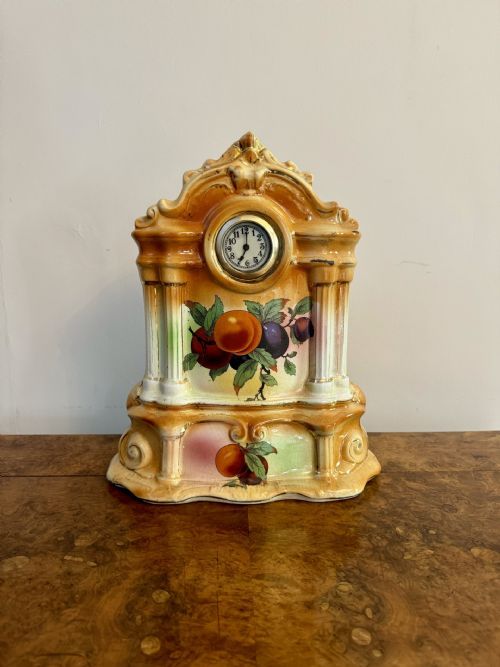


Victorian Ceramic Clock
A victorian ceramic clock brings sculptural form and timekeeping together, offering a striking mantel centrepiece crafted with period character.
Victorian Ceramic Clock
A victorian ceramic clock encompasses mantel clocks and clock garnitures fashioned from porcelain, earthenware, and pottery. These functional ornaments sit proudly on household surfaces, often accompanied by matching figures or sidepieces.
Most examples you encounter on this page date from the nineteenth century, including pieces spanning the Victorian era up to around nineteen hundred. They range from Staffordshire figure groups to French porcelain clock sets.
The aesthetic vocabulary stretches from Rococo Revival curves to the linear discipline of the Aesthetic Movement. Makers utilised varied materials such as brass fittings, glass covers, and enamel dials to complete each composition.
How they were made
Potters shaped these bodies from earthenware and porcelain, applying detailed glazes and hand-painted decoration directly onto the ceramic surface. Many incorporate gilding to highlight raised mouldings and sculptural contours.
Movements and dials sit within or alongside the ceramic housing, secured with brass bezels and protected behind glass faceplates. Ebonised timber cases sometimes integrate ceramic panels or dials into their architectural facades.
A Staffordshire dog keeps eternal watch beside the clock face.
What varies in quality
The ambition of the modelling dictates much of the visual success, separating standard factory output from more sculptural, expressive figure groups and clock garnitures. Hand-painted detail and crispness in the ceramic glaze show the maker's hand more clearly.
Integration between the ceramic body and the mechanical elements defines the structural integrity of the piece. Superior examples maintain balanced proportions where the dial, housing, and any flanking garnitures form a cohesive whole.
The Victorian Ceramic Clock Glossary
- Mantel clock
- A domestic clock designed to stand upon the shelf or mantelpiece above a fireplace. These portable timepieces served as both functional instruments and decorative room ornaments.
- Clock garniture
- A set comprising a central clock accompanied by matching decorative sidepieces such as vases or figures. They create a symmetrical display when arranged across a mantel or sideboard.
- Aesthetic movement
- A late nineteenth-century design style that emphasised visual beauty over narrative content. Objects from this movement often feature refined ebonised finishes and disciplined geometric details.
- Rococo revival
- A nineteenth-century design style drawing on eighteenth-century French motifs. Characterised by asymmetrical scrollwork, naturalistic shell forms, and exuberant curves.
- Earthenware
- Porous pottery fired at lower temperatures than porcelain. It forms the sturdy body for many Staffordshire figures and clock cases before glazing.
Victorian Ceramic Clock: Frequently Asked Questions
Where should I place a mantel clock?
These clocks find their traditional home on a fireplace mantel or a sturdy sideboard where their weight and height are fully supported. Ensure the surface is level so the pendulum and internal movement operate without interference.
Keep them away from direct sunlight and damp environments to protect the painted ceramic surfaces, gilding, and delicate brass components over time.
What is a clock garniture set?
A garniture consists of a central clock paired with matching sidepieces, such as decorative vases, urns, or figures. These sets were designed to create a balanced, formal arrangement on grand mantelpieces.
Matching materials and decorative motifs tie the central timekeeper and its accompanying ornaments together into a single visual statement.
How can I tell the period of a ceramic clock?
Examine the stylistic cues, such as the exuberant scrolls of Rococo Revival or the refined lines of the Aesthetic Movement. Materials like hand-painted porcelain, earthenware bodies, and ebonised wood help narrow down the decade of production.
Markings on the dial, movement backplate, or ceramic base often provide additional clues to the workshop or region of origin.