
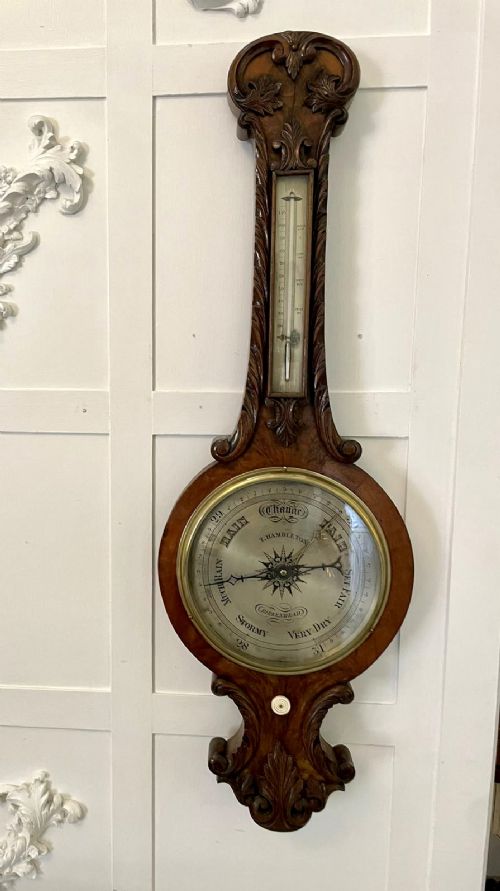
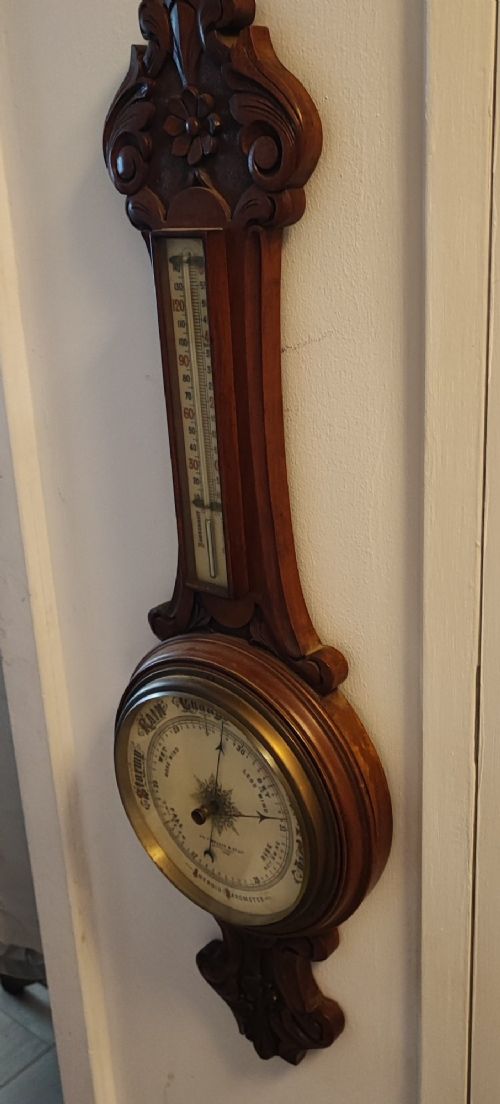
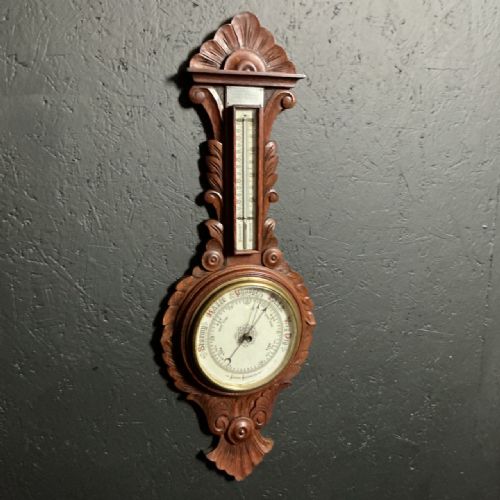
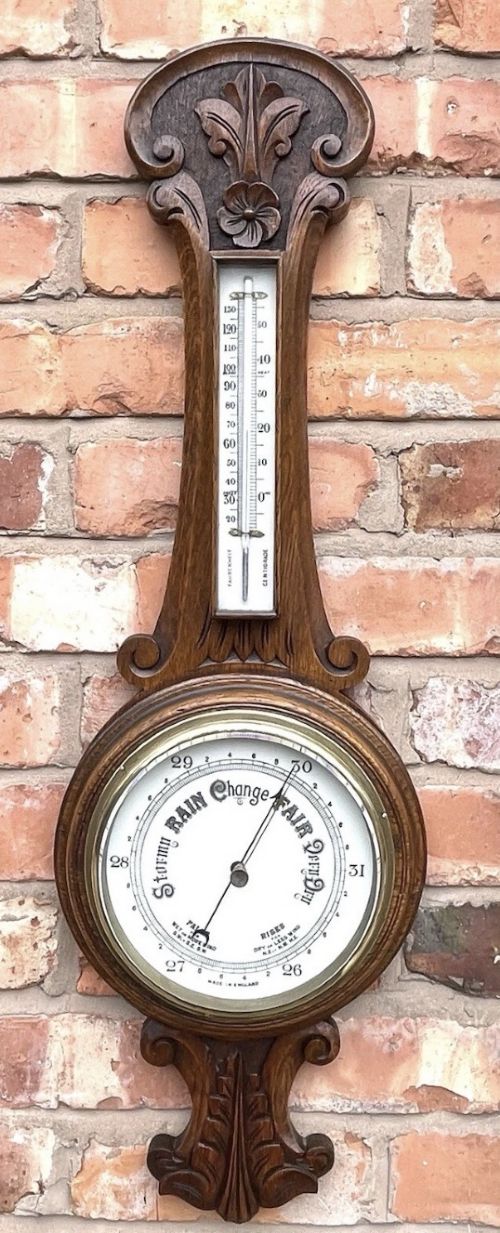

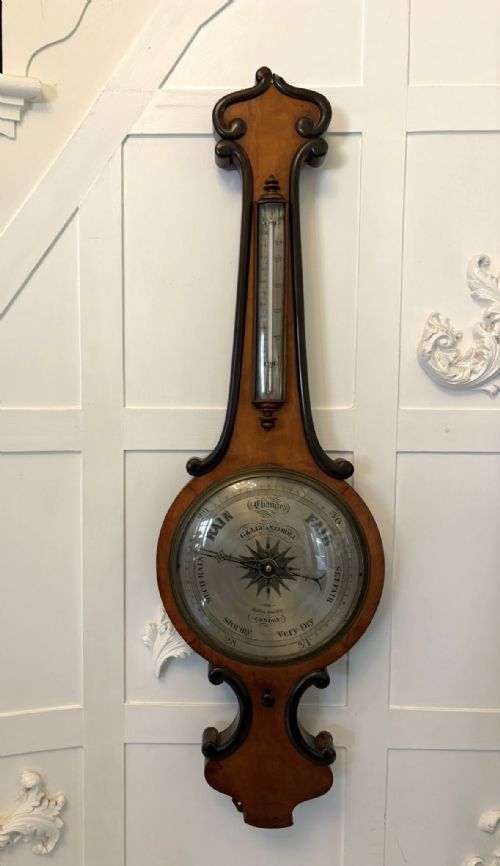


Victorian Carved Banjo Barometer
A Victorian carved banjo barometer brings mechanical precision and rich timber grain to a hallway or study.
Victorian Carved Banjo Barometer
A victorian carved banjo barometer is a wall-hanging weather instrument shaped with a distinctive bulbous lower body and a slender upper stem. The versions most commonly encountered on this page date from the nineteenth century, spanning the Victorian and Edwardian periods.
The form often includes a combination of barometer dials, thermometers, and sometimes clock movements or skeletonised mechanisms housed within carved wooden frames. Examples range from compact oak pieces to larger instruments executed in burr walnut, mahogany, and rosewood.
Makers and retailers of the era, such as Maple & Co and Negretti & Zambra, produced these instruments to serve both practical domestic forecasting and decorative display. The surviving pieces demonstrate the evolution from traditional mercurial tubes to aneroid movements.
Materials and construction
Cabinetmakers shaped the distinctive housings from dense hardwoods including oak, walnut, mahogany, and rosewood, frequently applying detailed foliage carving and marquetry inlay. Selected pieces utilise burr walnut veneer to create intricate grain patterns across the broad lower case.
Instrument makers fitted silvered brass dials, glass bezels, and thermometers into the carved wooden chassis, connecting them to either traditional mercurial glass tubes or spring-driven aneroid mechanisms.
Oak and walnut dominate the listed banjo barometers, complemented by occasional examples in mahogany, rosewood, and burr walnut.
Assessing quality and craftsmanship
The distinction between standard and superior instruments rests upon the depth and crispness of the hand carving on the wooden case, alongside the selection of figured timbers like burr walnut. Instruments bearing the signatures of established makers or retailers generally reflect higher standards of internal assembly and dial graduation.
G & L Guanziroli London·W Watson & Sons·Maple & Co·James H Kelly of Glasgow·Bianchi Ipswich·Russell of Liverpool·Negretti & Zambra·W Johnson
The Victorian Carved Banjo Barometer Glossary
- Aneroid barometer
- An instrument that measures atmospheric pressure using a flexible metal capsule rather than liquid mercury. It responds to changes in pressure without requiring a vertical glass tube.
- Banjo barometer
- A wall barometer housed in a case shaped like a banjo, featuring a circular dial at the base and a long vertical stem leading to a hygrometer or thermometer at the top.
- Mercurial barometer
- A traditional weather glass that measures atmospheric pressure by balancing the weight of mercury against the pressure of the air. These systems represent the older method of forecasting.
- Silvered dial
- A brass dial plate treated with a silver solution to create a matte white finish for engraved numerals and lettering. This treatment reduces glare and improves legibility.
- Skeletonised movement
- A clock or barometer mechanism with cut-away plates that expose the internal gears and springs to view. It allows the observer to watch the mechanical action directly.
Victorian Carved Banjo Barometer: Frequently Asked Questions
How do aneroid and mercurial barometers differ?
Mercurial barometers utilise a tall glass column filled with liquid mercury to measure atmospheric pressure changes directly. Aneroid versions rely on an internal sealed metal box that expands or contracts as pressure shifts.
This mechanical design allows aneroid instruments to avoid fragile liquid columns and take on more compact wall-hanging shapes.
Where should I hang a banjo barometer?
These instruments require a stable interior wall away from direct sunlight, central heating radiators, and excessive draughts. Sudden temperature swings can affect the delicate metal springs or liquid columns inside.
A hallway or study provides the ideal environment where the carved wooden case remains protected and easy to consult.
How do I set the barometer needle?
Most banjo barometers feature a manual setting hand attached to the glass bezel, which you align directly over the main pressure indicator. This movable pointer allows you to track whether the atmospheric pressure rises or falls over subsequent hours.
Tapping the wooden case gently before reading helps settle the internal linkage for an accurate measurement.
Can antique barometers still predict the weather?
Many surviving nineteenth-century instruments continue to function and respond accurately to local atmospheric shifts. Regular calibration against a known standard helps maintain their forecasting reliability.
Even when the internal mechanics require adjustment, the carved timber cases retain their decorative presence on the wall.