


Victorian Buttoned Leather Stool
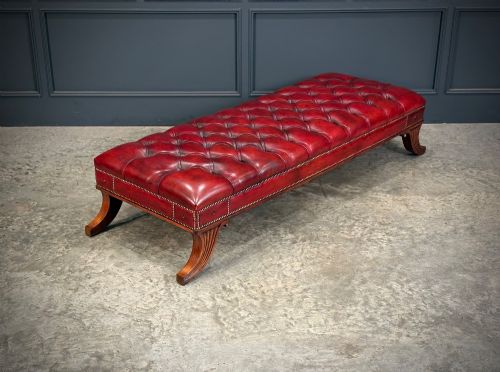
These Victorian buttoned leather stools bring substance and rich texture to a room, combining deep upholstery with robust timber frames.
Victorian Buttoned Leather Stool
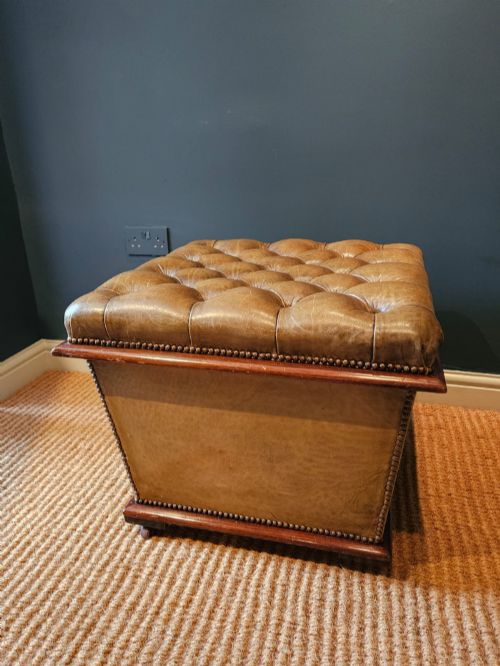
A Victorian buttoned leather stool is a sturdy seat or low table upholstered in supple hide and secured with deep tufting, originating across the nineteenth century. These pieces appear in varied forms throughout the listings, ranging from compact footstools and adjustable piano seats to generous country house centre stools and window seats.
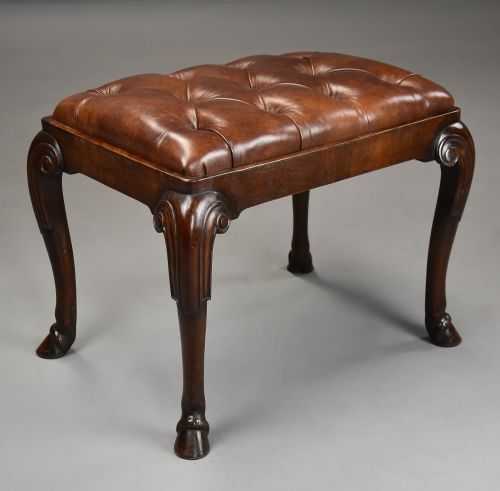
Most examples found on this page display the characteristic materials and proportions of the Victorian era, often resting on carved cabriole legs or turned supports. Buyers frequently encounter walnut and mahogany frameworks beneath hand-dyed leather upholstery, reflecting the diverse domestic uses of the period from libraries to dressing rooms.
Materials and construction methods
Makers built the structural frames of these stools using dense hardwoods such as walnut, mahogany, oak, and rosewood, ensuring long-term durability. These timbers were frequently shaped into cabriole legs, X-frames, or turned supports that matched contemporary furniture styles.
The upholstery technique relies on deep buttoning through leather, secured with internal padding and often finished with brass detailing or individual tacks. Hand-dyed English leather provides the characteristic surface texture, developing a rich patina over decades of use.
Listings for this phrase feature walnut, mahogany, oak, and rosewood timber frames paired with brass and leather.
Assessing quality and craftsmanship
The distinction between standard examples and finer pieces lies in the crispness of the timber carving and the depth of the button tufting. Superior stools utilise dense hardwoods like walnut or rosewood with well-proportioned legs rather than plain, utilitarian frames.
The quality of the hide and the precision of the hand-dyeing process dictate the visual appeal of the surface. Finely executed buttoning maintains uniform tension across the leather, whereas lesser pieces may show uneven settling in the padding.
James Shoolbred
The Victorian Buttoned Leather Stool Glossary
- Buttoning
- The technique of pulling upholstery tight with twine and securing it with recessed buttons to create a diamond pattern of tufts. This method keeps internal stuffing firmly in place while adding tactile depth to the leather surface.
- Cabriole leg
- A furniture leg that curves outward in a graceful convex arc and then tapers inward in a concave sweep toward the foot. This shape draws inspiration from animal limbs and frequently appears on refined Victorian seating.
- X-frame
- A structural base formed by two intersecting diagonal members shaped like the letter X. It provides sturdy cross-bracing beneath piano stools and occasional seating.
- Ottoman
- A low, upholstered seat or footstool typically lacking arms and a backrest, designed for generous lounging or serving as an informal coffee table. Large examples often anchor the centre of a room in country house interiors.
- Hand-dyed leather
- Hide treated with colourants applied by hand rather than factory immersion, creating subtle tonal variations across the surface. This finish allows the natural grain of the antique leather to show through clearly.
Victorian Buttoned Leather Stool: Frequently Asked Questions
What rooms suit a buttoned leather stool?
These stools sit comfortably in studies, libraries, and living rooms where their low profile and tactile leather surfaces complement traditional interiors. They function equally well as footrests, spare seating, or improvised coffee tables.
Larger centre stools and window seats anchor spacious rooms, while adjustable piano stools fit neatly beside desks or dressing tables. Their robust timber frames ensure they handle daily domestic use with ease.
How do I care for antique leather upholstery?
Antique leather requires gentle cleaning with a dry or slightly damp cloth to remove dust without stripping the natural oils from the hide. Applying a suitable leather conditioner periodically helps maintain suppleness and prevents cracking.
Keep these stools away from direct heat sources and strong sunlight to preserve the hand-dyed colour and the integrity of the vintage material.
Are piano stools adjustable in height?
Certain Victorian piano and dressing stools feature a revolving mechanism or screw thread that allows the seat height to be adjusted. These functional pieces were designed to suit individual musicians at the keyboard.
Non-adjustable footstools and window seats remain fixed in height, prioritising a stable platform for resting feet or sitting.
How can I tell the period of a stool?
Dating relies on observing the combination of timber species, leg profiles, and upholstery styles recorded across the nineteenth century. Pieces from the middle decades often display simpler turned legs, while later Victorian examples frequently showcase ornate walnut cabriole legs.
Stylistic revivals such as the Queen Anne style also guide dating, combining nineteenth-century construction methods with earlier furniture designs.