




Victorian Bureau Plat
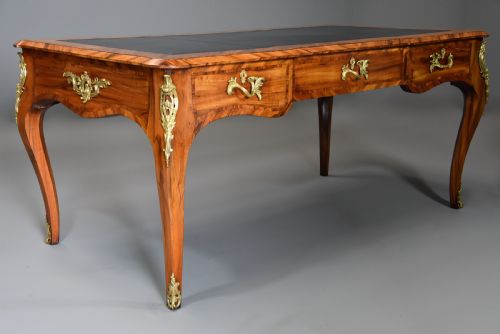
These Victorian bureau plat examples are freestanding writing desks modelled on French forms, offering leather writing surfaces and decorative mounts for the study.
Victorian Bureau Plat
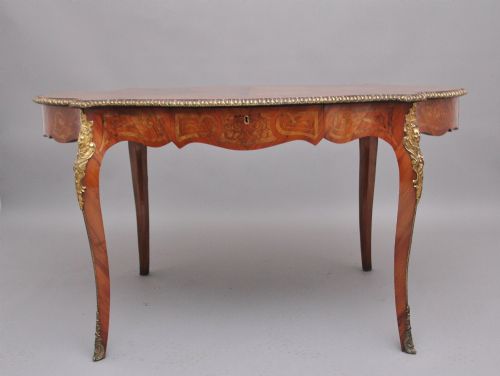
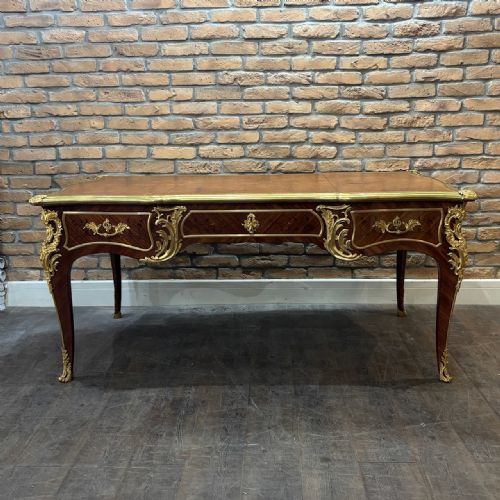
A Victorian bureau plat is a freestanding writing table designed to sit in the middle of a room rather than against a wall. The pieces appearing here span the nineteenth century and the Victorian period, embracing styles like Louis XV Revival and French Rococo Revival.
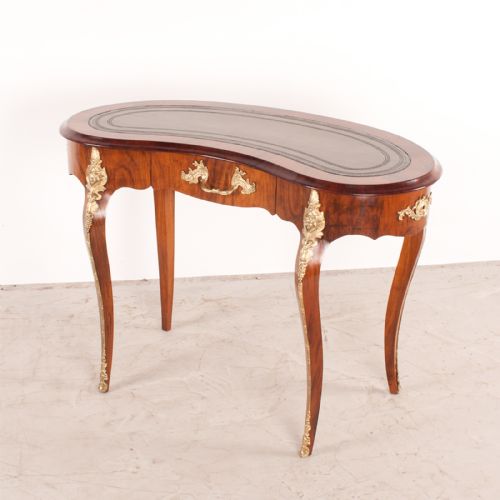
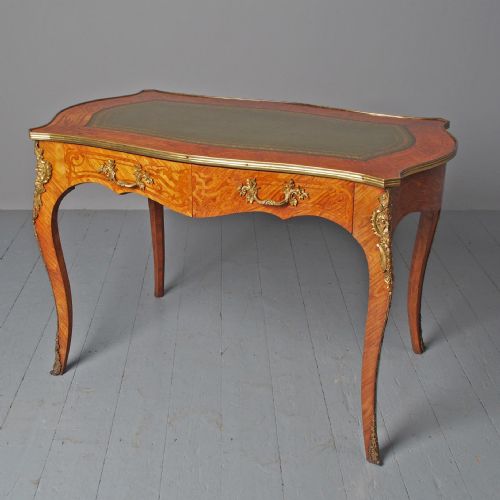
Most examples take the form of writing desks or kidney-shaped writing tables, frequently mounted with ormolu and detailed with marquetry. The primary function remains a writing surface, often lined with leather, supported on cabriole or tapered legs.
How They Were Made
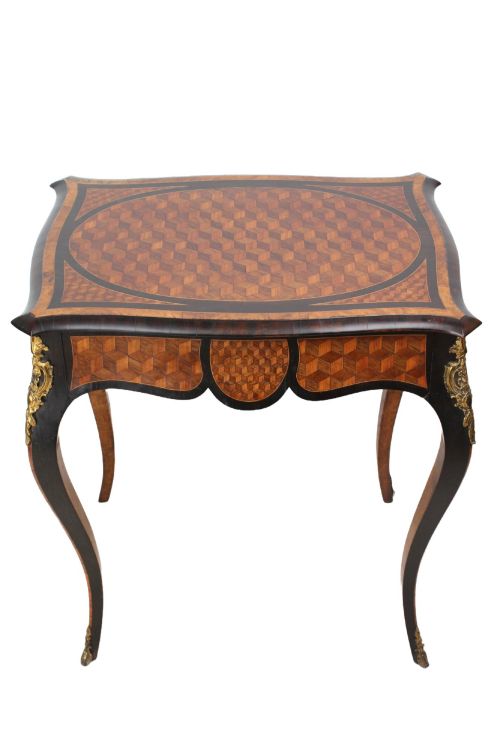
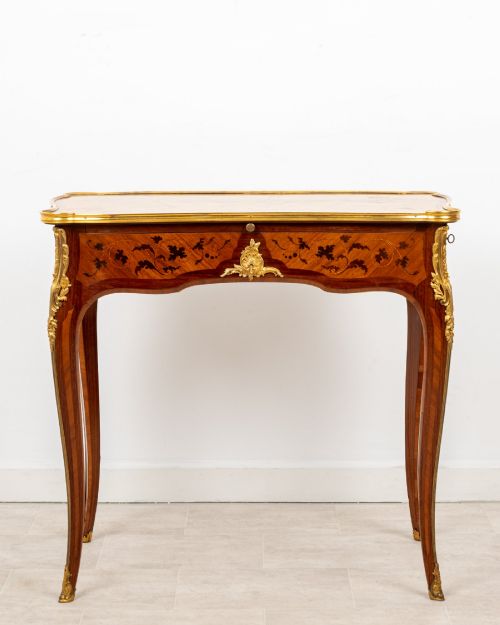
Cabinetmakers constructed carcases from timbers such as walnut, burr walnut, kingwood, rosewood, mahogany, satinwood, and calamander, often applying intricate parquetry and floral marquetry. Surfaces frequently incorporate inset leather panels framed by timber borders.
Gilt bronze and ormolu mounts adorn corners, edges, and drawers, paired with brass hardware. These cast and chased metal elements define the French revival aesthetic seen across the pieces.
Several ladies writing desks arrive with kidney shapes designed to curve neatly around the writer.
What Varies in Quality
The refinement of the ormolu mounts and the precision of the marquetry cutting distinguish the finer tables from simpler workshop output. Castings with crisp detail and hand-chiselled finishing require considerable skill compared to softer, mass-produced metalwork.
Selection of timber veneers, particularly figured burr walnut and matched kingwood grains, dictates the visual depth of the surface. Maker attribution, through stamps or known workshop signatures, also separates standard production from exceptional cabinet work.
JAS Shoolbred·Durand·Edwards & Roberts·Howard & Sons
The Victorian Bureau Plat Glossary
- Bureau plat
- A freestanding writing table, typically with one or more drawers and a leather-inset top. Originating in France, these desks were adopted by British makers during the Victorian period.
- Ormolu
- Gilt bronze mounts applied to furniture edges and corners. The technique involves mercury gilding or electroplating bronze to achieve a bright gold finish.
- Marquetry
- Decorative patterns formed by fitting together contrasting veneer slices on a timber carcase. Floral motifs and geometric designs appear frequently on these surfaces.
- Parquetry
- Geometric wood inlay arranged in patterns such as cubes or chequers. It creates structured surface decoration distinct from flowing floral marquetry.
- Kingwood
- A dense, richly figured Brazilian timber utilised for premium cabinet work. Its dark grain contrasts effectively with lighter inlay materials.
Victorian Bureau Plat: Frequently Asked Questions
Where should a bureau plat go?
Because these desks are finished on all sides, they are intended to stand away from walls in the centre of a room or study.
Positioning the desk centrally allows the ormolu mounts and timber veneers to be visible from any angle.
How do I care for the leather top?
The leather writing surface benefits from occasional cleaning with a damp cloth followed by neutral leather wax.
Avoiding excessive moisture and direct sunlight helps preserve the colour and suppleness of the hide.
Are these desks suitable for daily writing?
The generous proportions and stable construction make these tables practical for contemporary writing and laptop use.
Drawers provide storage for stationery, while the leather surface offers a smooth plane for daily tasks.
How do I identify a revival style?
French revival pieces adopt curved cabriole legs, asymmetrical mounts, and floral marquetry characteristic of eighteenth-century court furniture.
Victorian makers reinterpreted these continental motifs using native and exotic timbers available in nineteenth-century workshops.