


Victorian Bronze Candleholders
These victorian bronze candleholders bring heavy metal casting and sculptural form together to light a room with nineteenth-century weight.
Victorian Bronze Candleholders
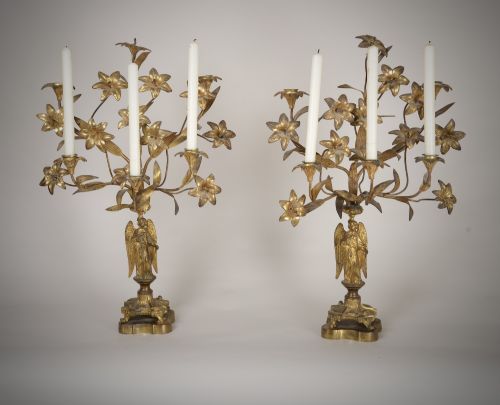
Victorian bronze candleholders take many forms across this selection, appearing most frequently as matched pairs of candlesticks and multi-arm candelabras. Examples range from single drum candleholders and pricket designs to wall sconces and figural mantel pieces.
The objects span the nineteenth century, including specific decades from eighteen-fifty to nineteen-hundred, alongside pieces attributed broadly to the Victorian era. Origins stretch beyond Britain to incorporate French, Italian, and Chinese elements within the aesthetic.
Makers and designers applied diverse historicist revivals to these items, drawing on Gothic, Renaissance, Neoclassical, and French Rococo styles. Other pieces reflect later nineteenth-century tastes through Art Nouveau lines, Aesthetic Movement motifs, and Grand Tour influences.
Materials and construction
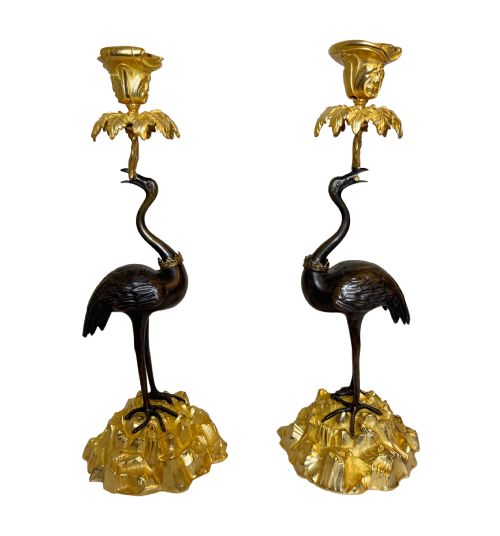
Foundry workers cast these pieces using bronze, patinated bronze, and brass, frequently combining them with gilded bronze, ormolu, and gilt metal highlights. Selected examples incorporate secondary materials such as marble bases and ceramic bodies.
Construction techniques involve both seamed metal fabrication and detailed figural casting, yielding surface finishes that range from dark patination to bright gilding. Components like sconces and branches are assembled to support single candles or multiple lights.
Design styles span Gothic revival, French Rococo, and Art Nouveau periods.
Evaluating quality and finish
Quality shows in the crispness of the chased detail across figural elements like cherubs, storks, flamingos, and soldiers. Softer definition in cast motifs often indicates a less careful secondary casting.
The integration of mixed materials alters the character of a piece, particularly where bronze meets polished marble or where fire-gilded ormolu contrasts against patinated surfaces. Heavier gauge metalwork and secure structural joins distinguish the more substantial examples from lighter productions.
Liberty
The Victorian Bronze Candleholders Glossary
- Ormolu
- Finely chopped high-karat gold applied to a bronze base using a mercury amalgamation process. This technique produces a rich, durable golden surface characteristic of nineteenth-century decorative metalwork.
- Pricket candlestick
- A candleholder featuring a sharp metal spike at the centre of the drip pan rather than a traditional socket. The base of the candle is pressed onto this spike to hold it upright.
- Candelabra
- A branched lighting fixture designed to hold multiple candles simultaneously. These pieces often feature removable arms to convert between single and multi-light configurations.
- Patinated bronze
- Metal that has undergone controlled chemical oxidation to produce a dark, aged surface tone. This finish protects the underlying alloy while accentuating the sculptural contours.
- Grand Tour
- A cultural journey undertaken by nineteenth-century travellers across continental Europe, inspiring the acquisition of classical antiquities and local bronze reproductions. Such pieces often replicate Italian and French monuments.
Victorian Bronze Candleholders: Frequently Asked Questions
How do I clean a bronze candleholder?
Dust the surface gently with a soft, dry brush to prevent dirt accumulation within recessed cast details. Avoid harsh chemical cleaners and abrasive cloths that can strip away original patination or gilding.
For pieces with mixed elements like marble bases, keep moisture away from the stone joints. Periodic light waxing can help protect exposed patinated surfaces without altering their finish.
Were these made for candles or electricity?
These items were manufactured exclusively for wax or tallow candles during the nineteenth century before electric lighting became common. Their sockets and drip pans are dimensioned for standard taper candles of the period.
While some owners choose to adapt them for modern wiring, many retain their original configuration. Using them with appropriately sized candles preserves the historic structure and function.
How can I tell the period?
Dating relies on stylistic clues, casting quality, and the specific material combinations typical of nineteenth-century manufacturing. Revivals such as Gothic, Renaissance, and French Rococo often reflect the historicist design movements popular during specific decades.
Construction methods also provide evidence, as seamed metal techniques and hand-chased surface details differ from later mass-produced alternatives. Comparing the decorative motifs against documented nineteenth-century design sources helps narrow the timeframe.
What is the difference between ormolu and gilt bronze?
Ormolu specifically describes mercury gilding applied to a bronze substrate, a technique prevalent in French and English workshops during the eighteenth and nineteenth centuries. This process creates a deep, warm golden lustre that resists tarnishing.
Gilt bronze is a broader term that can encompass various modern or historical gilding methods applied to a bronze base. Both terms indicate a deliberate finish designed to catch candlelight.