





Victorian Brass Compass
These victorian brass compass pieces are robust navigational and scientific instruments from the nineteenth century that collectors prize for their precision mechanics and lustrous metalwork.
Victorian Brass Compass
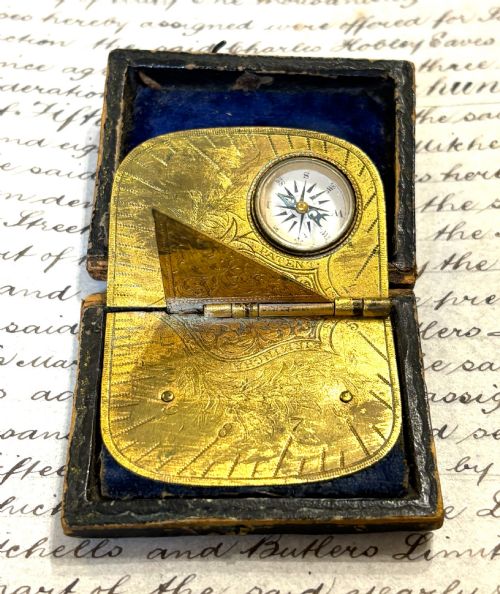
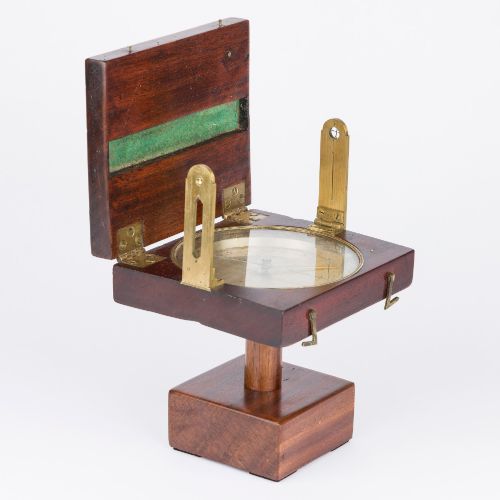
A victorian brass compass is a functional directional instrument, often housed in mahogany cases or combined with clinometers, thermometers, and sundials. You will frequently encounter pocket compasses, surveyors' models, and cased nautical pieces originating from the nineteenth century and the Edwardian era.
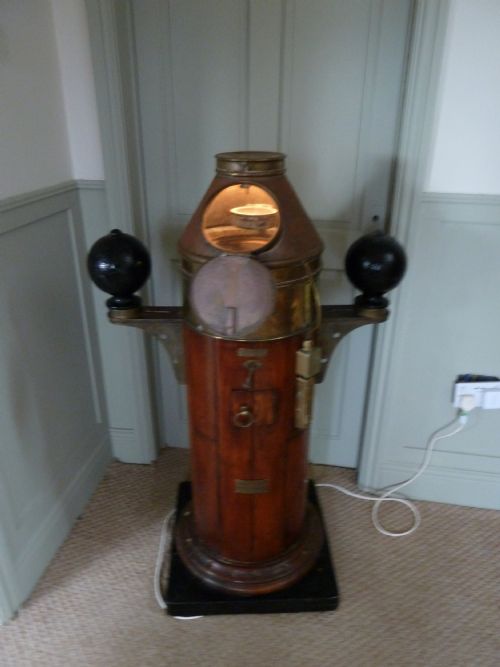
Makers produced these instruments for explorers, surveyors, and ships at sea, employing durable materials suited for field use. The examples on this page range from simple desk ornaments to complex military compendiums and large binnacles.
Materials and construction
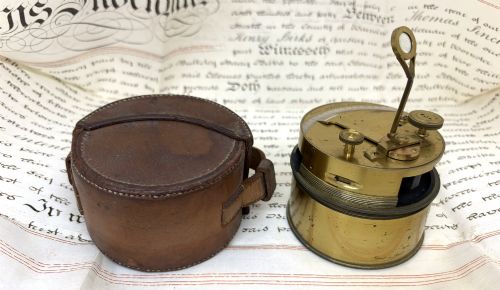
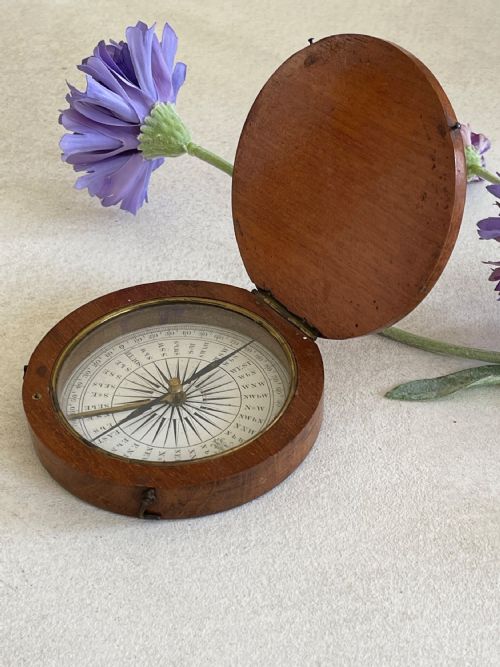
Makers fashioned the primary bodies from cast and turned brass, protecting the delicate internal needles beneath glazed glass covers. Many instruments rest inside fitted mahogany, leather, or leatherette cases lined with velvet or paper scales.
Precision engraving marks the dial faces, while specialised models incorporate boxwood, silvered metal dials, and integrated glass spirit levels for surveying and astronomical observations.
Materials appearing across these listings include brass, glass, mahogany, leather, paper, velvet, wood, and leatherette.
Quality and craftsmanship
The distinction between standard utility items and finer pieces lies in the crispness of the engraved markings and the smoothness of the needle movement. Signed instruments by known makers carry superior finishing on the brass housing and more robust hinge mechanisms in the fitted wooden cases.
Completeness dictates much of the value, with surviving original leather travel cases, secondary compass cards, and intact sighting arms marking the upper tier of instruments.
G Davis of Leeds·Baker London·Alfred Apps·Stanley London·Malby·John Newman·Barker and Son·Watkins·J Hicks
The Victorian Brass Compass Glossary
- Binnacle
- A navigational housing designed to hold a ship compass steady on deck. It protected the instrument from the motion of the vessel.
- Clinometer
- An instrument used for measuring angles of slope or inclination. It frequently accompanied compasses in surveying and military compendiums.
- Gimbal
- A pivoted support ring that allows a compass to remain horizontal despite the roll of a ship. This mechanism ensured accurate readings at sea.
- Galvanometer
- An electromechanical measuring instrument for detecting electric current. These were occasionally housed alongside compasses in scientific compendiums.
- Theodolite
- A precision optical instrument for measuring angles between designated points in the horizontal and vertical planes. Surveyors used these alongside magnetic compasses.
Victorian Brass Compass: Frequently Asked Questions
How do I read a pocket compass?
Align the floating magnetized needle with the oriented markings on the dial face to determine magnetic north. Ensure the instrument is held level on a flat surface for an accurate reading.
Older pocket instruments often feature jewelled bearings that allow the needle to swing freely within the brass housing.
What is a surveyor compass used for?
Surveyors utilised these specialised instruments for measuring property boundaries, laying out roads, and mapping terrain. They typically featured fold-out sighting arms and were mounted on wooden tripods or staffs.
Many examples include brass vernier scales and leveling bubbles to increase precision in the field.
How should I clean brass compass cases?
Remove surface dust gently with a soft dry cloth without applying harsh chemical polishes. Preserving the natural patina maintains the historical integrity of the nineteenth-century metalwork.
Inspect the glass covers carefully to avoid applying pressure directly to the glazed bezels during maintenance.
Why do some compasses have wooden boxes?
fitted mahogany and leather cases protected delicate glass faces and sensitive magnetic needles during travel. These protective enclosures were standard for explorer and military instruments.
Many cases retain paper directional labels or maker instructions pasted inside the hinged lids.
Are these compasses still accurate today?
While many nineteenth-century needles still point toward magnetic north, localized magnetic interference and age can affect precision. They are collected primarily as historical scientific artefacts rather than for modern wilderness navigation.
The fluid-filled or dry-pivot mechanisms serve to demonstrate nineteenth-century manufacturing capabilities.