





Victorian Blue John
Victorian blue john pieces are striking decorative items carved from a rare fluorite spar found in Derbyshire, prized for their rich violet and yellow banding.
Victorian Blue John
The material originates almost exclusively from Treak Cliff and Blue John Cavern near Castleton in Derbyshire. Surviving examples demonstrate the nineteenth-century taste for displaying mineral specimens in domestic interiors.
Materials and construction
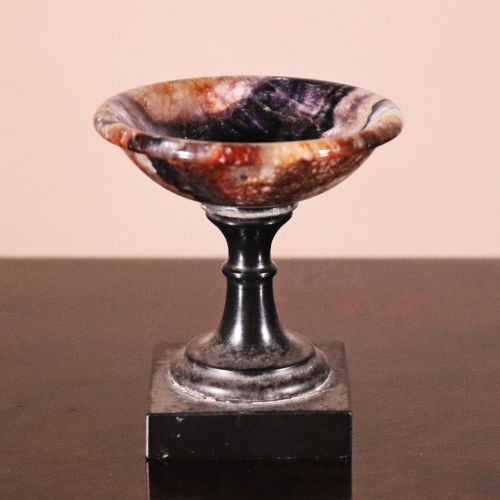
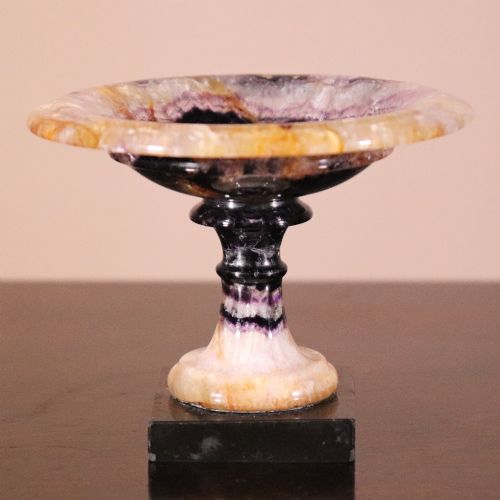
The working of blue john requires careful selection of the fluorite nodules, which are heated and treated with resin to stabilise the soft stone before turning on a lathe. Craftsmen shape the mineral into vessels and decorative objects, exploiting the concentric violet and yellow crystalline layers.
Mounts and fittings on these pieces often utilise silver or other metals to secure the turned stone components. The natural variations in the mineral mean each fashioned object demands individual handling by the lapidary.
Victorian Blue John Retail Price Guide 2026
Typical asking prices for victorian blue john among the pieces listed under this phrase on Sellingantiques today, from the lower quarter to the upper quarter. They describe what is for sale here now, not the wider market.
Assessing quality and craftsmanship
Quality in victorian blue john depends largely on the intensity and configuration of the colour banding within the mineral. Specimens exhibiting deep purple hues combined with sharp yellow veins command greater appreciation than paler, more uniform stones.
The precision of the lathe work and the stability of the mounted components determine the overall integrity of the finished object. Clean turning without excessive filler material indicates superior selection of the raw mineral block.
John Meir and Son of Tunstall
The Victorian Blue John Glossary
- Tazza
- A shallow saucer-like ornamental vessel raised on a stem and foot. This form is frequently utilised for displaying mineral specimens.
- Fluorspar
- The mineral name for calcium fluoride, known commercially as blue john when found in the distinctive banded Derbyshire deposits.
- Lapidary
- An artisan who cuts, polishes, and engraves stone into ornamental objects and vessels. The craft requires skill to prevent the fragile fluorite from fracturing.
Victorian Blue John: Frequently Asked Questions
What is blue john stone?
Blue john is a semi-precious mineral composed of calcium fluoride with distinctive purple and yellow bands. It forms in underground cavities in Derbyshire.
The unique geological conditions create colour patterns that do not occur in standard fluorite deposits elsewhere.
How are these items cleaned?
Cleaning requires only a soft, dry cloth to remove dust from the polished surface. Moisture and chemical cleaners damage the treated stone.
Keeping objects away from direct sunlight prevents the violet tones from fading over time.
Where did the material originate?
The stone comes from specific mines near Castleton in the Peak District of Derbyshire. Extraction historically took place in small quantities due to the scarcity of the veins.
Workers extracted the mineral by hand to preserve the fragile crystalline structure before transport to workshops.
How do you date these pieces?
Dating relies on the style of the mounting hardware, turning marks, and historical documentation associated with the workshop. Nineteenth-century examples often feature specific Victorian proportions.
Comparing the mineral banding and base construction against dated archive pieces helps establish the period of manufacture.