


Victorian Blue Glass Vase
A victorian blue glass vase brings vivid colour and striking nineteenth-century craftsmanship into a room.
Victorian Blue Glass Vase
When you search for a victorian blue glass vase, you encounter a striking array of nineteenth-century decorative vessels ranging from deep cobalt tones to pale opaline shades. These pieces emerge primarily from English, French, and Bohemian workshops spanning the mid to late nineteenth century, encompassing everything from diminutive posy vessels to grand mantel lustres.
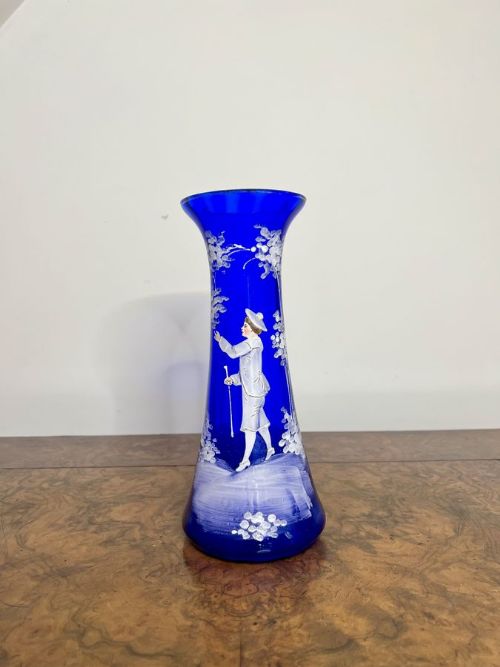
The most common examples on this page reflect the Victorian enthusiasm for vibrant domestic display, often featuring hand-painted enamel flowers or contrasting cased layers. Alongside standard decorative vases, buyers frequently meet specialised forms like hyacinth vases and converted table lamps that demonstrate the era's varied uses for coloured glass.
How they were made
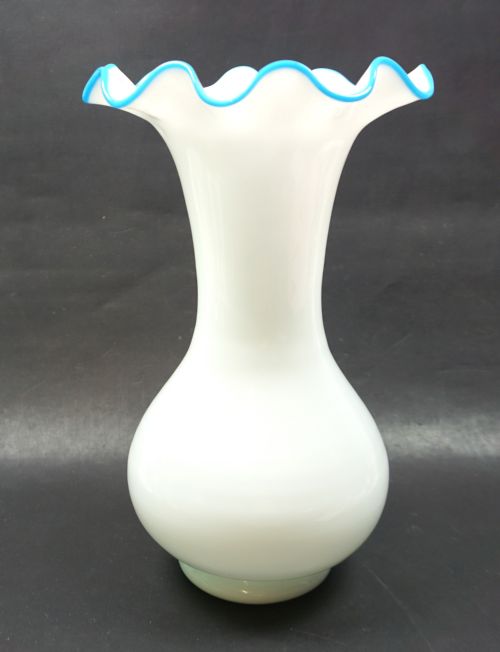
Glassmakers achieved these intense hues through specialised metal oxide additions during melting, creating rich cobalt or translucent pale blue bodies. Artisans then utilised techniques such as cased glass, where a coloured layer is fused over a white interior, or cut-to-clear methods that expose the contrasting strata beneath.
Surface ornamentation involved hand-applied enamel decoration, delicate gold leaf detailing, and decalcomania transfers. Workshops in Bohemia, France, and England employed these distinct decorative skills to elevate standard blown forms into elaborate mantel and table ornaments.
Hyacinth vases were designed with narrow necks specifically to nurse bulbs into bloom indoors, proving Victorians loved forced flowers as much as bright blue glass.
What varies in quality
The distinction between standard domestic wares and exceptional studio pieces rests in the execution of the surface decoration and the purity of the glass body. Hand-painted enamelling with fine detailing and intact gilding separates superior examples from simpler mass-produced items.
Weight and structural balance also dictate worth, as heavier cased or cut-to-clear vessels demand greater technical mastery from the glassblower. The crispness of the facets and the evenness of the colour saturation determine whether a piece represents the upper tier of nineteenth-century production.
Baccarat·Webb·George Tye
The Victorian Blue Glass Vase Glossary
- Cased Glass
- A vessel formed from two or more distinct layers of glass fused together during the blowing process. This technique allows artisans to cut through the outer layer to reveal a contrasting colour underneath.
- Opaline Glass
- An opaque or translucent pale glass popular in nineteenth-century decorative pieces. It often serves as a canvas for hand-painted enamel floral motifs.
- Mantel Lustres
- Large decorative vases fitted with hanging glass prisms around the rim. They were designed to reflect candlelight from a fireplace mantelpiece.
- Decalcomania
- A transfer decoration technique utilised on nineteenth-century glass lamps and vases. Printed motifs were applied to the interior or exterior surface and sealed with a clear varnish.
- Hyacinth Bulb Vase
- A tall, narrow-necked vessel specifically engineered to support a single bulb suspended over water. Victorian examples in deep blue glass combined botanical utility with interior decoration.
Victorian Blue Glass Vase: Frequently Asked Questions
What is a victorian blue glass vase?
It is a nineteenth-century decorative glass vessel produced in shades ranging from deep cobalt to pale opaline. These pieces were fashioned in English, French, and Bohemian glassworks during the Victorian era.
Many examples feature hand-painted enamel flowers, gilding, or overlay techniques designed for ornamental display in period drawing rooms.
How do I identify a period piece?
Look for pontil marks on the base where the glassblower's rod was snapped off, indicating traditional free-blown or mold-blown manufacturing. Weight, hand-finished enamel work, and historical wear patterns also help confirm nineteenth-century origin.
Matching the stylistic cues, such as aesthetic movement shapes or neoclassical motifs, assists in narrowing down the decade of production.
Where were these vases made?
Production was centered in major European glass-making hubs, notably England, France, and the region historically known as Bohemia. Each region developed distinct signatures, such as Bohemian overlay and French opaline.
English makers like those in Stourbridge and Bristol produced significant quantities of cobalt and satin glass variations for domestic and export markets.