



Victorian Black Forest Barometer
A victorian black forest barometer brings richly carved woodland detail and reliable aneroid weather tracking into any hallway.
Victorian Black Forest Barometer
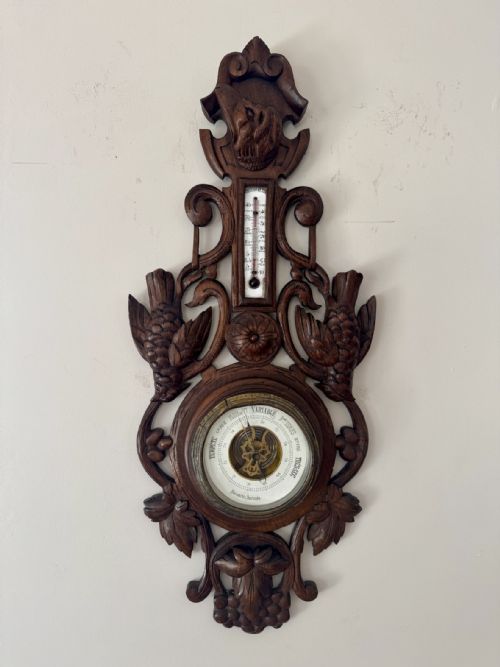
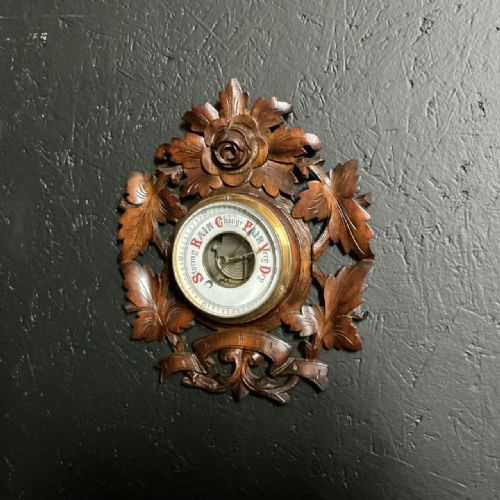
A victorian black forest barometer combines traditional Swiss and German wood carving with nineteenth-century meteorological mechanics. These wall barometers typically feature deep relief carvings of foliage, game, or rustic motifs surrounding a central dial.
Buyers encounter examples spanning the late nineteenth century, including pieces dated to the eighteen-eighties and eighteen-nineties, alongside Edwardian interpretations. The most common format is a robust wall barometer with a visible porcelain, ceramic, or brass-rimmed glass dial.
These instruments serve as both functional weather gauges and striking decorative wall art. The form relies heavily on regional carving traditions passed down through generations of Alpine artisans.
How they were made
Carved wood forms the structural and artistic foundation of these pieces, utilising lindenwood, walnut, and oak. Artisans worked these timbers by hand to achieve intricate, three-dimensional foliage and animal subjects.
Glass protects the delicate dial face while brass components often secure the bezel and internal aneroid movement. Ceramic or porcelain dials provide a clear, legible surface for barometric readings.
Victorian Black Forest Barometer Retail Price Guide 2026
Typical asking prices for victorian black forest barometer among the pieces listed under this phrase on Sellingantiques today, from the lower quarter to the upper quarter. They describe what is for sale here now, not the wider market.
Materials documented across the pieces include glass, brass, carved wood, walnut, porcelain, lindenwood, horn, and oak.
What varies in quality
The depth and crispness of the wood carving distinguish superior examples from simpler production. Master carvers achieved remarkable lifelike detail in the foliage and animal motifs, whereas lesser pieces display flat, mechanical incisions.
The choice of primary timber also dictates the tier of the piece, with richly figured golden walnut and fine lindenwood sitting above standard oak. Additionally, the presence of a ceramic dial rather than a plain metal face elevates the overall character.
The Victorian Black Forest Barometer Glossary
- Aneroid barometer
- An instrument that measures atmospheric pressure without using liquid mercury, relying instead on a flexible metal box. This mechanical approach allowed barometers to be securely mounted vertically on walls.
- Black Forest
- A mountainous region in Germany renowned for intricate woodcarving traditions. Pieces from this origin often depict naturalistic forest scenes, leaves, and wildlife.
- Bezel
- The metal ring that holds the glass cover in place over the barometer dial. It is commonly fashioned from polished brass.
- Lindenwood
- A pale, fine-grained timber favoured by carvers for its smooth texture and resistance to splitting. It allows for extremely detailed undercut foliage.
Victorian Black Forest Barometer: Frequently Asked Questions
How do I hang a wall barometer?
These instruments require a sturdy wall fixture capable of supporting the weight of the carved wooden frame and internal mechanism. Ensure the mounting screw secures firmly into a stud or uses a proper wall anchor.
Position the barometer away from direct heat sources and heavy draughts to maintain the accuracy of the aneroid movement.
Are these barometers still accurate?
Many aneroid movements continue to track atmospheric pressure changes effectively after more than a century. They respond to shifts in weather by measuring air pressure rather than temperature.
Calibration can sometimes be adjusted via a small screw on the back or through the dial face if the readings drift from local meteorological standards.
How do I clean the carved wood?
Dust the intricate foliage and crevices regularly using a soft, dry brush or a feather duster. Avoid using liquid polishes or damp cloths that can penetrate the grain and damage the aged timber.
Keeping the wood dry preserves the natural patina developed over the nineteenth and early twentieth centuries.
What is golden walnut?
Golden walnut refers to timber exhibiting a warm, honey-toned hue with distinct grain patterns. It was selectively chosen by makers for high-end barometer frames.
This material adds visual depth and a lustrous finish that distinguishes finer pieces from darker, standard woods.