



Victorian Anglo Indian Shelf
A victorian anglo indian shelf brings rich colonial craftsmanship into a room, offering sturdy exotic timbers and intricate hand-carved detail.
Victorian Anglo Indian Shelf
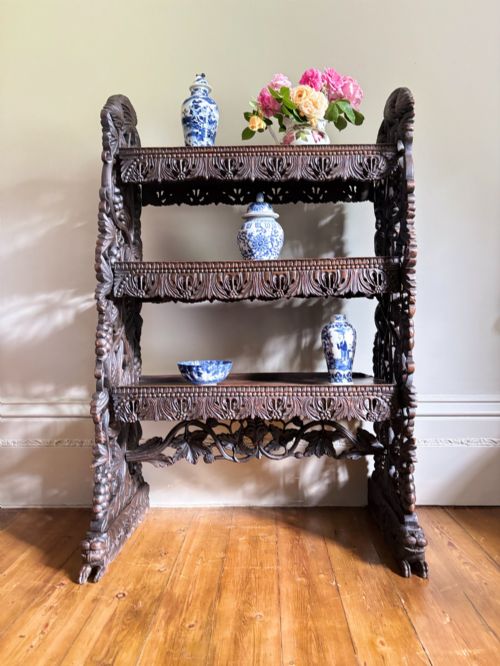
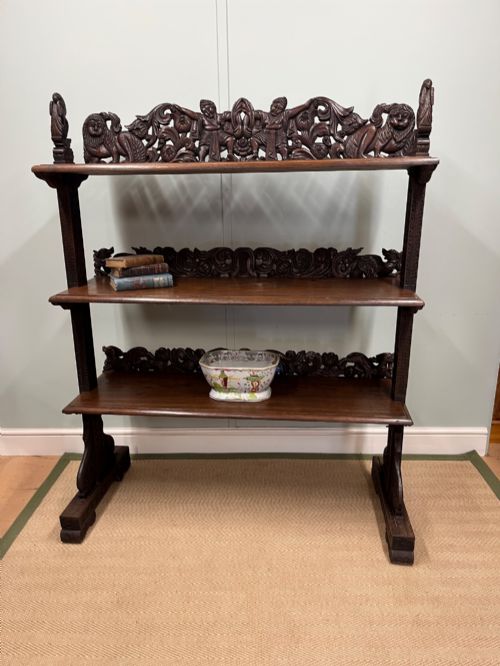
A victorian anglo indian shelf encompasses wall brackets, tiered whatnots, and bookcases produced during the nineteenth century. These items bridge British domestic demand with the rich carving traditions of the subcontinent and surrounding regions.
Buyers frequently encounter three-tier buffets, wall-mounted display brackets, and floor-standing whatnots across these listings. Forms range from compact corner stands to substantial side cabinets and revolving bookcases.
Origin details in the evidence point to Ceylonese and Burmese workshops alongside broader Anglo-Indian production. The styles merge Victorian furniture shapes with dense indigenous floral and foliate carving.
Materials and construction methods
These pieces rely heavily on dense tropical hardwoods including teak, padauk, rosewood, satinwood, and ebony. Workshops selected these heavy timbers both for their deep natural colours and their ability to hold razor-sharp carved detail.
Makers utilised intricate fretwork and deep relief carving to decorate upright supports, friezes, and backplates. Brass fittings and secondary woods appear occasionally to stabilise multi-tier structures like whatnots and buffets.
Victorian Anglo Indian Shelf Retail Price Guide 2026
Typical asking prices for victorian anglo indian shelf among the pieces listed under this phrase on Sellingantiques today, from the lower quarter to the upper quarter. They describe what is for sale here now, not the wider market.
Listings span the 19th century, with dates specified around 1850, 1860, 1880, and 1890 alongside general Victorian designations.
Judging quality and execution
Quality rests primarily on the depth and crispness of the hand-carving across the timber. Superior examples display sharply defined foliage and figures with no softening in the undercut relief.
The choice of primary wood also dictates standard, with dense figured satinwood or padauk sitting above standard utility hardwoods. Solid construction throughout multi-tier joints separates superior pieces from lighter decorative items.
The Victorian Anglo Indian Shelf Glossary
- Whatnot
- An open set of tiered shelves used for displaying ornaments or books. These pieces usually stand on four upright supports.
- Padauk
- A heavy, durable tropical hardwood with a reddish hue. This material responds exceptionally well to deep carving.
- Etagere
- A piece of furniture consisting of a set of open shelves for displaying small objects. The term is often used interchangeably with whatnot.
- Satinwood
- A pale, lustrous timber native to India and Ceylon. It produces a distinctive golden sheen when polished.
- Wall Bracket
- A small shelf designed to be fixed directly to a wall. These items support single display objects or small books.
Victorian Anglo Indian Shelf: Frequently Asked Questions
What is a victorian anglo indian shelf?
A victorian anglo indian shelf is a nineteenth-century wall-mounted or freestanding display piece. It combines British furniture forms with traditional South Asian carving techniques.
These items were produced in workshops across India, Burma, and Ceylon during the Victorian era. They utilise dense tropical hardwoods such as teak, padauk, and satinwood.
How do I use a whatnot?
A whatnot serves as an open display unit for books, ceramics, and decorative objects. Floor-standing versions work well in corners or against empty walls.
Tiered shelving allows for varied arrangements of ornaments by height. Wall-mounted variants provide display space without occupying floor area.
What woods were used?
Makers employed heavy exotic timbers including teak, padauk, rosewood, ebony, and satinwood. Mahogany also appears in some Victorian variants.
These dense woods allowed artisans to execute deep, intricate relief carvings without compromising structural integrity. Each timber offers distinct natural colour variations.
How do I style these shelves?
These pieces suit both traditional and contemporary interiors as focal points for display. Their dark carved timbers add texture against neutral walls.
Pair wall brackets with single statement objects to highlight the woodwork. Freestanding whatnots and buffets accommodate collections of small ceramics or books.