
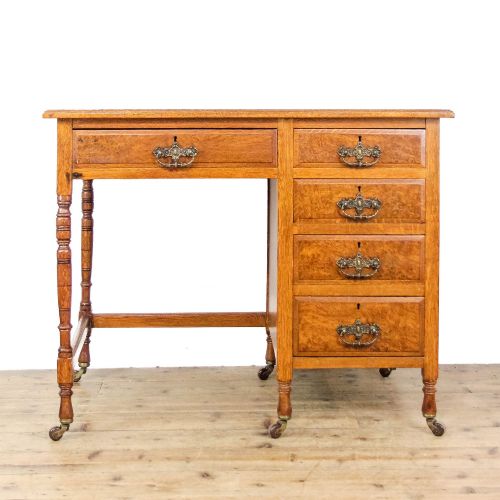
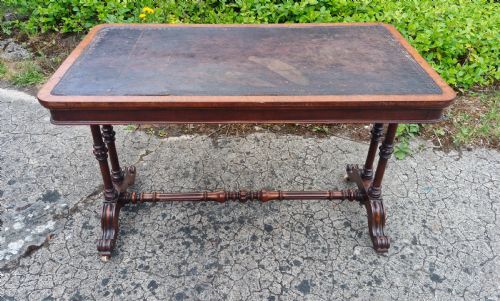


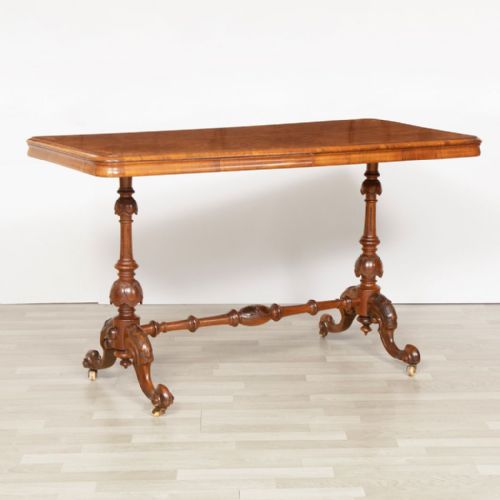


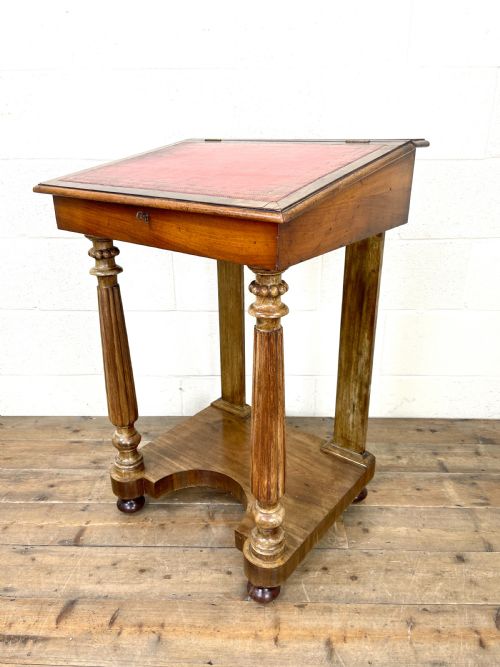

Turned Pedestal Desk
A turned pedestal desk offers a sturdy workspace with drawers, built from mahogany, oak, or walnut to anchor a study.
Turned Pedestal Desk
A turned pedestal desk combines deep storage pedestals with a central workspace, appearing across Georgian, Victorian, and Edwardian periods in the evidence.
The form encompasses twin-pedestal layouts, kneehole desks, and related library or writing tables featuring turned elements.
How they were made
Joiners built these pieces using solid timbers such as mahogany, oak, and walnut, frequently applying burr walnut veneers to the exterior surfaces.
Workspaces frequently incorporate tooled Moroccan leather writing surfaces, while brass hardware appears on handles and mounts.
Pedestals and supports exhibit turned woodwork, pairing structural stability with period decorative details.
Materials across these listings include mahogany, oak, walnut, burr walnut, brass, leather, glass, and amboyna.
What varies in quality
The choice of primary timber and decorative veneer sets the baseline for quality, with burr walnut and figured mahogany representing the finer end of the range.
Attention to detail in the turned wooden elements and the retention of original leather writing inserts distinguish superior examples.
Maker attribution and period integrity elevate particular pieces above standard workshop production.
Gillows of Lancaster·Heal and Sons
The Turned Pedestal Desk Glossary
- Pedestal desk
- A heavy piece of furniture featuring two stacks of drawers supporting a writing surface.
- Kneehole desk
- A compact desk configuration featuring a central recess for the user's legs, flanked by pedestals.
- Library table
- A large freestanding table utilised for reading and writing, often finished on all sides.
- Burr walnut
- A prized veneer taken from the gnarled growth of a walnut tree, showing intricate swirling grain patterns.
Turned Pedestal Desk: Frequently Asked Questions
What is a turned pedestal desk?
It is a substantial workspace featuring twin drawer pedestals and turned wooden architectural details. These pieces originate across the Georgian, Victorian, and Edwardian eras.
They provide extensive drawer storage alongside a dedicated writing surface, making them practical for daily use in a study or library.
How do I date a pedestal desk?
Dating relies on examining the timber species, construction methods, and hardware styling. Georgian and Victorian examples show distinct joinery practices and wood selections.
Changes in aesthetic preferences, from Georgian mahogany to Victorian walnut and Edwardian oak, help pinpoint the period of manufacture.
Are these desks suitable for daily work?
Their solid timber construction and large top surfaces make them highly practical for modern working environments. Many retain durable leather inserts suited for writing.
Drawer arrangements within the pedestals offer ample room to organise stationery and documents securely.
What woods were used for these desks?
Workshop records show frequent use of mahogany, oak, and walnut. Burr walnut and amboyna also appear as decorative veneer choices.
Secondary woods and brass fittings provide internal structure and hardware detail across the various periods.