

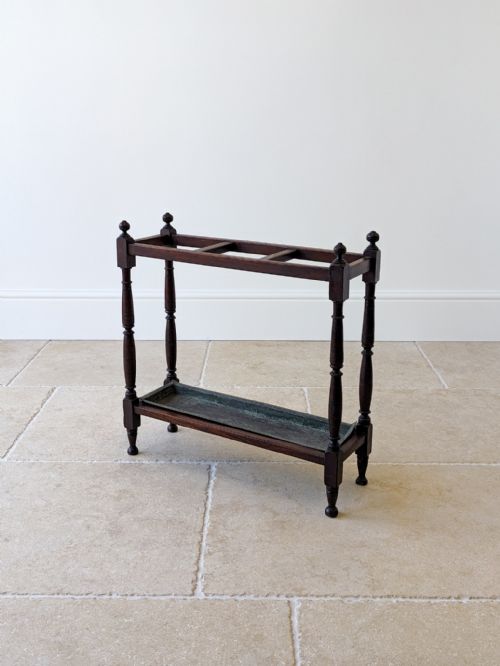
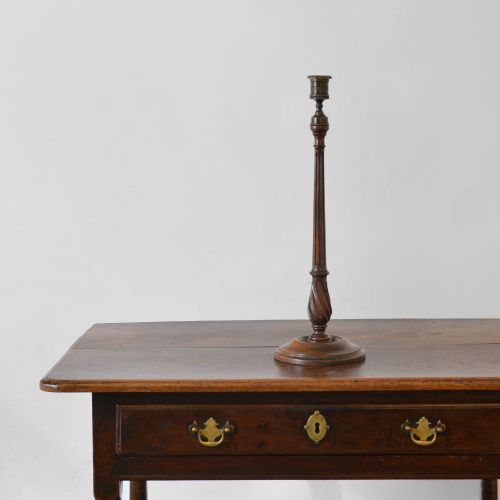


Turned Mahogany Stick Stand
A turned mahogany stick stand brings practical elegance to a hallway, holding umbrellas and walking canes with simple, upright grace.
Turned Mahogany Stick Stand
When you search for a turned mahogany stick stand, you are looking at hallway furniture designed to organise walking sticks and umbrellas. These pieces appear across Georgian, Victorian, and Edwardian periods, alongside later twentieth-century interpretations.
The forms listed here include dedicated umbrella stands, corner stick stands, whip stands, and occasional candlesticks that share the same turned woodwork. Mahogany is the primary timber, often paired with brass fittings.
You are most likely to meet Victorian and 1900 examples on this page, reflecting the domestic habits of those eras when visitors needed a designated place to leave wet weather gear and canes.
How they were made
Maker's work relied on the lathe to shape solid mahogany and timber into upright columns and stems. Turning created the symmetrical rings, baluster profiles, and smooth cylindrical shafts characteristic of these pieces.
Brass sconces, liners, and mounts were integrated into the wooden structures to catch drips from wet umbrellas or to hold candles securely. These metal components were fitted by hand using screws or drop-in sockets.
Turned Mahogany Stick Stand Retail Price Guide 2026
Typical asking prices for turned mahogany stick stand among the pieces listed under this phrase on Sellingantiques today, from the lower quarter to the upper quarter. They describe what is for sale here now, not the wider market.
Listings span Georgian, Victorian, and Edwardian eras, combining mahogany timber with brass mounts and metal fittings.
What varies in quality
Quality rests in the crispness of the turning and the depth of the mahogany grain. Finer examples show careful proportioning in the stem and solid weight in the base, rather than rushed machine work.
The integration of brass elements defines the upper tier of pieces. Where brass drip trays or sconces are substantial and well-fitted to the turned timber, the piece holds greater presence.
The Turned Mahogany Stick Stand Glossary
- Turned
- Shaped on a lathe by rotating the timber against cutting tools to create circular profiles. This technique produces the characteristic columns and stems found on stick stands and candlesticks.
- Mahogany
- A durable tropical timber valued for its rich reddish-brown colour and stable grain. It forms the structural body of the pieces gathered here.
- Sconce
- A metal socket or drip pan, usually made of brass, fitted to the top of a candlestick or the base of a stand. It protects the surrounding wood from moisture and wax.
- Whip stand
- A tall specialised rack designed specifically for storing riding crops and whips. These share construction methods with standard stick and umbrella holders.
Turned Mahogany Stick Stand: Frequently Asked Questions
Where should I place a stick stand?
Position your stand in an entrance hall or porch where guests arrive. It keeps walking aids and umbrellas within arm's reach.
Ensure the floor beneath is protected if the piece lacks an original metal drip tray underneath.
How do I clean mahogany wood?
Dust the turned surfaces regularly with a soft, dry cloth. Avoid using modern aerosol sprays that leave silicone residue.
Feed the timber occasionally with a traditional beeswax polish to maintain the natural lustre of the grain.
Can I use a candlestick as a stand?
Candlesticks and stick stands share turned wooden construction methods but serve entirely different domestic functions. Candlesticks hold wax tapers for illumination.
Do not attempt to use tall candlesticks for heavy walking umbrellas, as their bases lack the necessary internal drainage.
How do I date a mahogany stand?
Examine the turning style and the type of brass fittings attached to the timber. Georgian pieces display restrained classical proportions.
Victorian and Edwardian items often incorporate heavier brass drip pans and more exuberant turned baluster profiles.