
Turn of Century Sofa
A turn of century sofa brings substantial upholstery and timber framing from the Victorian and Edwardian periods into a modern room.
Turn of Century Sofa
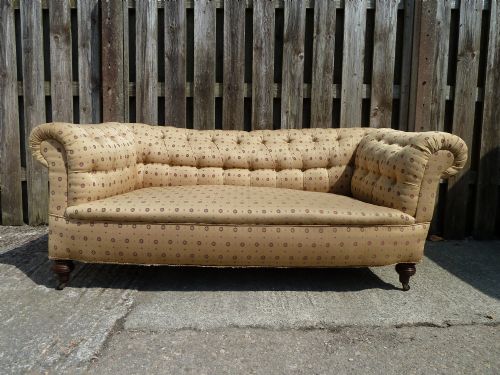
When you examine a turn of century sofa, you are looking at seating shaped by late nineteenth and early twentieth century domestic life. These pieces encompass deep buttoned chesterfields, salon sofas, and daybeds originating from the Victorian, Edwardian, and French periods.
The version you are most likely to meet on this page is the Victorian chesterfield or chaise longue, often constructed with generous sprung seating and substantial upholstered backs. These forms reflect a Victorian and Edwardian taste for comfort alongside formal reception room styling.
Beyond the standard chesterfield, the evidence shows related seating such as French banquettes, salon sofas, and daybeds. Each variety demonstrates how workshops of the period adapted traditional frames for specific domestic spaces.
Materials and construction methods
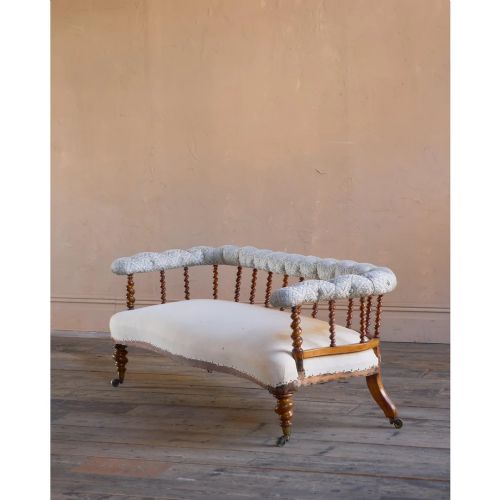
Makers built the structural frames of a turn of century sofa using hardwoods such as mahogany, walnut, and oak, often exposing turned or carved wooden legs beneath the upholstery. Exposed wooden elements frequently feature decorative details like bobbin turning or inlay.
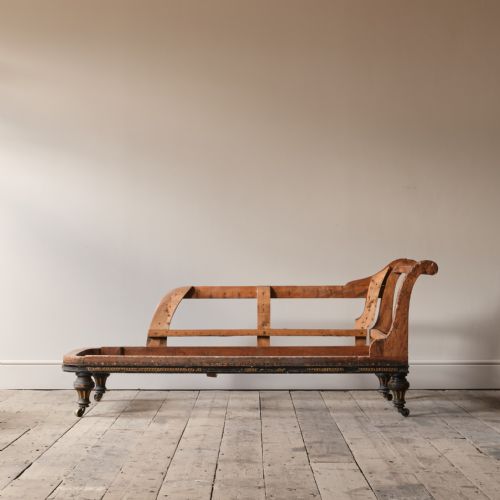
Upholstery forms the core of these pieces, relying traditionally on calico foundations, horsehair stuffing, and heavy fabric coverings. Frames designed for re-upholstery occasionally appear bare, showing the underlying webbing and coil springs.
The archive records a mid nineteenth century rosewood sofa fitted with bobbin turned legs.
Markers of distinction and build quality
The distinction between ordinary production and superior craftsmanship in a turn of century sofa lies in the integrity of the frame and the precision of the upholstery work. Heavier timber frames and tightly tied internal coil springs indicate a higher grade of manufacture.
Design nuance also separates standard examples from workshop pieces bearing attribution to notable makers. Subtleties in wood turning, veneer selection on exposed parts, and harmonious proportions elevate certain pieces above mass production.
Holland & Sons·C. Hindley & Sons·Howard and Sons·Johnstone and Jeanes·Hampton & Sons
The Turn of Century Sofa Glossary
- Chesterfield
- A deep-buttoned upholstered sofa with arms and back of the same height. This form provides a formal yet heavily padded seat structure.
- Chaise longue
- An upholstered sofa in the form of a chair with a seat long enough to support the legs. These pieces combine seating and reclining functions.
- Calico
- A plain-woven cotton fabric used historically as the inner lining or base cover beneath decorative upholstery. It conceals internal stuffing while holding the springs in place.
- Bobbin turned
- Wood turning shaped to resemble a series of bobbins or spools strung together. This decorative technique appears frequently on legs and stretchers.
- Burr walnut
- Wood taken from the wart or burl of a walnut tree, yielding a swirling and highly figured grain pattern. Cabinet makers used it as a decorative veneer on furniture panels.
Turn of Century Sofa: Frequently Asked Questions
How do I clean an antique sofa frame?
Wipe exposed wooden legs and frames gently with a dry or barely damp cloth to remove surface dust. Avoid harsh chemical polishes that can degrade nineteenth-century finishes.
For the upholstered sections, rely on professional textile cleaning suited to historic fabrics. Vacuuming with a soft brush attachment helps maintain fabric surfaces without disturbing internal stuffing.
Can I use these sofas daily?
Most pieces handle everyday sitting comfortably if the internal webbing and springs remain stable. Heavier frames tolerate regular household use well.
Delicate salon seating or pieces awaiting reupholstery require a lighter touch. Assessing the rigidity of the frame helps determine suitability for daily lounging.
What defines an Edwardian sofa?
Edwardian seating generally displays lighter proportions and brighter woods than heavier Victorian furniture. These pieces often feature satinwood, lighter oak, or simpler upholstery lines.
The aesthetic shifted toward airier drawing-room designs around the turn of the twentieth century. Frames became less burdened by heavy tufting and dark finishes.
Are these sofas usually reupholstered?
Many surviving examples have undergone reupholstery over the decades to maintain usable fabric. Original coverings from the nineteenth century rarely survive intact in daily-use condition.
Some pieces are sold specifically for re-covering, allowing buyers to choose new fabric. The underlying springs and frame remain the primary historic components.