

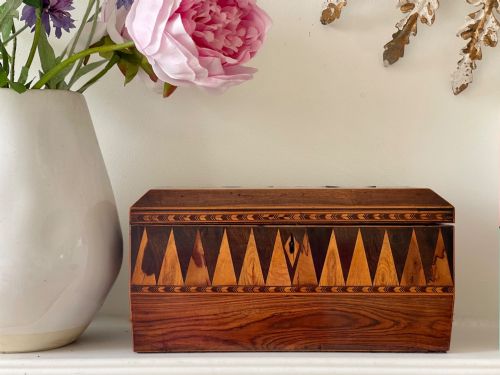

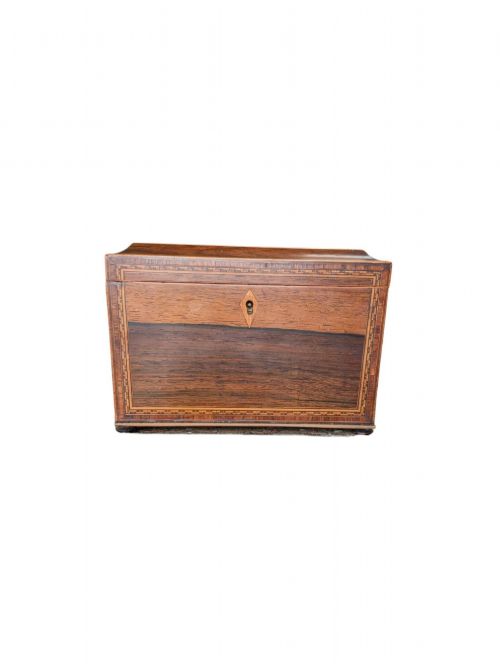


Tunbridge Ware Caddy
A tunbridge ware caddy brings intricate wood mosaic to the tea table, offering miniature geometric and pictorial decoration built from thousands of tiny timber blocks.
Tunbridge Ware Caddy
A tunbridge ware caddy is a specialised container designed to store precious tea leaves, distinguished by its meticulous surface decoration of assembled wood blocks. These decorative boxes appear in walnut, rosewood, and burr walnut, reflecting Georgian, Regency, and Victorian periods.
The most common form met here is the tea caddy, alongside related decorative containers such as sewing baskets and lined boxes. The craftsmanship relies on mosaic techniques developed in Kent, utilising natural woods to form detailed patterns without paint or dye.
Makers utilised native and exotic timbers to construct these lidded receptacles, often incorporating fitted interiors for storing leaf varieties. Pieces span the nineteenth century, ranging from simple inlaid bands to elaborate pictorial panels depicting castles like Hever.
How they were made
Craftsmen built these objects using solid timber carcases of walnut or rosewood, prepared to receive intricate surface veneers. Strips of holly, boxwood, sycamore, and other contrasting woods were glued together in bundles, then sliced across to produce identical mosaic tile patterns known as mosaic veneers.
Workers applied these tiny geometric tesserae by hand onto the box lid and sides, creating complex parquetry and pictorial scenes. Finished surfaces were planed flat, scraped, and polished to highlight the natural colours of the un-dyed woods.
Tunbridge Ware Caddy Retail Price Guide 2026
Typical asking prices for tunbridge ware caddy among the pieces listed under this phrase on Sellingantiques today, from the lower quarter to the upper quarter. They describe what is for sale here now, not the wider market.
Listings feature items from the Regency, Georgian, and Victorian periods, constructed primarily in walnut, rosewood, and boxwood.
What varies in quality
The primary distinction in quality lies in the scale and complexity of the wood mosaic work, separating simple geometric banding from elaborate pictorial craftsmanship. Pieces featuring detailed architectural views or complex floral panels demand greater skill than those with repetitive parquetry borders.
Material selection also defines the tier of the piece, with choice burr walnut and rich rosewood carcases supporting the most ambitious inlay. The preservation of the original fitted interior and the crispness of the mosaic blocks further elevate the standing of an example.
Henry Hollamby
The Tunbridge Ware Caddy Glossary
- Tunbridge Ware
- A type of decorative woodwork originating from Tunbridge Wells in Kent, characterised by mosaic designs made from many small pieces of differently coloured wood.
- Parquetry
- Geometric mosaic woodwork formed by small veneer blocks arranged in patterns on a box or panel.
- Tesserae
- The individual tiny blocks of wood combined to create the larger mosaic picture or geometric border.
- Caddy
- A small container or box historically used for storing tea leaves securely.
Tunbridge Ware Caddy: Frequently Asked Questions
What is a tunbridge ware caddy?
A tunbridge ware caddy is a wooden box decorated with tiny mosaic tiles arranged to form geometric or pictorial designs. These containers were used in the nineteenth century to store dry tea leaves.
Craftsmen built them from timbers such as rosewood and walnut, applying intricate bands of contrasting woods to the lid and sides.
How do I date a tea caddy?
Dating relies on the cabinet form, timber choices, and the style of the mosaic decoration. Georgian and Regency examples often feature simpler geometric banding, while Victorian pieces can incorporate elaborate pictorial panels.
Internal fittings, such as mixing bowls and lidded compartments, also help assign a piece to the nineteenth century.
How were the mosaic patterns made?
Workers glued together multi-coloured strips of wood in specific geometric arrangements, then sliced cross-sections from this block to produce hundreds of identical tiny tiles. These tiles were assembled by hand onto the wooden carcase.
No paint or artificial stain was used; the colours depend entirely on natural woods like holly, boxwood, and sycamore.
How should I care for a wood caddy?
Keep the box away from direct sunlight and dramatic changes in temperature or humidity to protect the delicate wood veneers and glue. A gentle dusting with a soft, dry cloth is usually sufficient for maintenance.
Avoid using modern liquid polishes or moisture, which can penetrate the mosaic joints and loosen the small wooden blocks.