
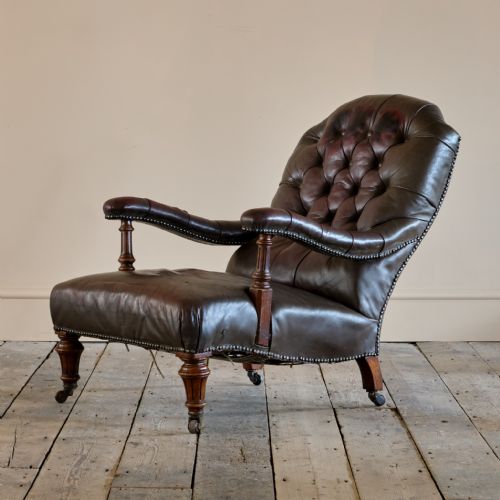


Tufted Country House Chair
A tufted country house chair brings relaxed seating and deep comfort to a room, offering enduring style through traditional upholstery and sturdy timber frames.
Tufted Country House Chair
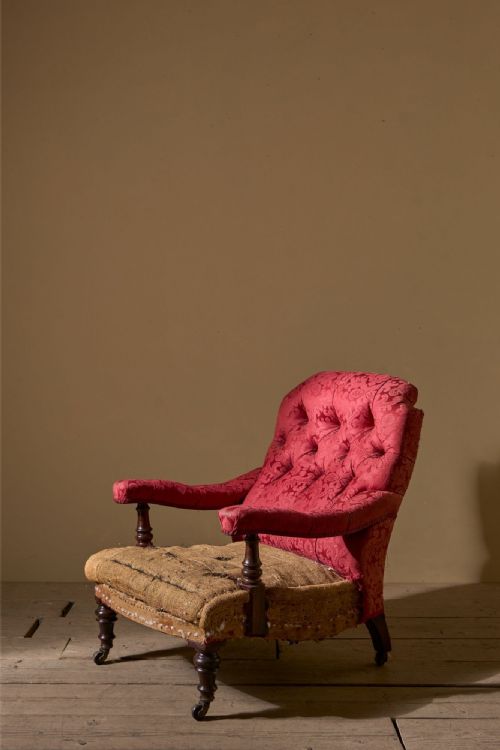
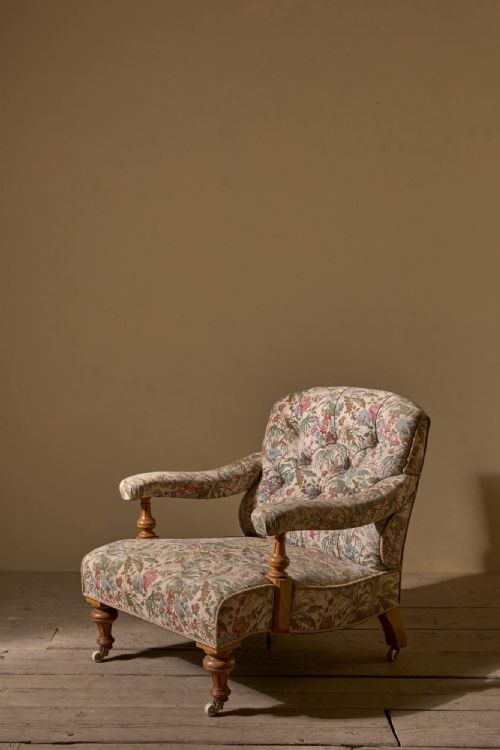
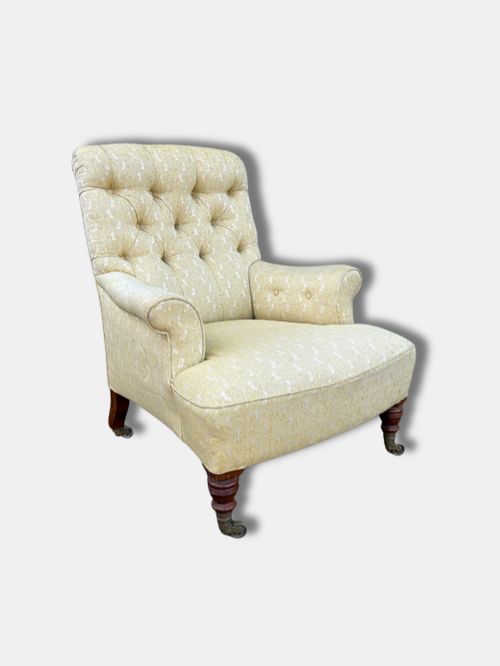
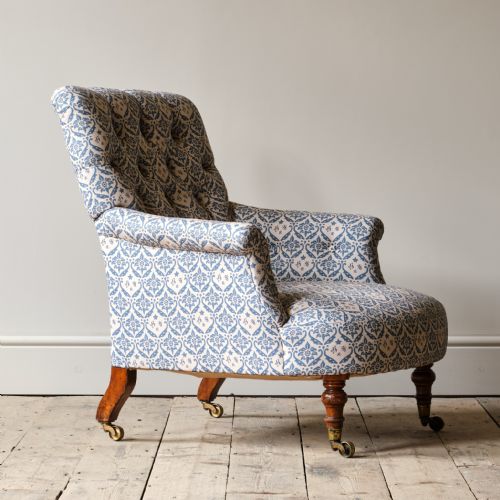
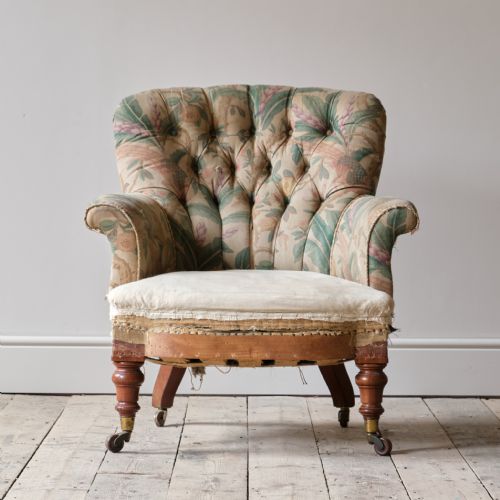
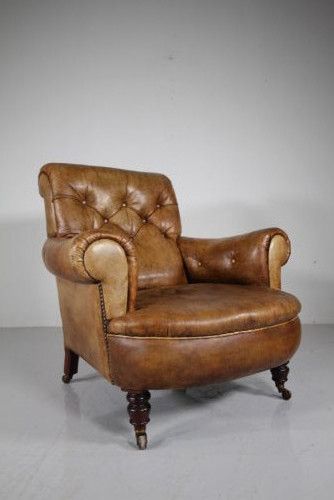
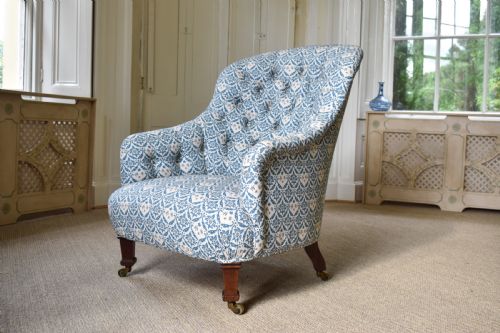
When you search for a tufted country house chair, you are looking at substantial nineteenth-century seating designed for comfort in English and Scottish domestic interiors. These armchairs often feature buttoned or tufted upholstery, wide proportions, and low profiles suited to relaxed drawing rooms and libraries.
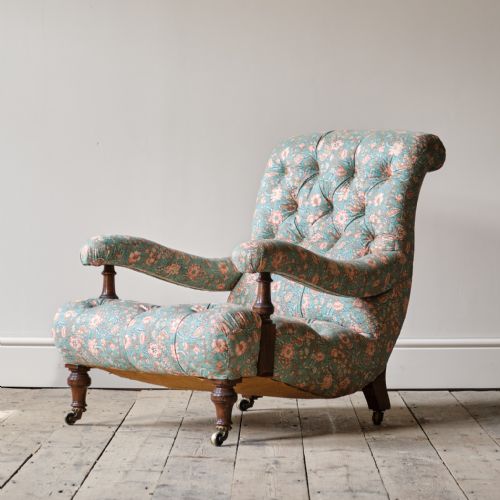
The versions most common on this page date from the Victorian era and span the mid to late nineteenth century, alongside a few pieces reaching into the early twentieth century. You will encounter open armchairs, tub chairs, barrel backs, and spoon backs built for deep seating.
Makers and styles range from simple vernacular pieces to specialised workshop output associated with the English country house aesthetic. Frames typically appear in mahogany, walnut, or general timber, often paired with brass castors and various fabric coverings.
How They Were Made
Makers constructed the structural frames of these armchairs using dense hardwoods such as mahogany and walnut, ensuring a stable skeleton that could withstand decades of heavy use. Exposed wooden elements often received careful turning or modest inlay work, while hidden internal frames relied on robust timber and hessian webbing.
Upholstery techniques defined the comfort of the piece, utilising traditional stuffing and deep buttoning to secure the padding within the fabric or leather cover. Brass castors were frequently fitted to the feet for mobility, and maker stamps or numbering were sometimes applied directly to the wooden legs or castors.
Materials recorded across the inventory include mahogany, walnut, brass, leather, timber, hessian, and various fabrics.
What Varies in Quality
The standard of a tufted country house chair depends heavily on the integrity of the underlying timber frame and the precision of the joinery. Pieces produced by established workshops exhibit tighter frame construction and more resilient internal webbing than simpler vernacular examples.
Upholstery execution also distinguishes the tier of a piece, with even buttoning and neat pleating demonstrating higher craftsmanship. Original details, such as stamped brass castors and maker markings, elevate the historical standing of the armchair.
Howard and Sons·Holland and Sons·Gillows
The Tufted Country House Chair Glossary
- Button back
- A style of upholstery where buttons are pulled deep into the padding in a regular diamond pattern. This technique secures the internal stuffing and creates distinct tufting.
- Castor
- A small wheel fitted to the foot of a piece of furniture for ease of movement. Brass versions are common on nineteenth-century seating.
- Hessian
- A coarse woven fabric typically made from jute fibres. It is used as a foundational webbing and scrim layer beneath final upholstery covers.
- Open armchair
- A seat with un-upholstered wooden arms that reveal the structural timber frame. These contrast with fully padded armchairs.
- Barrel back
- A seating form where the backrest curves continuously around the user to form an enclosing shape. It provides a sheltered and supportive seat.
Tufted Country House Chair: Frequently Asked Questions
Are these chairs comfortable for daily use?
These armchairs were originally built for relaxed domestic sitting spaces and generous proportions make them naturally suited to lounging.
The deep padding and supportive backrests provide a comfortable sit, though nineteenth-century cushioning may feel firmer than modern foam seating.
How do I identify a Victorian piece?
Victorian armchairs often display characteristic timber choices like walnut and mahogany, combined with traditional joinery and period upholstery methods.
Look for structural clues such as hand-turned wooden legs, brass castors, and period fabric or ticking under secondary covers.
What is an English country house style?
This aesthetic reflects a collected, lived-in interior where comfortable upholstered seating mixes with various woods and traditional textiles.
Chairs from this tradition prioritise unpretentious comfort and durability, fitting easily into both formal and relaxed room schemes.
Do these chairs have maker marks?
Some pieces carry stamps or inscriptions left by the original cabinetmakers or upholstery firms, often found on the wooden frame or brass castors.
Not all chairs bear marks, as many vernacular and workshop pieces were produced without explicit signatures.