
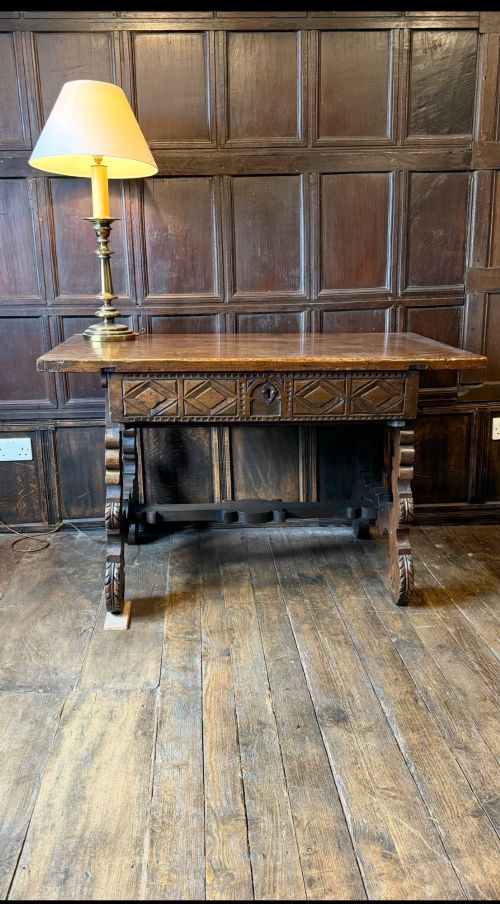
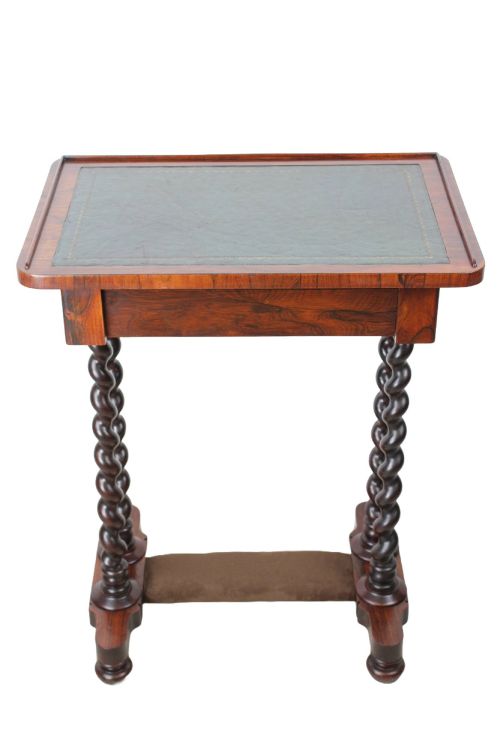
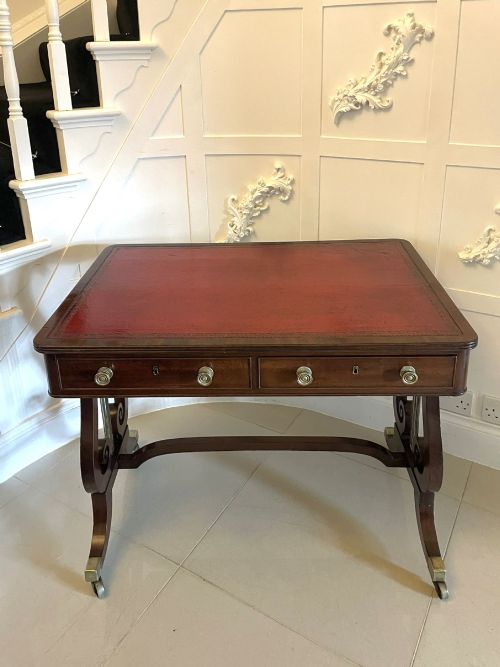
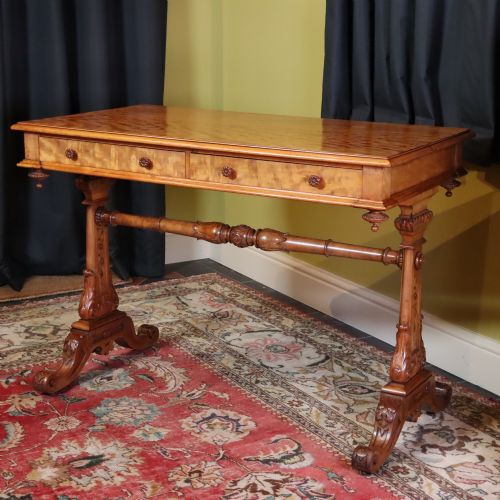


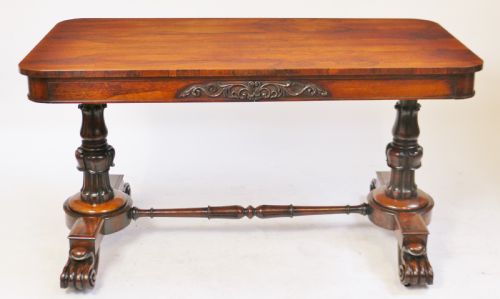

Trestle End Writing Table
These trestle end writing table examples provide sturdy surfaces and handsome proportions, grounding a study or library with period timber.

Trestle End Writing Table
A trestle end writing table brings together sturdy end supports and a dedicated writing surface, often featuring drawers for stationery and papers. These pieces appear in forms such as library tables, writing desks, and sofa tables.
The selections span from the early nineteenth century through the Victorian era, showing influences from Regency, George IV, and William IV periods, alongside Continental Provincial, Italian Renaissance Revival, Spanish Revival, and Victorian Gothic styles.
Mahogany and rosewood dominate the surfaces, complemented by walnut, satinwood, pitch pine, wrought iron, and oak, frequently inset with leather writing panels and fitted with brass details.
How they were made
Cabinet makers utilised dense hardwoods like mahogany and rosewood, applying figured veneers to tabletops and shaping solid timber for the structural end supports. These trestle ends provide the necessary rigidity without heavy central legs.
Details such as brass fittings, turned stretchers, and tooled leather inserts complete the construction, alongside carved ornamentation seen in revival styles.
The selection includes formal Regency library designs, Victorian Gothic desks, and Continental Provincial side tables.
What varies in quality
The grade of timber and the choice of figuring on the top dictate the visual impact of the piece, with carefully selected grain patterns elevating standard construction. Maker attribution, such as stamps from known workshops, also distinguishes the finest examples.
Proportion and the execution of carved or turned details on the trestle ends separate workshops of high skill from straightforward utility pieces.
Gillows·Whytock and Reid
The Trestle End Writing Table Glossary
- Trestle end
- A form of support consisting of two feet connected by a vertical post or pillar, holding up the ends of a tabletop.
- Library table
- A large freestanding table designed for reading and writing, finished on all sides so it can sit in the middle of a room.
- Sofa table
- A rectangular table traditionally placed against the back of a sofa, often featuring drop leaves and end supports.
- Satinwood
- A yellowish-brown timber with a lustrous grain, frequently utilised for veneers and inlay work on finer nineteenth-century furniture.
- Gothic
- A revival style drawing on medieval architectural motifs, featuring pointed arches, heavy timbers, and dark finishes.
Trestle End Writing Table: Frequently Asked Questions
Where should I place one?
These tables work effectively freestanding in the centre of a room or positioned against a wall in a study or library. Because many are finished on all sides, they do not need to anchor against a wall.
Ensure the height aligns with your seating, and consider the clearance needed for the end supports when pulling up a chair.
How do I date these tables?
Dating relies on identifying the prevailing style, timber choices, and construction methods associated with periods like the Regency or Victorian eras. Secondary woods and hardware also offer clues to the decade of manufacture.
Maker stamps or labels, when present, provide the most direct evidence of origin and date.
Are they suitable for daily work?
Many of these pieces were built precisely for writing and administrative tasks, making them practical for modern laptops and paperwork. Leather writing surfaces provide a durable and comfortable pad for daily use.
Drawer configurations vary, so check internal dimensions if you need specific storage for modern office supplies.