




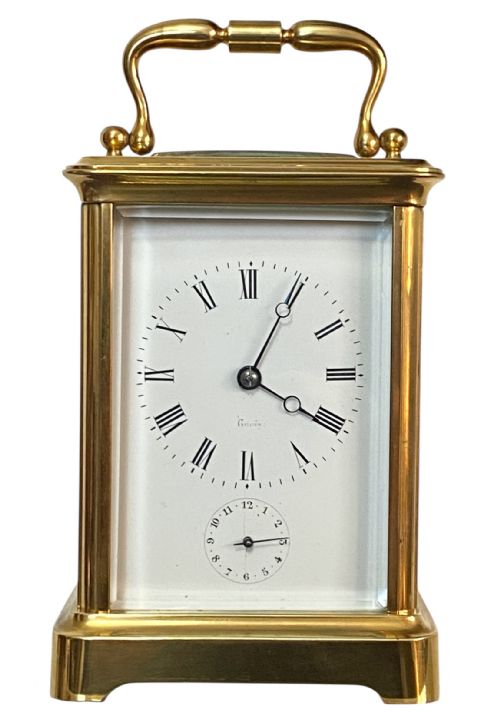
Travelling Clock Leather Case
A travelling clock leather case houses portable timepieces designed for the road, combining robust protection with precision mechanics.
Travelling Clock Leather Case
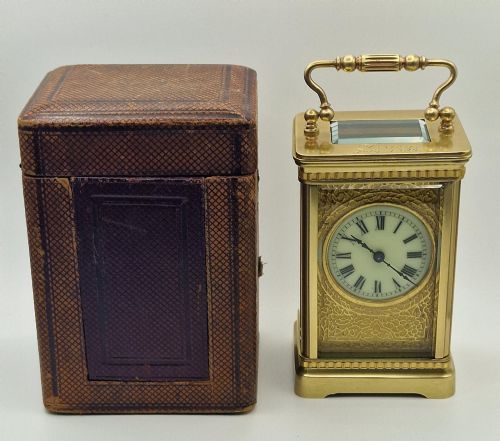
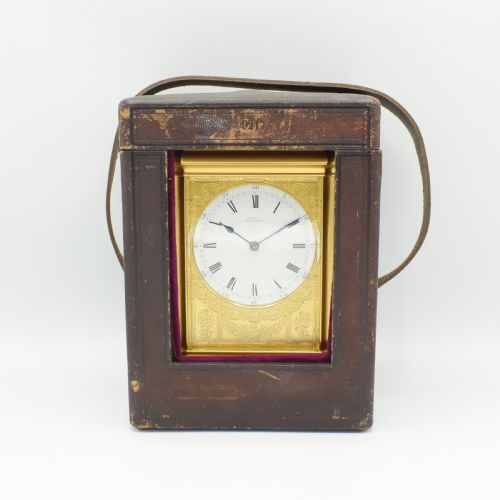
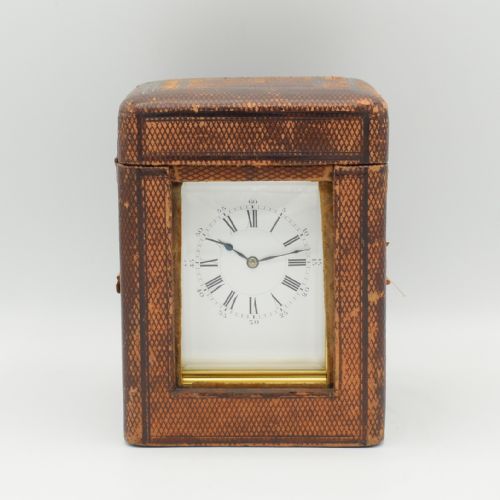
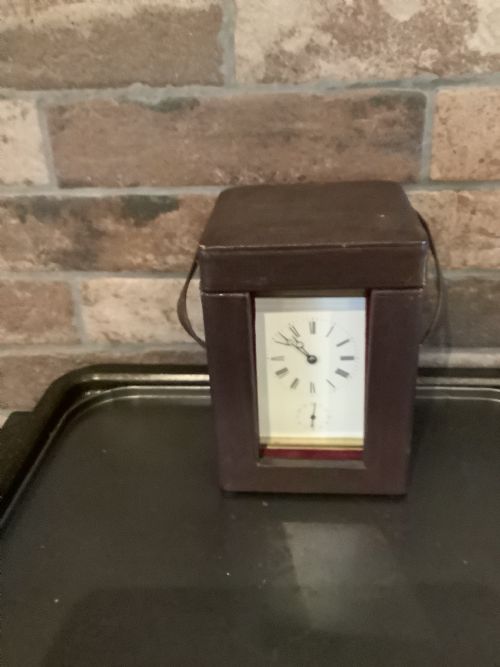
A travelling clock leather case encloses portable timepieces, most commonly carriage clocks and small desk clocks from the nineteenth and early twentieth centuries. These housings range from fitted antique leather outer cases to original boxes intended to shield delicate mechanisms during transit.
The pieces appearing on this page span the Victorian, Edwardian, and Art Deco periods, with French workshops providing many of the brass and gilt carriage clock examples. Buyers encounter miniature boudoir pieces alongside larger striking models, each paired with protective leather housing.
Materials and construction
Clockmakers utilised brass, gilt brass, and sterling silver for the internal frames and dials, incorporating glass panels to reveal the escapement and gear trains. Enamel dials and engraved masks provide decorative detail to the clock faces.
Protective outer housings were constructed from moulded and stitched leather, often lined with velvet or silk to cushion the brass and glass timepiece within during journeys.
Materials in these listings range from brass and chrome-plated metal to sterling silver and floral enamelled surfaces.
Judging quality and preservation
Quality rests in the crispness of the hand-engraving on the brass case, the complexity of the movement such as grand sonnerie striking or alarm functions, and the survival of the original leather travelling case. Maker signatures from established Paris or London makers elevate the standing of a piece.
Preservation of the original leather skin, intact bevelled glass panels, and retention of the winding key distinguish superior examples from those with replaced components or heavily worn outer protection.
Henri Jacot·Harrods of London·Hunt and Roskell·Alfred Hollinge
The Travelling Clock Leather Case Glossary
- Carriage clock
- A portable spring-driven timepiece designed for travellers, featuring a carrying handle on top and glass panels.
- Gorge case
- A stepped rectangular brass case style popular in nineteenth-century French carriage clocks.
- Grand sonnerie
- A complication movement that strikes the hours and quarters on passing quarters as well as the full hour.
- Escapement
- The internal mechanism that controls the release of power to maintain the regular movement of the clock hands.
Travelling Clock Leather Case: Frequently Asked Questions
What is a travelling clock leather case?
A travelling clock leather case is a fitted protective outer covering made to house a portable clock, such as a brass carriage clock, during transit.
These housings preserve the delicate glass panels and metal finishes of nineteenth and early twentieth-century timepieces.
How do I wind a vintage carriage clock?
Wind the mainspring using the matching key inserted into the winding arbours on the backplate, turning gently until resistance is felt.
Care must be taken not to over-wind the movement, particularly on delicate miniature or repeating mechanisms.
Are these clocks suitable for daily use?
These mechanical clocks can run reliably when properly serviced, though their antique escapements require gentle handling and careful placement.
Many owners wind them periodically rather than running them continuously as primary household timepieces.
How can I tell the period of a clock?
Stylistic indicators such as heavy Victorian brass casting, Edwardian silver decoration, or sleek Art Deco chrome-plated metal date the piece.
Maker signatures and movement serial numbers provide further documentation of the production era.