
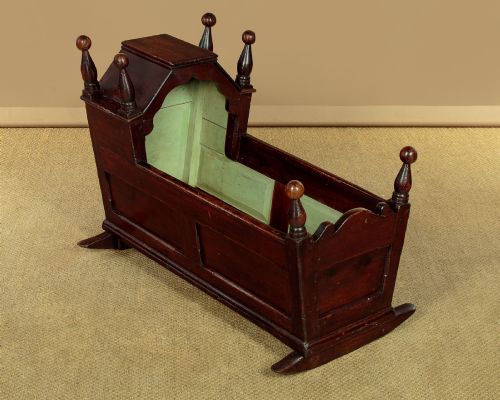


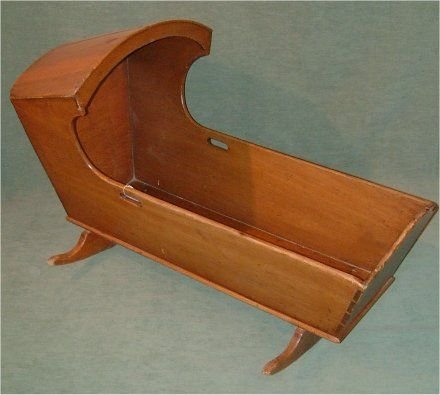
Traditional Wooden Baby Cradle
A traditional wooden baby cradle offers centuries of domestic history, rendered in sturdy oak, pine or mahogany for gentle rocking.
Traditional Wooden Baby Cradle
When you search for a traditional wooden baby cradle, you encounter low-slung sleeping vessels built for infants and mounted on curved rockers or fixed stands. The selections span from seventeenth-century panels to nineteenth-century country workshops, showing how domestic furniture evolved across generations.
You are most likely to meet sturdy oak or pine examples on this page, often featuring panelled construction or painted finishes. Many retain their original rocking mechanisms, designed to soothe an infant with a gentle push of the foot or hand.
The forms range from simple rural pine boxes to elaborate mahogany and upholstered cribs from the Victorian era. Some incorporate hoods or canopies to shield the sleeping child from drafts in older homes.
How they were made
Joiners built these pieces using solid timbers like oak, pine, and mahogany, often employing traditional frame-and-panel construction to accommodate the natural movement of wood over time. Metal fittings or iron brackets occasionally reinforce the joints, particularly on pieces subjected to frequent motion.
Surface treatments vary from polished hardwood to layers of historic paint, such as the blue finishes found on Welsh pine variants. Upholstery appears on later Victorian iterations, adding padded interior linings for comfort.
Surviving examples demonstrate how domestic furniture adapted from functional rural utility to styled Victorian interiors.
What varies in quality
The distinction between standard domestic wares and finer pieces rests on timber selection and joinery detail. Early oak panels show careful beveling and hand-planed surfaces, whereas simpler pine items prioritize utility over ornament.
Survival of original elements, such as unaltered rocker feet, early paint finishes, and original iron hardware, elevates the integrity of a piece. Later alterations to the structure or stripped surfaces alter the historical character.
The Traditional Wooden Baby Cradle Glossary
- Rockers
- Curved wooden rails attached to the base of a cradle to allow smooth back-and-forth movement. These are essential for the primary function of soothing a child.
- Panelled
- Construction method where a fitted wooden panel floats within a grooved frame to prevent splitting as humidity changes. This technique defines seventeenth-century oak examples.
- Hood
- A protective wooden canopy or cover built over the head end of a cradle. It sheltered infants from cold air in draughty rooms.
- William and Mary
- A stylistic period spanning the late seventeenth and early turn of the century, marked by sturdy proportions and restrained ornamentation. Pieces from this era often utilise rich oak.
Traditional Wooden Baby Cradle: Frequently Asked Questions
How do I date an old wooden cradle?
Dating relies on examining the tool marks, timber species, and construction methods used by the maker. Seventeenth-century examples typically feature hand-rived oak panels, while nineteenth-century pieces often show machine-sawn pine or mahogany.
Hardware and surface finishes also provide clues, as hand-forged iron nails and original historic paint layers differ significantly from later Victorian manufacturing techniques.
Were these cradles used for everyday sleeping?
Families kept these cradles beside parent beds for night-time tending and throughout the day for supervised naps. Their compact footprints allowed them to sit close to hearths for warmth.
As domestic spaces evolved, the function shifted from practical nursery furniture to treasured heirloom items displayed within modern homes.
What is the difference between oak and pine cradles?
Oak cradles tend to originate from earlier centuries, offering heavy, durable construction with intricate panel work. They reflect the high status of woodworkers in earlier domestic settings.
Pine versions frequently date to the nineteenth century, often displaying painted surfaces or simpler rustic country forms intended for everyday rural households.