

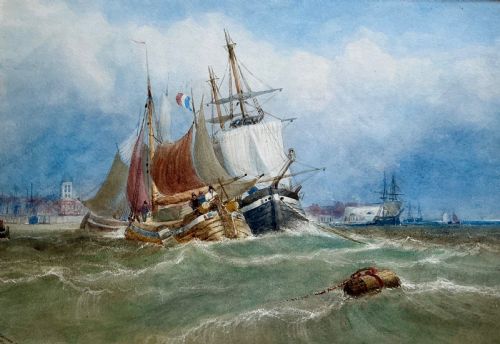


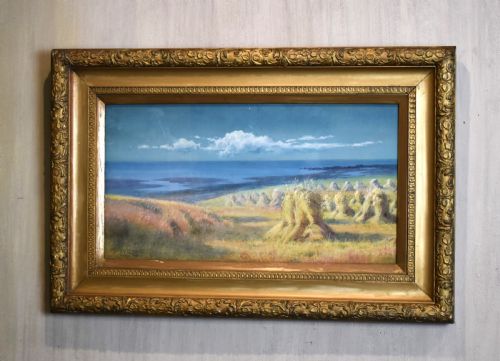


Traditional Seascape Watercolour
A traditional seascape watercolour captures maritime life and coastal views on paper, prized by collectors for bringing historical atmosphere directly into a room.
Traditional Seascape Watercolour
When you search for a traditional seascape watercolour, you encounter maritime and coastal subjects executed on paper across the nineteenth and twentieth centuries. These paintings record harbour scenes, sailing vessels, and coastal cliffs from specific locations in Britain, Ireland, and beyond.
The versions most frequently met on this page include nineteenth-century and Victorian maritime depictions, alongside early twentieth-century harbour and beach views. Works span styles such as Victorian realism and traditional marine art, framed in wood, gilt wood, or ebonised glass settings.
How they were made
These pieces utilise watercolour pigment applied to paper supports, often framed beneath protective glass within wooden, gilt wood, or hand-enamelled polychrome surrounds. Some examples incorporate gold leaf details to highlight points within the composition.
Artists worked en plein air or in studios using water-soluble pigments to build transparent washes and opaque details, capturing the changing light of coastal environments.
Several watercolours journeyed across the sea inside ebonised and hand-enamelled frames to watch clipper ships and fishing boats from parlour walls.
What varies in quality
Quality rests in the precision of the brushwork and the artist's command of light and atmospheric conditions across the paper surface. Stronger examples display confident handling of water, sky, and vessel rigging.
The integrity and period appropriateness of the framing also affect the overall standard, with hand-enamelled polychrome or gilt wood frames elevating the presentation of the painting.
William Banks Fortescue·Henry Barlow Carter·John McDougal·Ernest F Hill·Peter Ghent·James Aitken·George Marks·Joseph West
The Traditional Seascape Watercolour Glossary
- Watercolour pigment
- Finely ground colour particles suspended in a water-soluble binder, applied to paper. This medium allows for luminous washes that simulate the transparency of sea and sky.
- Ebonised frame
- Wood treated to imitate ebony wood, producing a dark, polished finish. This framing style provides a stark contrast that makes the lighter tones of the watercolour stand out.
- Gilt wood
- Wood coated with a thin layer of gold leaf or metallic gilt. It adds warmth and decorative weight to the presentation of a maritime painting.
- Marine art
- Artistic representation of ships, boats, and coastal or open sea views. It forms the primary subject matter for traditional coastal watercolours.
- Polychrome frame
- A decorative framing element adorned in multiple colours. Hand-enamelled versions introduce intricate surface patterns around the artwork.
Traditional Seascape Watercolour: Frequently Asked Questions
How should I frame an antique watercolour?
Antique watercolours require framing under glass with acid-free mounts to protect the paper from humidity and ultraviolet light.
Traditional wood, gilt, or ebonised frames suit these pieces best, preserving their historical character while offering necessary physical protection.
Where were most of these scenes painted?
The subjects typically depict British and Irish coastal locations, harbours, and international maritime routes.
Specific places like St Ives, Scarborough, and Beer appear frequently in the titles, alongside broader coastal and shipping views.
How do I identify a Victorian maritime painting?
Victorian marine art often exhibits detailed rigging on sailing vessels combined with realistic coastal atmospheres and specific nineteenth-century naming conventions.
Signatures, framing materials, and paper types further help establish the period of execution.
Can I hang watercolours in direct sunlight?
Direct sunlight causes watercolour pigments to fade and damages the paper fibres over time.
Position these works on interior walls away from windows to maintain the vibrancy of the original washes.