

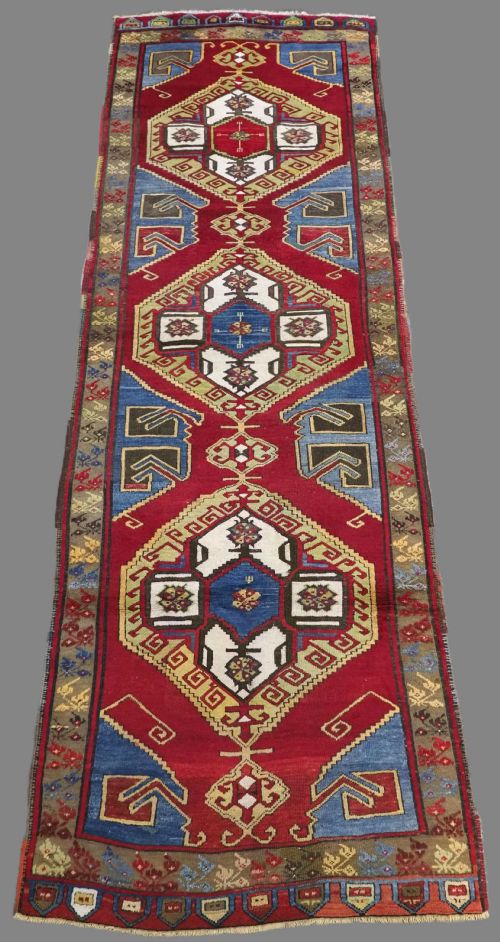


Traditional Konya Rug
A traditional konya rug brings the genuine warmth and geometric weight of Central Anatolia into a room.
Traditional Konya Rug
A traditional konya rug comes from Central Anatolia, taking various forms from long runners and prayer rugs to large village carpets and flatweave kilims. These pieces span the nineteenth century and the early decades of the twentieth century, reflecting the rich weaving heritage of Turkish regions such as Karapinar, Malatya, Reyhanli, and Sivrihisar.
Buyers frequently encounter village prayer rugs and half kilim kelim runners alongside embroidered cicim panels and yatak rugs. Each object type carries distinct regional motifs and structures, whether functioning as a floor covering, a wall hanging, or a traditional sleeping mat.
What varies in quality
The standard of a traditional konya rug depends on the precision of its tribal motifs and the clarity of its classic design. Tighter weaves and well-preserved structures separate finer examples from those with extensive wear.
Colour retention and the integrity of the wool pile significantly influence the overall character of each piece. Regional attribution, such as work originating from specific villages like Kavak or Sivrihisar, also shapes the interest of individual rugs.
Traditional Konya Rug Retail Price Guide 2026
Typical asking prices for traditional konya rug among the pieces listed under this phrase on Sellingantiques today, from the lower quarter to the upper quarter. They describe what is for sale here now, not the wider market.
Listings feature pieces spanning the 1850s to the 1910s, utilising wool and cotton materials in pile and flatweave formats from Central Anatolia.
The Traditional Konya Rug Glossary
- Kilim
- A flatweave rug produced without a pile by tightly interweaving warp and weft strands. These textiles are typically lighter and feature sharp geometric patterns.
- Prayer rug
- A small rug designed with a mihrab or niche motif that indicates the direction of prayer. These pieces were traditionally used for daily devotions in village settings.
- Yatak
- A traditional sleeping rug featuring a deeper pile and softer handle. These are designed for warmth and comfort.
- Cicim
- A decorative embroidery technique applied to a woven foundation to create raised patterns. This method adds tactile relief and surface texture to panels and wall hangings.
- Runner
- A long, narrow carpet format suited for hallways and corridors. They adapt traditional central Anatolian designs to linear proportions.
Traditional Konya Rug: Frequently Asked Questions
Where do traditional konya rugs come from?
These rugs originate from the Konya region in Central Anatolia, encompassing surrounding districts like Karapinar and Sivrihisar. Local village weavers produced them using regional methods passed down through generations.
The materials and designs reflect the specific cultural traditions of the Anatolian plateau, connecting each textile to its geographic source.
How do I use a prayer rug at home?
Prayer rugs function well as small accent pieces, wall hangings, or bedside mats due to their compact dimensions. Their distinct architectural niches create a strong visual focal point in a room.
Placing them on low-traffic floors or mounting them on walls protects the pile while displaying the design clearly.
What is the difference between a rug and a kilim?
Rugs possess a knotted wool pile that provides a plush surface underfoot. Kilims are flatwoven without a pile, resulting in a lighter and thinner textile.
Both forms utilise wool and cotton materials, but their underlying construction creates entirely different textures and weights.
How do I date a nineteenth-century textile?
Dating relies on stylistic indicators, structural evidence, and dye characteristics recorded in the piece. Nineteenth-century examples often display specific village motifs and hand-spun materials typical of that era.
Comparing regional variations helps narrow the production period between the 1850s and the early 1900s.
Are runners suitable for hallways?
Runners provide a long, narrow format specifically proportioned for corridors and passage spaces. Their construction handles regular foot traffic while introducing traditional patterns to transitional areas.
Using an appropriate underlay keeps the flatweave or pile runner secure on the floor.