
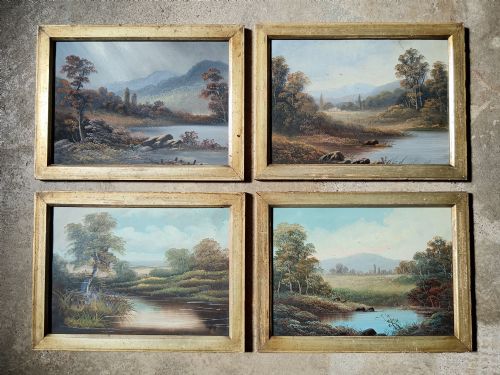


Traditional Gouache Artwork
Traditional gouache artwork brings opaque pigment and delicate detail to paper and silk across the nineteenth and twentieth centuries.
Traditional Gouache Artwork
Traditional gouache artwork encompasses painted scenes executed on paper, silk, and card from periods spanning the nineteenth century through the mid twentieth century. Buyers seeking traditional gouache artwork encounter Indian miniatures, Chinese export paintings on silk, and European landscape and architectural views.
The selections on this page range from Victorian and Edwardian British works to Indian School portraits and Qing Dynasty export pieces. Forms vary from framed paintings and wall art to intimate miniature watercolours and multi-media ink drawings.
How traditional gouache artwork was made
Artists deployed heavy opaque gouache pigments alongside watercolours, inks, and oil paint to build rich surfaces on delicate supports. Silk and prepared paper served as the foundational grounds for intricate brushwork.
Many surviving examples utilise wood framing and glass to protect the pigment layers, preserving the fine details of miniatures and larger landscape compositions alike.
Listings feature works from the 19th century through 1960, utilising gouache, silk, paper, ink, and oil paint.
What varies in quality in traditional gouache artwork
The integrity of the paper or silk ground and the preservation of the opaque pigment layers determine the overall condition and visual impact of the piece.
AJ Thornton
The Traditional Gouache Artwork Glossary
- Gouache
- An opaque water-based paint consisting of pigment, water, and a binding agent such as gum arabic. It dries to a smooth, matte finish that allows for dense colour application.
- Miniature painting
- A small-scale, highly detailed artwork often produced on paper, card, or ivory. These works demand extreme precision and fine brushes.
- Chinese Export
- Art objects manufactured in China specifically for Western markets during the eighteenth, nineteenth, and early twentieth centuries. Silk and paper paintings frequently adopted styles suited to European tastes.
- Indian School
- A term denoting regional painting traditions within India, encompassing court portraits, miniature scenes, and historical subjects. These works often employ vibrant pigments on paper.
Traditional Gouache Artwork: Frequently Asked Questions
What is traditional gouache artwork?
Traditional gouache artwork comprises paintings created with opaque water-based pigments on supports such as paper and silk. These works include European landscapes, Chinese export paintings, and Indian miniatures.
The medium allows for both broad washes of colour and minute, precise brushwork that retains its intensity over centuries.
How do I care for gouache on paper?
Gouache works on paper or silk require protection from direct sunlight to prevent the pigments from fading over time. Glazing with glass helps shield the delicate paint surface from atmospheric dust and moisture.
Displaying pieces in stable indoor environments away from excessive humidity preserves both the paper ground and the paint layer.
How do I identify a miniature painting?
Miniature paintings are characterised by their small physical scale and exceptional density of detail. They often depict portraits, court scenes, or natural history subjects executed with fine-tipped brushes.
Examining the work under magnification reveals the meticulous layering of pigment and ink characteristic of traditional miniature traditions.
What periods do these paintings date from?
The pieces available span from the late nineteenth century through the early and mid twentieth century. Examples include Victorian, Edwardian, and Qing Dynasty productions.
Each period reflects distinct regional aesthetics, from Persian and Indian miniature styles to European watercolour and ink techniques.