
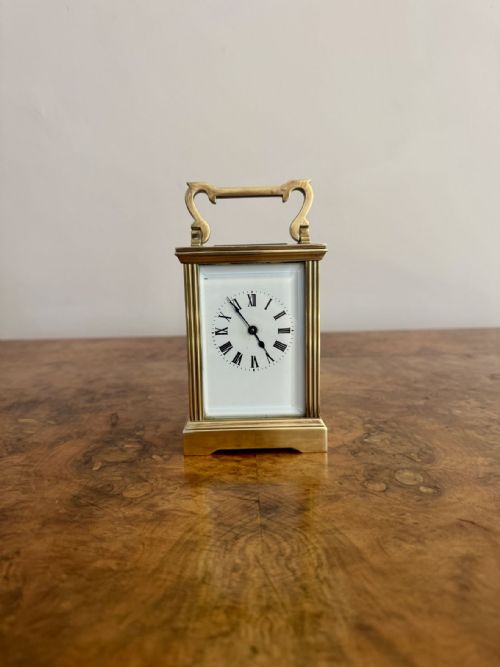


Traditional French Timepiece
A traditional french timepiece brings mechanical precision and nineteenth-century craftsmanship into a room.
Traditional French Timepiece
When you search for a traditional french timepiece, you are looking at portable carriage clocks and stationary mantel clocks dating from the late nineteenth century into the twentieth century. The selection leans heavily towards brass carriage clocks housed in glass panels, alongside marble, slate, and gilt brass mantel pieces.
The objects originate from French workshops and Victorian or Edwardian importers, reflecting styles such as the French Second Empire and French Empire. You will frequently encounter brass carriage clocks with eight-day movements and repeating mechanisms alongside four-glass mantel clocks.
How they were made
Makers utilised heavy brass, gilt brass, and ormolu to construct robust cases, often integrating bevelled glass panels to expose the internal mechanics. Heavier mantel variants employed black slate and marble for structural solidity.
Enamel dials received delicate hand-painted numerals, while the movements themselves relied on precision brass gear trains, escapements, and occasionally moon phase complications housed within gorge cases.
Listings span periods from eighteen-sixty to nineteen-sixty, using brass, marble, slate, and glass.
What varies in quality
Quality rests in the weight of the metal casing, the clarity and thickness of the bevelled glass, and the crispness of the enamel dial. Superior pieces exhibit refined finishing on the brass work and complex interior mechanisms such as striking trains and repeater functions.
The distinction between standard production and finer examples lies in the heft of the gilt brass, the presence of signed maker movements, and the unblemished state of the painted enamel dial faces.
Tiffany·L Epee·Malecot of Paris·Penlington & Batty
The Traditional French Timepiece Glossary
- Carriage clock
- A small, portable spring-driven clock designed for travellers, typically featuring a brass case with glass sides and a handle on top. They originated in France during the nineteenth century.
- Gorge case
- A specific rectangular brass carriage case style with stepped mouldings at the top and base. It represents a standard housing for better quality French movements.
- Repeating carriage clock
- A clock that strikes the last hour and quarter-hour on demand when a button or pendant on the case is depressed. This mechanical complication required intricate internal gong systems.
- Four glass mantel clock
- A freestanding clock enclosed on all four sides by glass panels, allowing a clear view of the pendulum and movement. They appeared in nineteenth-century French drawing rooms.
- Ormolu
- Finely ground high-carat gold-mercury amalgam applied to a bronze object. It gives a rich golden surface sheen to nineteenth-century metalwork.
Traditional French Timepiece: Frequently Asked Questions
How do I wind a carriage clock?
Use the designated key on the underside or back of the movement to wind the springs gently until resistance is felt. Avoid over-winding to protect the internal tension components.
Ensure the clock is placed on a level surface before setting the time by moving the minute hand forward carefully.
What is an eight day movement?
An eight day movement refers to a mechanical clock mechanism that runs for approximately eight days on a single wind. This reduced the frequency of winding for nineteenth-century households.
Most traditional French carriage clocks utilise this spring-driven system for domestic convenience.
How do I identify a Victorian carriage clock?
Look for heavy brass framing, bevelled glass panels, and white enamel dials typical of late nineteenth-century British import standards. Maker signatures or retailer stamps on the movement backplate also help establish the era.
Stylistic cues often align with Victorian interpretations of French brass work from the eighteen-eighties and nineties.
Where should I place a slate mantel clock?
Position your marble or slate clock on a sturdy, level mantelpiece or sideboard capable of supporting substantial stone weight. Keep the clock away from direct heat sources and damp environments.
Stability is essential for the pendulum and escapement to maintain an even beat.