
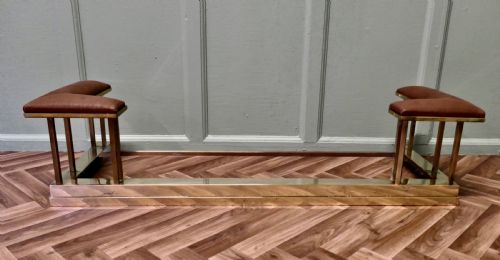
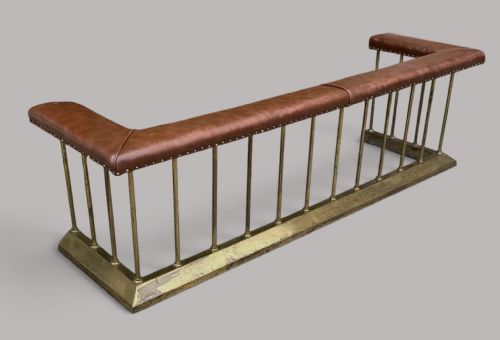
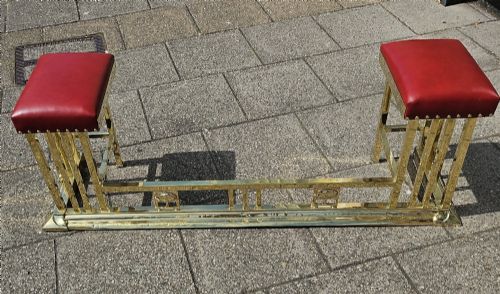
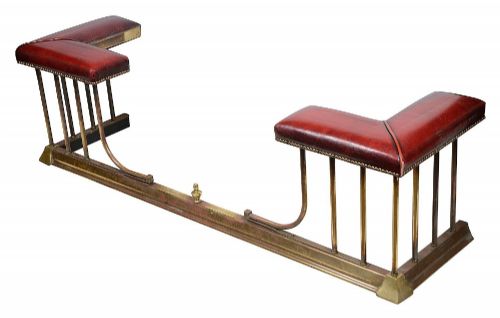


Traditional Fireplace Club Seat
These traditional fireplace club seat pieces are robust hearth-side fenders and armchairs designed to bring warmth and solid comfort into a room.
Traditional Fireplace Club Seat
These items originate predominantly from the nineteenth and early twentieth centuries, spanning the Victorian and Edwardian eras through to Art Deco designs. They transform an open hearth into an accessible social hub by combining a protective metal barrier with padded seating.
Materials and construction
Makers constructed these pieces using a solid structural core of brass, steel, iron, or oak, often incorporating detailed cast or polished metalwork. These metals provided durability and safety close to open flames, whilst mahogany appeared in specific framing and seating elements.
For the seating components, craftsmen utilised high-grade leather, velvet, and various traditional fabrics. The upholstery was frequently finished in tan or green tones, sometimes featuring Chesterfield-style buttoning for added comfort and support.
Current listings feature materials spanning polished brass, cast steel, wrought iron, oak, and mahogany, paired with leather and fabric upholstery.
Distinctions in quality
Quality rests heavily on the substance of the metal frame and the integrity of the joinery, distinguishing heavy cast brass and steel from lighter or purely decorative alternatives. Substantial weight and thick gauge metals indicate superior hearth furniture made to withstand regular use.
The finish of the leather upholstery and the precision of any carved woodwork also divide the standard range from exceptional examples. Finer pieces display mature, well-fitted hides and careful polishing that complement the underlying metal framework.
The Traditional Fireplace Club Seat Glossary
- Club Fender
- A low metal frame surrounding a fireplace, fitted with upholstered top rails that serve as seats. This design allows people to sit closely to the fire while remaining protected from sparks.
- Chesterfield Seat
- An upholstered seat style characterised by deep button tufting and padded armrests. It provides a cushioned surface on top of the rigid metal fender structure.
- Sheraton Revival
- A late nineteenth and early twentieth-century design style drawing on neoclassical eighteenth-century motifs. It appears in refined woodwork and traditional armchair frames.
- Art Deco
- A design movement prominent in the early twentieth century featuring stylised geometric forms. In this context, it influences the linear metalwork and heavy iron or brass structures of later fenders.
Traditional Fireplace Club Seat: Frequently Asked Questions
What is a club fender?
A club fender is a low metal structure placed around the base of a fireplace, featuring padded upholstered seats on top. It allows family and guests to sit directly by the hearth while maintaining a safe distance from the fire.
Originally popularised in large country houses, these pieces turned the fireplace into a warm seating area. They combine a sturdy brass or steel barrier with comfortable leather cushioning.
How do I style a club fender?
Position the fender snugly against the fireplace hearth, ensuring the metal surround frames the opening correctly. It pairs well with traditional fire irons, coal buckets, and hearth accessories made from matching brass or iron.
Keep the surrounding floor space clear to highlight the architecture of the metalwork and the colour of the leather seat. The piece naturally draws the eye, serving as a functional centrepiece for the room.
Are these pieces safe for daily use?
These items are constructed from heavy-duty metals and durable frame materials designed to withstand regular domestic environments. The metal barriers protect against stray embers while providing stable seating.
Inspect the internal frame and the stability of the bolted joints periodically to ensure secure placement. The leather or fabric upholstery is built for daily interaction, provided it receives appropriate care and conditioning.
How do I date a brass fender?
Dating relies on examining the specific manufacturing techniques, metal alloys, and style cues present in the frame. Victorian examples often show heavier cast brass work, whereas Edwardian pieces display polished finishes and refined proportions.
Look for fastening methods, patina on the brass, and the style of the leather upholstery to narrow down the era. Art Deco variations introduce heavier ironwork and distinct geometric lines characteristic of the 1920s and 1930s.