
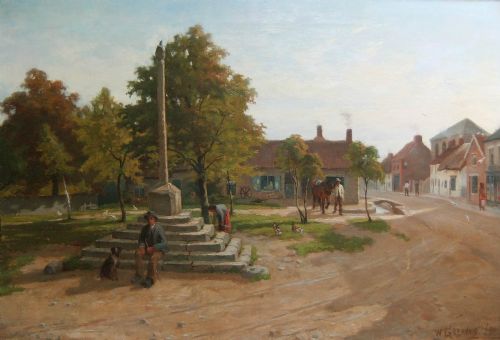


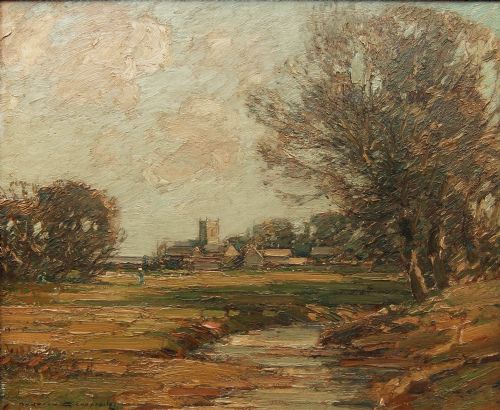


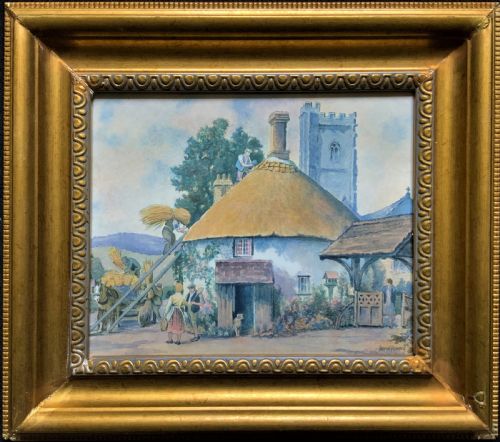


Traditional English Village Picture
Traditional English village picture works bring rural life into a room through oil paint and watercolour.
Traditional English Village Picture
A traditional english village picture captures rural settlements, country lanes, and local taverns across England. These works record historic locations from Yorkshire to Devon, preserving scenes of village life.
The selections on this page span the nineteenth century, the Edwardian era, and the mid-twentieth century. Paintings appear in both oil on canvas and watercolour pigment on paper, housed within wood and gilt frames.
Materials and methods
Artists painted these subjects using oil paint on canvas or watercolour pigment on paper. Oils provide a rich, durable surface, while watercolours rely on fine washes to build light and atmosphere.
Finished works sit within wood frames, frequently enhanced with gilt details. The combination of pigment, paper or canvas, and traditional framing preserves these rural views.
Qualities of distinction
Quality rests in the precision of the brushwork and the artist's command of light across stone cottages and village streets. Strong compositions capture the specific atmosphere of a named location rather than a generic scene.
The handling of natural light and shadow distinguishes accomplished works from simpler decorative pieces. Condition of the pigment and the integrity of the original frame also shape the character of the work.
William Greaves·Fred Lawson·M. C. Hider·Louie Stanley Maurice Prince·John Edward Bale·David Woodlock·Kershaw Schofield·Walter Henry Sweet·David Heward·Stephanie Cooper·John Holland Snr
The Traditional English Village Picture Glossary
- Watercolour pigment
- A medium consisting of finely ground colour suspended in a water-soluble binder. It is applied in translucent washes on paper.
- Oil on canvas
- A painting technique using pigments bound in drying oil applied to a stretched cloth surface. This method allows for deep tones and textured brushstrokes.
- Gilt
- A thin layer of gold leaf applied to wood frames. It provides a bright border that separates the painting from the surrounding wall.
- Victorian Realism
- An art movement focusing on accurate depictions of everyday subjects. Works in this style record nineteenth-century rural life with direct observation.
Traditional English Village Picture: Frequently Asked Questions
What periods do these paintings cover?
The works date from the nineteenth century through the mid-twentieth century. Artists recorded village scenes across the Victorian, Edwardian, and later periods.
Changes in painting styles reflect the shifting tastes of each era, moving from detailed realism towards freer interpretations of the countryside.
How are these pictures framed?
Most pieces retain their wood frames, often accented with gilt finishes. These traditional surrounds complement the rural subject matter.
Original frames help protect the edges of the canvas or paper and provide historical context for the artwork.
Where do the locations come from?
Named places include Yorkshire, Devon, Norfolk, and Hampshire. Artists travelled across rural England to paint specific village streets and country inns.
Inscribed titles on the reverse or front of the work frequently identify the exact spot.
Are these works painted on canvas or paper?
Artists used both oil paint on canvas and watercolour pigment on paper. The medium often dictates the texture and overall scale of the piece.
Watercolours offer a lighter, translucent quality, whereas oils provide deeper colour saturation and visible brush texture.