
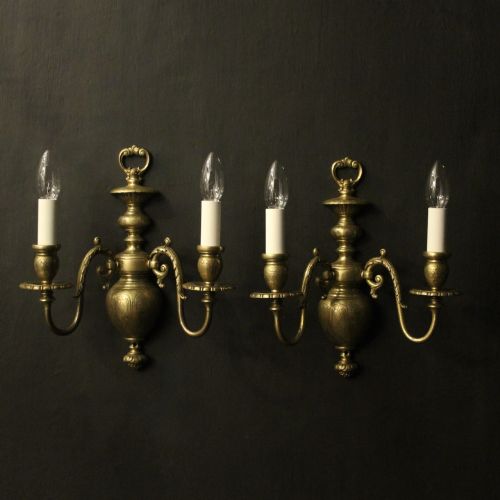
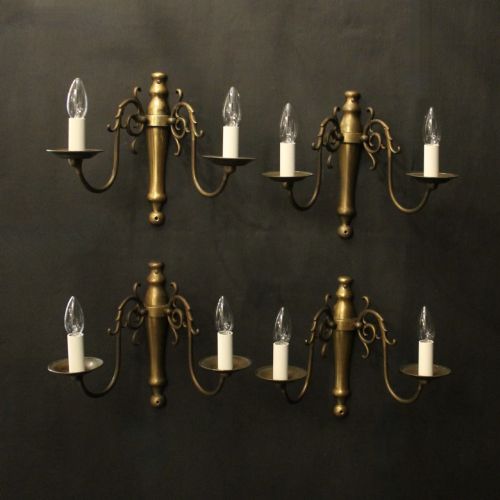
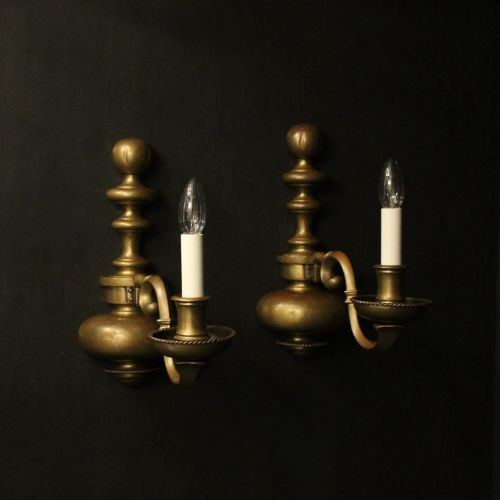
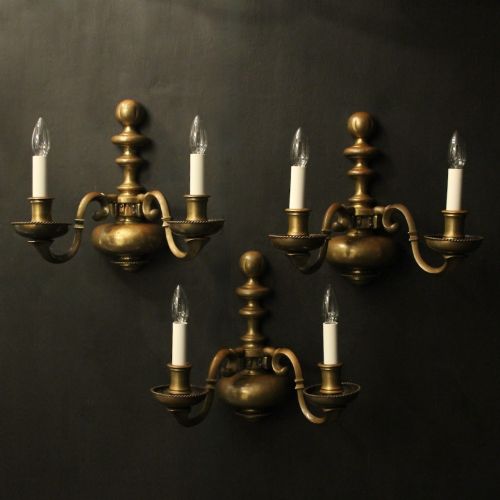


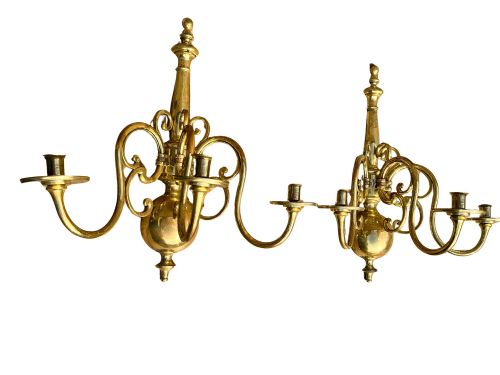


Traditional Brass Candle Sconce
A traditional brass candle sconce brings warmth and period character to a wall, illuminating rooms through the reflection of polished metal.
Traditional Brass Candle Sconce
When searching for a traditional brass candle sconce, buyers encounter wall lights, wall brackets, and candle holders spanning the eighteenth century through to the 1930s. These pieces include single and multi-branch fixtures, frequently found in pairs or larger sets.
The selection ranges from Georgian and Victorian examples to Edwardian and early twentieth-century designs, encompassing styles such as Adam Revival, Gothic Revival, French Rococo, and Neoclassical. Brass forms the primary metal, often combined with mahogany, oak, bronze, glass, and crystal elements.
English and French workshops dominate the origins, alongside pieces reflecting North Indian and Italian craftsmanship. Wall lights and wall sconces represent the most common wall-mounted formats available in this grouping.
How they were made
Metalworking techniques for these fixtures involved casting and turning brass and bronze components, which were then assembled into single or twin arm configurations. Patinated, gilded, and repolished surface treatments altered the finish of the brass according to the period taste.
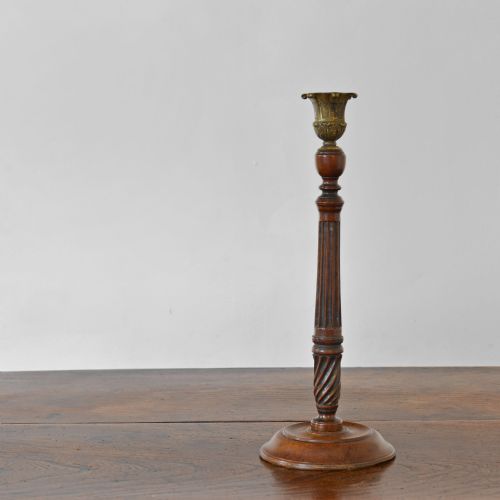
Woodworking craftsmanship appears in examples that pair turned mahogany and oak with brass sconces, utilising open barley twist columns and shaped wooden supports. Glass and crystal prisms or mirrored backs frequently accompanied the metal frames to enhance light reflection.
Several pairs feature mirrored backs designed to bounce flickering candlelight around dark Victorian rooms before the invention of the lightbulb.
What varies in quality
The standard of a traditional brass candle sconce rests in the crispness of its casting and the proportional harmony of its arms and backplate. Finer pieces display deliberate attention to detail in stylistic elements like neoclassical motifs or rococo curves.
The integration of secondary materials, such as figured mahogany, heavy bronze, or cut crystal, distinguishes standard utilitarian lighting from more ambitious decorative pieces. Original surface patination and the integrity of multi-arm assemblies further separate ordinary items from superior examples.
F. & C. Osler
The Traditional Brass Candle Sconce Glossary
- Sconce
- A wall-mounted lighting fixture designed to hold candles or electric bulbs. These pieces project outward from panels or brackets fixed directly to the wall surface.
- Adam Revival
- A neoclassical style drawing on eighteenth-century designs characterised by symmetry, delicate proportions, and classical motifs. Pieces in this style often feature urns, swags, and fluted columns.
- Gothic Revival
- An architectural and decorative style inspired by medieval forms, prevalent in nineteenth-century ecclesiastical and domestic metalwork. Sconces in this style utilise pointed arches, tracery, and robust proportions.
- Barley twist
- A woodworking technique producing a spiral column resembling twisted barley sugar. This turned form appears frequently on wooden candlestick shafts from the Edwardian era and the 1920s.
- Patination
- The natural surface change, ageing, and mellowing acquired by metal or wood over decades of exposure to air and handling. A patinated brass surface displays subtle shifts in colour and tone.
Traditional Brass Candle Sconce: Frequently Asked Questions
How do I install an antique brass wall sconce?
Most antique wall sconces were originally manufactured for candles and require careful adaptation if intended to hold electrical wiring. Professional electricians can safely channel wiring through existing structural cavities without compromising the original metalwork.
Surface-mounted brackets should be secured to wall studs or fitted with appropriate wall anchors to support the weight of solid brass and bronze assemblies.
Are these sconces meant for candles or electricity?
The pieces listed under this phrase originate from periods when candles provided the primary source of domestic illumination. Many retain their original drip pans and candle cups designed strictly for wax candles.
Some later twentieth-century variations or converted examples accommodate electrical fittings, so checking the individual socket or nozzle configuration is essential for determining the intended fuel source.
How do I clean polished brass without damage?
Maintaining brass surfaces requires simple dusting with a soft, dry cloth to prevent the accumulation of airborne particles. Abrasive cleaners and harsh chemical polishes strip away desirable historical patination and scratch the metal.
If cleaning is necessary for repolished or bright brass, use a mild, pH-neutral soap solution applied sparingly and dried immediately with a lint-free cloth.
What is the difference between a sconce and a candlestick?
A sconce specifically refers to a lighting fixture that is mounted directly onto a vertical surface such as a wall or a panel. These units project outward to illuminate surrounding spaces from a fixed elevation.
Candlesticks, by contrast, are freestanding portable objects with a base designed to rest flat upon horizontal surfaces like tables, mantelpieces, or sideboards.