




Three Sided Bookcase
A three sided bookcase solves the corner or wall dilemma by stacking shelves within three distinct faces of timber.
Three Sided Bookcase
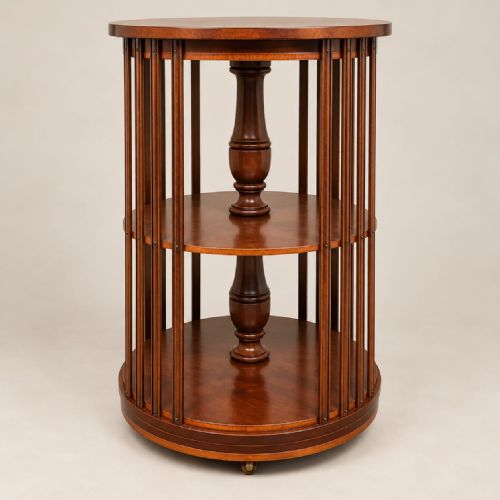
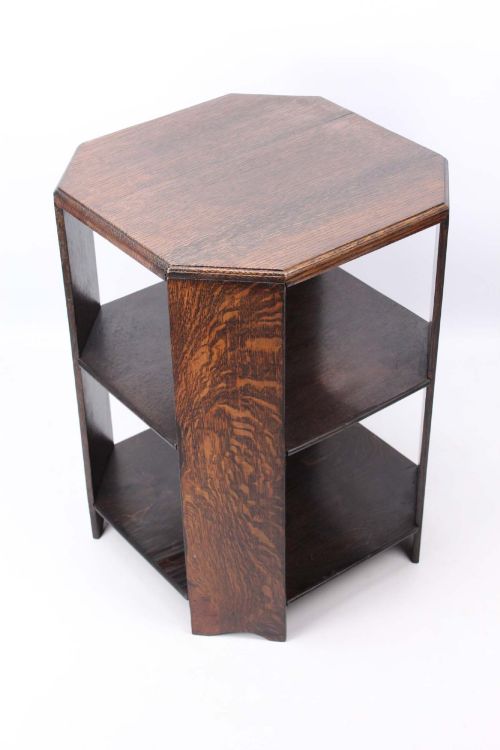
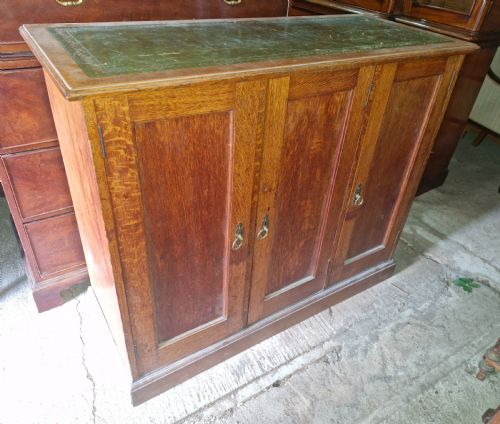
A three sided bookcase offers a practical footprint for tight corners or open room placement, drawing upon forms from the Georgian era through to the Art Deco period. Buyers seeking a three sided bookcase encounter revolving tables, tiers, and multi-sided cabinets built in woods such as mahogany, oak, and walnut.
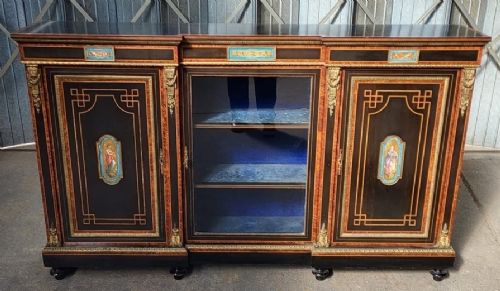
The selection ranges from Victorian breakfront bookcases to 1920s revolving book tables and 1830s rosewood whatnots. These items served libraries, parlours, and drawing rooms as accessible storage for volumes and display items.
How they were made
Cabinet makers utilised dense timbers including mahogany, walnut, rosewood, and oak, often selecting burr walnut veneers and marquetry for decorative surfaces. Joinery relies on traditional framing methods, sometimes incorporating brass galleries, glass panels, and ormolu mounts to accent the woodwork.
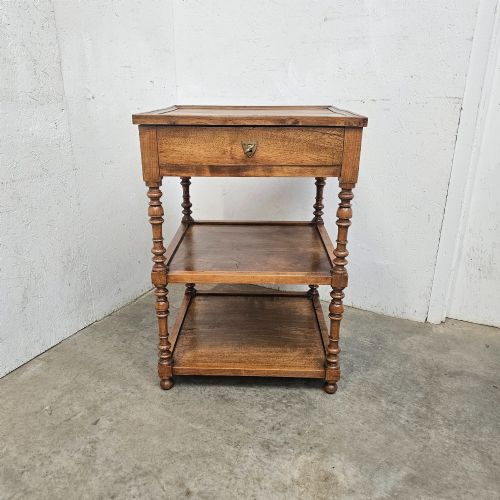
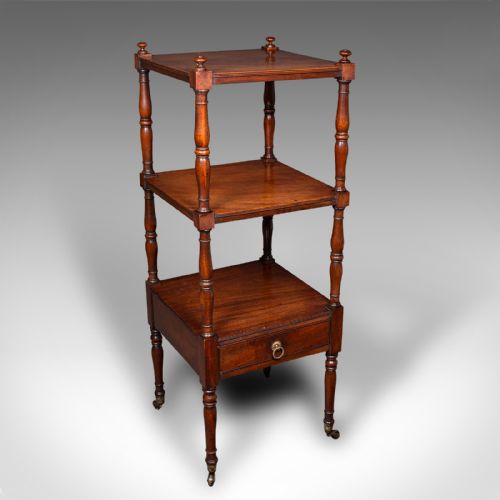
Revolving mechanisms employ central timber or metal pivots to allow smooth rotation, while etageres and whatnots feature turned or faceted legs supporting tiered platforms.
Three Sided Bookcase Retail Price Guide 2026
Typical asking prices for three sided bookcase among the pieces listed under this phrase on Sellingantiques today, from the lower quarter to the upper quarter. They describe what is for sale here now, not the wider market.
Listings span the Georgian, Regency, Victorian, Edwardian, and Art Deco periods, predominantly constructed in mahogany, walnut, and oak.
What varies in quality
Quality rests in the selection of timber veneers, the crispness of marquetry work, and the stability of the revolving or tiered construction. Pieces featuring solid brass galleries, fine ormolu mounts, and precise inlay demonstrate superior craftsmanship compared to simpler utilitarian cupboards.
The integration of the three-sided geometry requires precise woodworking so that corners and joints remain flush and durable through generations of use.
The Three Sided Bookcase Glossary
- Whatnot
- A moveable set of open shelves used for displaying ornaments and books, popular from the late Georgian period onwards. These structures typically feature three or four tiers supported by slender turned columns.
- Ormolu
- Gilded bronze ornamentation applied to furniture mounts, popular in Victorian and Regency cabinet making. It adds metallic contrast to dark woods such as ebonised timber and walnut.
- Breakfront
- A piece of furniture where the central section projects forward from the flanking wings. This architectural arrangement creates depth and visual weight in larger library cabinets.
- Marquetry
- The art of applying pieces of veneer to a structure to form decorative patterns and pictures. Makers utilised contrasting timbers to create complex geometric and floral designs on surfaces.
- Etagere
- A French style of piece consisting of a set of open shelves for displaying small objects. They appear in walnut and mahogany with turned or fluted upright supports.
Three Sided Bookcase: Frequently Asked Questions
Where should a three sided bookcase go?
These pieces suit corners, tight study spaces, or positions beside seating where rotational access keeps volumes close at hand. Their multi-sided geometry makes them versatile for rooms requiring compact shelving.
Position them away from direct heat sources to protect the mahogany, rosewood, and walnut veneers from drying out or splitting.
How do revolving book tables operate?
Revolving tables utilise an internal pivot mechanism hidden beneath the top surface, allowing the entire three-sided or circular carcass to turn smoothly on a heavy base. This enables access to books from a single seated position.
Keep the internal pivot mechanism lightly lubricated with appropriate oil to ensure the rotation remains silent and balanced.
What is the difference between an etagere and a whatnot?
An etagere is typically a French-influenced set of open tiers designed for decorative display, whereas a whatnot is a traditional English multi-tiered stand for books and ornaments. Both share open shelving supported by vertical posts.
Victorian and Georgian examples of both types utilise mahogany and walnut construction with turned leg supports.
How do I care for antique walnut and mahogany?
Maintain timber surfaces by dusting with a dry, soft cloth and applying traditional beeswax sparingly to nourish the grain. Avoid synthetic sprays that can damage older polished finishes.
Protect the brass galleries and ormolu mounts from moisture to prevent tarnishing and discolouration of the metalwork.