




Thatched Cottage Watercolour Painting
These thatched cottage watercolour painting works capture the enduring appeal of rural English life through delicate washes and traditional paper surfaces.
Thatched Cottage Watercolour Painting
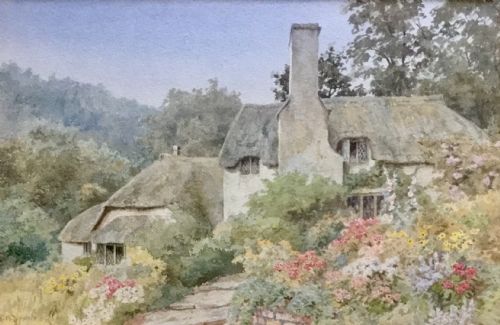
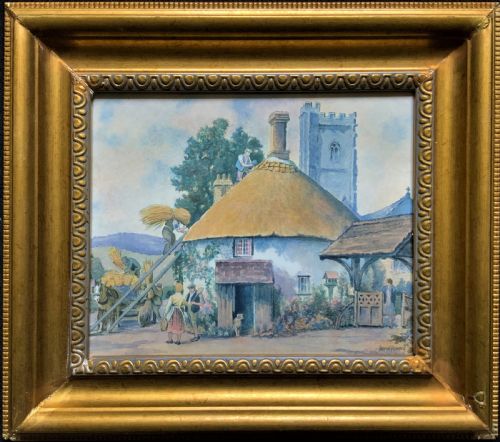
A thatched cottage watercolour painting depicts traditional rustic dwellings nestled within English rural, pastoral, and coastal landscapes. These works typically emerge from the nineteenth and early twentieth centuries, spanning periods from the Georgian era through the 1940s.
Buyers encounter framed wall art executed in styles such as Victorian Pastoral, Edwardian Pastoral, and English School realism. These pieces frequently feature cottage gardens, village scenes at dusk, and daily country life.
The selection ranges from intimate nineteenth-century sketches to larger works by established landscape artists working in counties like Devon, Somerset, and Warwickshire.
Materials and technique
Artists applied watercolour pigment and paint onto paper supports, often utilising transparent washes to build luminous skies and detailed architectural textures. Many surviving pieces retain their period wooden frames and protective glass glazing.
The execution relies on skilled brushwork to render the organic curves of straw thatch, rustic timber framing, and surrounding foliage. Pigments were layered carefully on paper to achieve depth and atmospheric light in rural genre scenes.
Several cottages share their canvas with domestic pets, rabbits, and livestock tending peacefully in quintessential English gardens.
Assessing quality and execution
Quality rests upon the artist's handling of light, shadow, and atmospheric perspective within the landscape. Finer examples display confident brushwork and precise architectural detail without losing the softness inherent in the watercolour medium.
The relationship between the cottage and its natural surroundings distinguishes superior compositions from standard topographical records. Well-preserved works maintain vibrant pigment tones on stable paper without excessive fading or discolouration.
John McDougal·Harry Sylvester Stannard·Robert Hollands Walker·Thomas James Lloyd·Joseph Kirkpatrick·Henry Sylvester Stannard·Arthur Claude Strachan·Walter Henry Sweet·Thomas Nicholson Tyndale·David Heward·Yeend King·Joseph Hughes Clayton·Alfred Leyman·Thomas Rowlandson·Peace Sykes·David Woodlock·Sidney Valentine Gardner·Stanley Herdman·Henry Charles Fox
The Thatched Cottage Watercolour Painting Glossary
- Watercolour pigment
- The finely ground colour substance mixed with a water-soluble binder used by artists on paper.
- Pastoral realis
- An artistic style focusing on realistic depictions of rural life, agricultural labour, and country cottages.
- Edwardian
- Pertaining to the period from 1901 to 1910, noted for pastoral and romantic countryside depictions.
- Gilt
- A thin layer of gold or gold-like material applied to wooden picture frames to enhance the presentation.
Thatched Cottage Watercolour Painting: Frequently Asked Questions
How do I date a watercolour?
Dating typically relies on artist active dates, stylistic cues, and framing materials recorded in the documentation. Comparing costume and architectural details also helps narrow the period.
Many pieces bear signatures or inscriptions identifying the specific English village and year of creation.
Where should I hang these paintings?
These works suit traditional living rooms, studies, or hallways where natural light can be controlled. Keeping them away from direct sunlight preserves the delicate pigments on paper.
Pairing them with period wooden furniture enhances their historic English country character.
Are these paintings original antiques?
The inventory comprises original works created during the nineteenth and early twentieth centuries. Each piece is a unique painting rather than a modern reproduction.
Signatures and period framing provide further evidence of their historical origin.
What framing is appropriate?
Many examples retain their original wood and gilt frames which complement the age of the watercolour. Retaining these historic frames preserves the authentic presentation of the artwork.
Glazing with glass protects the paper surface from environmental dust and moisture.