


Antique Agricultural Fine Art
These antique agricultural fine art pieces capture rural working life on canvas and paper, offering a rich connection to the historic countryside.
Antique Agricultural Fine Art
When you search for antique agricultural fine art, you encounter pastoral scenes rendered in oil paint and watercolour on paper, depicting shepherds, cattle, ploughmen, and harvest fields. These works date from the nineteenth century up through the nineteen-twenties, reflecting changing rural landscapes across Britain and Belgium.
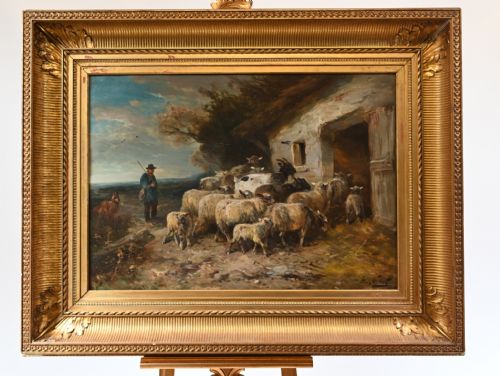
The objects on this page predominantly take the form of framed oil paintings and wall art executed in styles such as Victorian Pastoral, Edwardian Pastoral, and British Impressionism. Subjects range from solitary animals like a recumbant Hereford cow to labourers at work in hay fields and barns.
Makers and artists represented in these listings include named painters such as Henry Schouten, James William Booth, Arthur Winter Shaw, Joseph Kirkpatrick, Frederick William Jackson, John Percy Cooke, William Greaves, William Huggins, and George Cole. Their works preserve traditional farming methods and rural views before mechanisation altered the countryside permanently.
How they were made
Artists utilised oil paint on canvas as well as watercolour on paper to capture rural subjects, framing the finished works in gilded wood or simple wood frames. The handling of the medium varies from the precise realism of nineteenth-century depictions to the looser brushwork associated with British Impressionism.
Canvas supports provide a durable ground for thick applications of oil paint, allowing painters to build texture in fields, animals, and clothing. Watercolour on paper requires a lighter touch, capturing the delicate atmospheric conditions of rural settings.
Recumbent cows and resting calves make surprisingly frequent appearances, proving that historic farm animals were quite content to pose.
What varies in quality
The skill of the brushwork and the accuracy of animal and human anatomy distinguish the upper tier of these pastoral works from more ordinary depictions. Artists who successfully convey the weight of working horses, the texture of a fleece, or the quality of late afternoon light command greater attention.
The harmony of the palette and the preservation of the original canvas or paper surface also play a significant role. Works that retain their original gilded wood frames and show minimal restoration offer a more complete historic survival.
Henry Schouten·James William Booth·Arthur Winter Shaw·Joseph Kirkpatrick·Frederick William Jackson·John Percy Cooke·William Greaves·William Huggins·George Cole
The Antique Agricultural Fine Art Glossary
- Oil paint
- A slow-drying medium consisting of pigments suspended in a drying oil, typically linseed oil, which allows artists to build rich textures and deep tones on canvas.
- Watercolour on paper
- A painting method where the paints are made of pigments suspended in a water-soluble vehicle, applied to paper to create luminous and translucent effects.
- Gilded wood
- Wood that has been coated with a thin layer of gold leaf or gold paint, frequently used for traditional picture frames during the nineteenth and early twentieth centuries.
- Pastoral realism
- An artistic style focused on depicting rural life, agricultural workers, and farm animals with a high degree of fidelity to actual conditions.
- British Impressionism
- A late nineteenth and early twentieth-century movement characterised by visible brushstrokes, an emphasis on light, and everyday subject matter.
Antique Agricultural Fine Art: Frequently Asked Questions
What subjects appear in these paintings?
These works typically depict shepherds with flocks, ploughmen with horses and dogs, dairy cattle, and harvest scenes in fields or barns. The focus remains squarely on traditional rural labour and countryside animals.
Artists drew inspiration from the daily rhythms of farming life, recording specific locations and agricultural practices across Britain and continental Europe.
Which periods do these works cover?
The available pieces span the nineteenth century through to the nineteen-twenties, encompassing Victorian and Edwardian eras. This period captures the transition from traditional manual farming towards the dawn of the twentieth century.
Styles shift across these decades from detailed nineteenth-century realism toward the lighter, more atmospheric touch of British Impressionism.
How should I hang and light them?
Keep these framed oil and watercolour works away from direct sunlight and damp environments to protect the canvas, paper, and gilded wood frames. Gentle, directional picture lighting helps bring out the subtle tones in pastoral scenes without generating excessive heat.
Ensure that wall fixings are secure and appropriate for the weight of traditional wooden frames and stretched canvases.
How do I identify different artistic styles?
Nineteenth-century realism focuses on precise detail and accurate textures in animal coats, clothing, and landscape elements. Pastoral realism and Edwardian pastoral works soften these details slightly to emphasise the mood and light of the countryside.
British Impressionism relies on looser, more visible brushwork to capture fleeting atmospheric effects rather than photographic precision.