



Teak Campaign Drawers
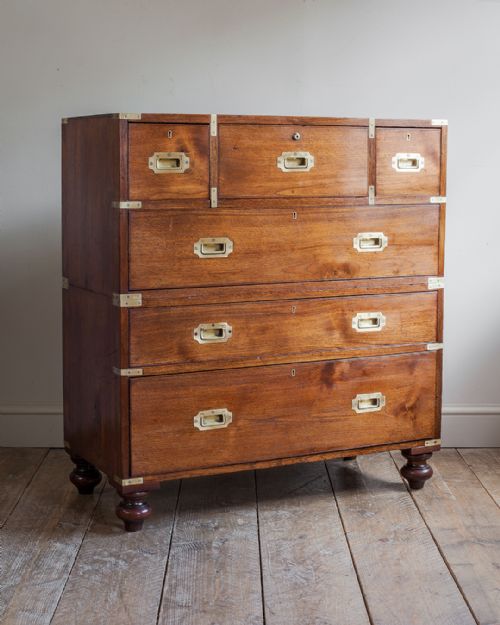
Teak campaign drawers are modular portable chests built for officers on the move, offering robust timber construction and clever brass fittings designed to survive long journeys.
Teak Campaign Drawers
Teak campaign drawers represent a distinct category of modular furniture constructed for military officers, civil servants and travellers requiring durable storage on the move. When searching for teak campaign drawers, buyers typically encounter sturdy two-part chests designed to separate easily for transport across land and sea during the nineteenth century.
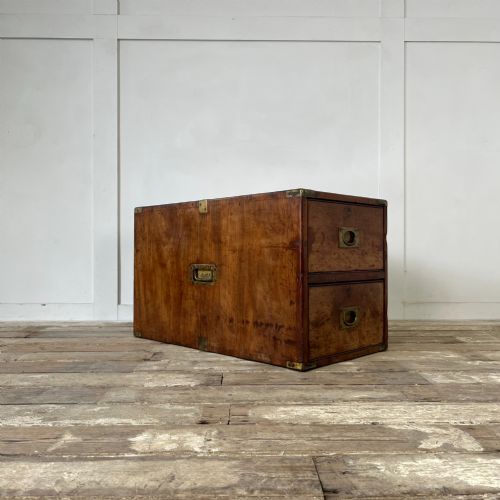
The dominant format on this page is the classic two-part chest of drawers, often reinforced with brass corners and strapped with brass banding to protect the edges during transit. Variations include pieces fitted with secretaire drawers that fold down to reveal a writing surface and small pigeonholes, alongside occasional desktop storage units and miniature chests.
Origins span British Victorian military contexts and Anglo-Indian colonial workshops, where dense tropical hardwoods suited humid climates and arduous journeys. These pieces combine utilitarian dismantling mechanisms with disciplined proportions, making them practical for modern interiors that value functional storage and clean lines.
Materials and construction methods
Makers relied primarily on dense, oil-rich teak timber, complemented occasionally by padouk and mahogany, chosen for resistance to warping and insect damage in tropical environments. The wood was typically worked into solid panels or sturdy drawer carcases designed to withstand frequent dismantling without losing structural integrity.
Brass corners, flush-fitting recessed drawer pulls and protective strapwork were screwed into the timber to shield vulnerable edges from heavy handling by handlers and baggage animals. Iron carrying handles were frequently fitted to the sides of each separate section to facilitate lifting during transit.
Joints inside the drawers and carcases relied on traditional cabinet-making techniques like dovetails, ensuring the rigid framework could endure the physical stress of constant relocation. Secondary linings often incorporated cedar or other softwoods, while writing compartments utilised fitted leather inserts.
Some chests retain tiny hidden drawers inside secretaire compartments, designed for officers to safeguard confidential letters and personal valuables.
Markers of superior craftsmanship
Quality in these chests is determined by the precision of the hardware integration, where flush brass fittings sit completely level with the timber surface rather than protruding or leaving excessive gaps. Superior examples demonstrate meticulous hand-cut dovetailing and uniform thickness in the brass strapping and corner plates.
The choice and grain matching of the teak timber heavily influence the overall aesthetic standing of a piece, with select items displaying rich, consistent dark tones and tight grain patterns. Furthermore, the complexity of the interior layout - such as fully fitted secretaire drawers with hidden compartments and turned bone pulls - separates standard utility models from elite officer commissions.
Army and Navy·Ross and Co Dublin
The Teak Campaign Drawers Glossary
- Campaign chest
- A portable chest of drawers built in two separate sections designed to be stacked and fastened together with side brackets for military transport. These units feature recessed hardware to prevent snagging.
- Secretaire chest
- A chest of drawers where the upper drawer pulls down on hinges to reveal a writing desk fitted with small pigeonholes and small drawers. This clever integration saved valuable tent space for officers.
- Two-part chest
- A modular cabinet design split horizontally into an upper and lower half, allowing two people to carry the heavy load independently. The sections lock together using brass side pins or hooks.
- Brass bound
- The method of reinforcing cabinet corners and edges with brass plates and strips to absorb the impacts of travel. This heavy metal reinforcement is a defining characteristic of military furniture.
- Padouk
- An exotic tropical hardwood with a reddish-brown hue, sometimes utilised alongside teak for campaign furniture due to its exceptional durability and resistance to moisture. It patinates deeply over time.
Teak Campaign Drawers: Frequently Asked Questions
Why are teak campaign drawers built in two parts?
The two-section design allowed officers to pack, load and transport their heavy belongings easily on ships, wagons and pack animals during long military deployments.
Each half was fitted with side carrying handles so a single person or two handlers could lift and maneuver the unit through tight spaces.
Are these chests made entirely of solid teak?
Most quality campaign chests utilise solid teak for the exterior carcase, drawer fronts and structural panels to withstand fluctuating humidity and rough handling.
Secondary timbers such as cedar or pine were sometimes used for interior drawer linings and drawer bases to reduce overall weight.
What is the purpose of the brass corners?
The heavy brass corners and straps protected the vulnerable wooden edges of the furniture from splintering when loaded onto carts or ships.
Embedding the brass flush with the wood surface ensured nothing would catch on ropes, tent canvas or uniforms during transit.