

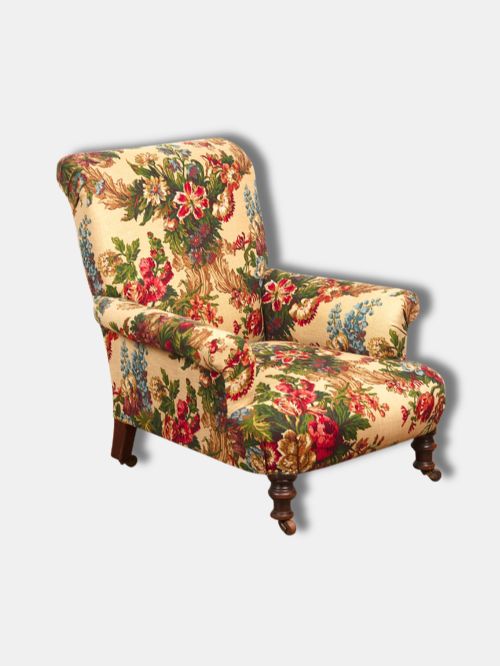
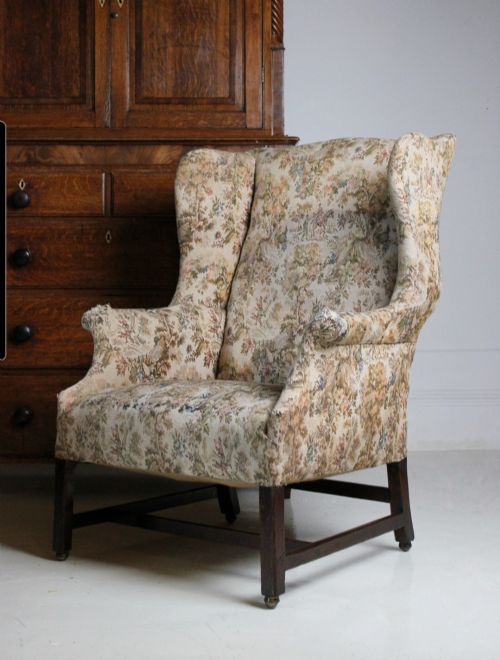
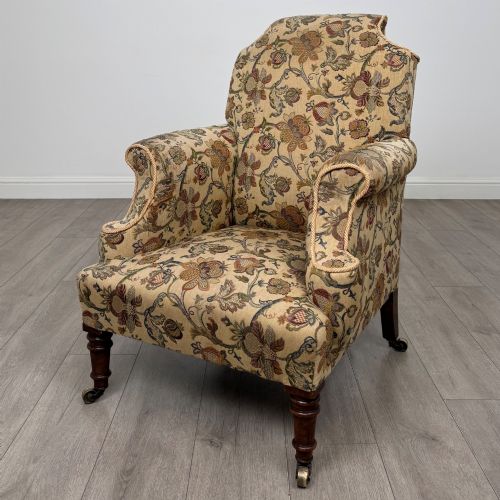


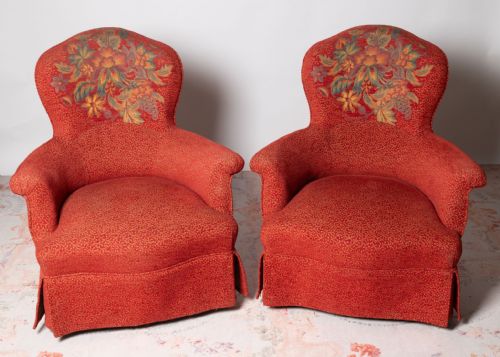
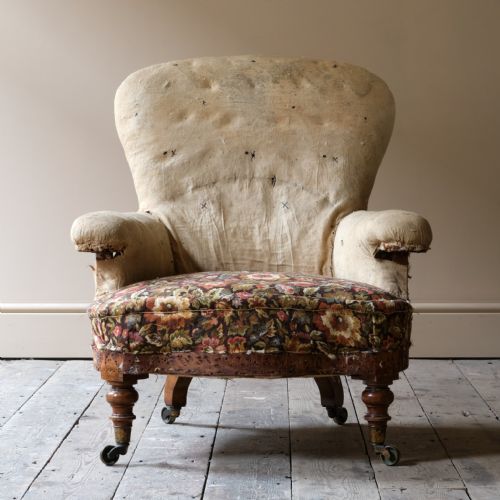


Tapestry Easy Chair
These tapestry easy chair examples offer deep sprung comfort wrapped in historical textiles, bringing proper Victorian and Edwardian character to a room.
Tapestry Easy Chair
When you search for a tapestry easy chair, you are looking at substantial upholstered seating designed for relaxation, typically featuring supportive wings, high backs, or low open arms. The pieces appearing here span the Victorian, Edwardian, and Art Deco periods, alongside later twentieth-century interpretations.
The most common form you will meet on this page is the nineteenth-century or early twentieth-century wingback armchair, upholstered in heavy woven fabric, needlepoint, or carpet panels. You will also encounter pairs of armchairs, slipper chairs, and occasional library seats rooted in Queen Anne, Georgian, and French design traditions.
Originating largely from British and French workshops, these chairs were built to anchor a drawing room, parlour, or study. Their enduring appeal lies in the combination of robust timber framing and decorative textile upholstery that tells a visual story.
How they were made
The structural framework relies on traditional timber framing using woods such as mahogany, walnut, rosewood, beech, and general timber or wood. Joinery was built to bear weight and movement over decades of daily use.
Upholstery techniques combined heavy interior webbing, coil springs, and stuffing layered beneath decorative exterior textiles like tapestry fabric, petit point, velvet, and kilim. Brass details often appeared in castors or nailhead trim securing the fabric edges.
Tapestry Easy Chair Retail Price Guide 2026
Typical asking prices for tapestry easy chair among the pieces listed under this phrase on Sellingantiques today, from the lower quarter to the upper quarter. They describe what is for sale here now, not the wider market.
Some Victorian chairs secretly harboured heavy horsehair stuffing that occasionally migrated outwards after a century of enthusiastic lounging.
What varies in quality
Quality in these chairs rests upon the integrity of the underlying timber frame and the precision of the original joinery. A heavier, rigid frame demonstrates superior craftsmanship compared to loose or modified structures.
The grade of the upholstery textile and the hand-stitched detail of the needlepoint or tapestry create a clear distinction across the range. Hand-stitched petit point and tightly woven historical tapestries elevate a piece far above standard commercial fabric replacements.
Howard and Sons·William Morris
The Tapestry Easy Chair Glossary
- Wingback
- An armchair with side panels, or wings, attached to the arms and framing the back to shield the sitter from drafts. This form became particularly popular during the Georgian and Victorian eras.
- Petit point
- A fine, highly detailed needlepoint stitch worked on single-thread canvas. It allows for intricate pictorial designs on upholstery.
- Fauteuil
- An open-armed wooden armchair with upholstered arm pads and a exposed frame. Originating in France, it is typically associated with formal salon seating.
- Bentwood
- Wood that has been heated and bent into curved shapes for furniture frames. This technique defined many Art Deco and modernist seating designs.
- Kilim
- A flatwoven carpet or rug textile used historically as durable upholstery material. It brings rich geometric patterns to traditional chair frames.
Tapestry Easy Chair: Frequently Asked Questions
Are these chairs comfortable for daily use?
Most of these pieces were built with deep coil springing and padded wing designs intended precisely for long hours of reading or fireside resting.
Their ergonomics suit modern living rooms well, provided the interior webbing and support have been properly maintained or restored over time.
How do I identify a Victorian piece?
Victorian examples generally show heavier mahogany, walnut, or rosewood frames paired with deep buttoning or elaborate tapestry upholstery. Look for sturdy proportions and traditional joinery methods typical of the nineteenth century.
Design cues often lean towards high backs, sweeping arms, and turned wooden legs fitted with brass castors.
Can I find matching pairs here?
Listings frequently include matched pairs of armchairs alongside individual statement seating. These pairs originate from formal drawing rooms and parlours where symmetrical seating arrangements were standard.
Checking the individual descriptions will confirm if two chairs share identical frames, wood types, and upholstery styles.
What is needlepoint tapestry upholstery?
Needlepoint tapestry upholstery involves hand-stitched yarn worked through a stiff canvas mesh to create pictorial or floral patterns. It provides a textured, durable surface that defines the character of many antique easy chairs.
Pieces retaining their original hand-stitched petit point or gros point textiles carry particular historical interest for collectors.