

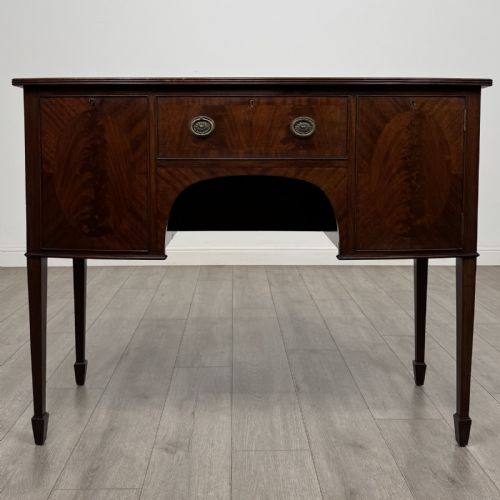
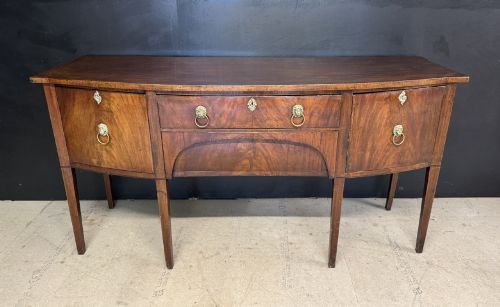
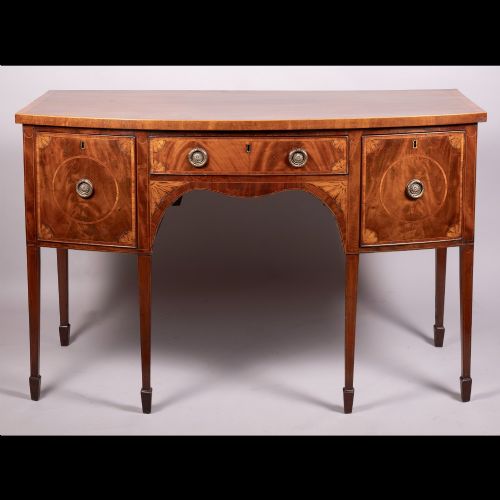
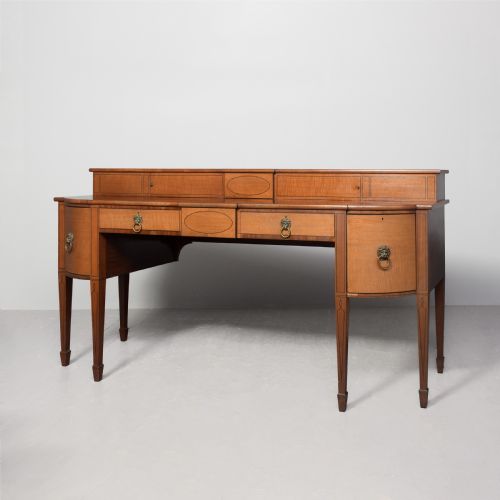
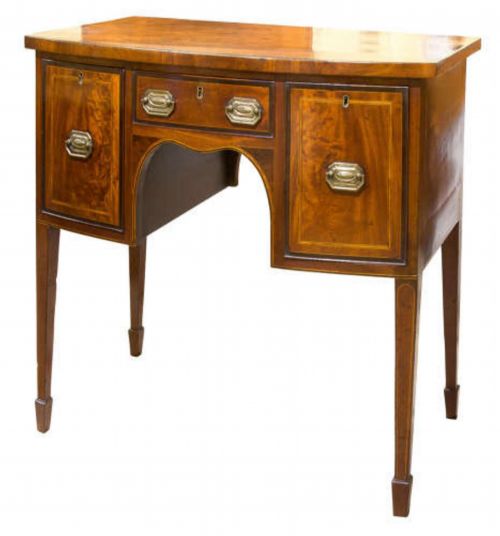

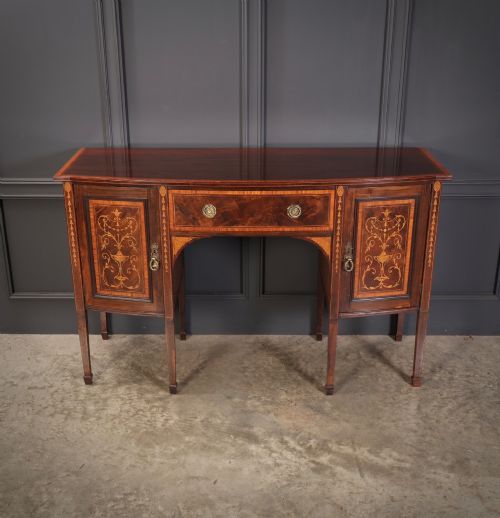


Tapered Leg Bow Sideboard
A tapered leg bow sideboard brings a curved, refined Georgian outline and practical dining storage into a room.
Tapered Leg Bow Sideboard
When you search for a tapered leg bow sideboard, you encounter formal dining furniture designed with a sweeping curved front and straight supporting legs. These items emerge primarily from the Georgian and Regency periods, alongside later Edwardian revivals.
The pieces on this page span sideboards, side tables, and serving tables, frequently showcasing the characteristic bow front profile paired with square tapered legs. Most examples date from the eighteenth and nineteenth centuries, with occasional later interpretations from nineteen hundred and nineteen ten.
Makers of these items focused on domestic utility for the dining room, incorporating drawers and cupboards behind the sweeping mahogany facade. You will find both compact examples and large stage-back variations designed for grander interiors.
Materials and construction methods
Cabinetmakers built these items predominantly using solid mahogany and mahogany veneers, providing a rich, dark timber base for the sweeping curved facades. Construction relied on traditional joinery techniques to shape the bow front and secure the framing.
Decoration frequently involved contrasting wood inlays, boxwood stringing, and satinwood banding to highlight the edges of drawers and tabletops. Brass handles and mounts completed the construction, adding functional detail to the wooden structure.
Tapered Leg Bow Sideboard Retail Price Guide 2026
Typical asking prices for tapered leg bow sideboard among the pieces listed under this phrase on Sellingantiques today, from the lower quarter to the upper quarter. They describe what is for sale here now, not the wider market.
Object forms include sideboards, console tables, and serving tables utilising square tapered legs.
Distinctions in quality
The standard of timber selection largely defines the upper tiers of these items, with figured mahogany and finely matched veneers demonstrating superior cabinet work. Subtle details such as delicate boxwood stringing and precise purpleheart banding indicate higher workshop ambition.
Proportion and structural integrity also separate fine examples from simpler versions, particularly in the execution of the curved bow front and the tapering of the legs. Original brass hardware and well-preserved internal drawer linings further distinguish superior pieces.
The Tapered Leg Bow Sideboard Glossary
- Bow front
- A convex curved front facade that swells outward, commonly seen on Georgian and Regency sideboards to soften rigid room angles. This shape required precise woodworking to ensure drawers operated smoothly within the curve.
- Tapered leg
- A vertical support that gradually narrows toward the base, frequently found on eighteenth-century and revival furniture. It imparts a lighter visual balance to heavy case pieces.
- Stringing
- Narrow inlaid lines of contrasting light wood, such as boxwood, used to outline drawer fronts and tabletops. This technique added subtle geometric definition to plain mahogany surfaces.
- Bandings
- Border strips of different wood veneers applied around the edges of top boards or drawer fronts for decorative contrast. They often frame the primary timber grain with a darker or lighter tone.
- Stage-back
- A raised tier at the rear surface of a sideboard used for displaying serving dishes or silver. Larger dining room pieces frequently incorporated this functional architectural addition.
Tapered Leg Bow Sideboard: Frequently Asked Questions
What rooms suit a tapered leg bow sideboard?
These pieces function primarily in dining rooms and large hallways, providing surface space for serving food and interior storage for tableware. Their curved profile allows them to soften the corners of a room while occupying less floor space than a breakfront cabinet.
Position them against a principal wall where the bow front can catch the light and display the mahogany grain effectively. Ensure adequate clearance around the drawers and doors for daily domestic use.
How do I identify a Georgian period piece?
Examine the timber quality, construction methods, and secondary woods used inside the drawer linings, which often include oak or pine in eighteenth-century examples. Look for hand-cut dovetails and subtle variations in the mahogany grain that indicate period hand tools were used.
Check for the characteristic square tapered legs and restrained stringing typical of late eighteenth-century Sheraton designs. Later Edwardian revivals often display standardised machine-cut elements and cleaner, more uniform internal timbers.
Are these sideboards practical for modern storage?
The internal compartments and drawer configurations provide ample space for linens, cutlery, and modern dining accessories. The shallow depth of the bow ends requires careful measurement for oversized serving platters.
Maintenance involves regular polishing with beeswax to nourish the antique mahogany surface and protect the veneer. Keep the timber away from direct heat sources to prevent the wood from splitting or warping.
What is the difference between a sideboard and a serving table?
A sideboard typically incorporates built-in drawers and enclosed cupboards for comprehensive dining room storage. A serving table relies on an open frame beneath the surface, occasionally featuring a single shallow drawer.
Serving tables offer a lighter visual presence in a room compared to the solid mass of a full sideboard. Both share the characteristic bow front and tapered leg profiles found across this furniture group.