

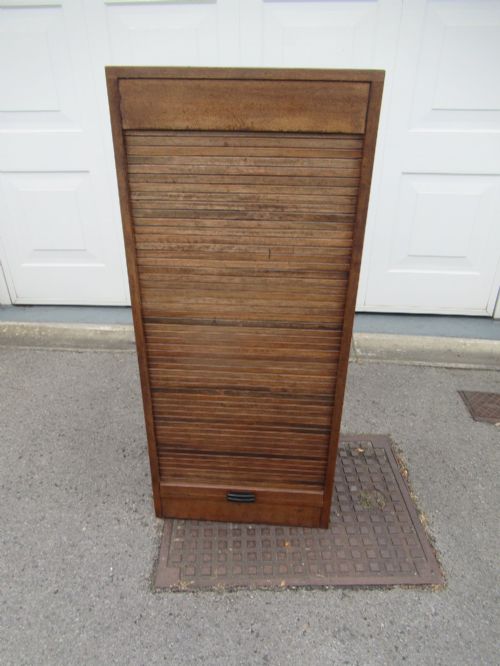
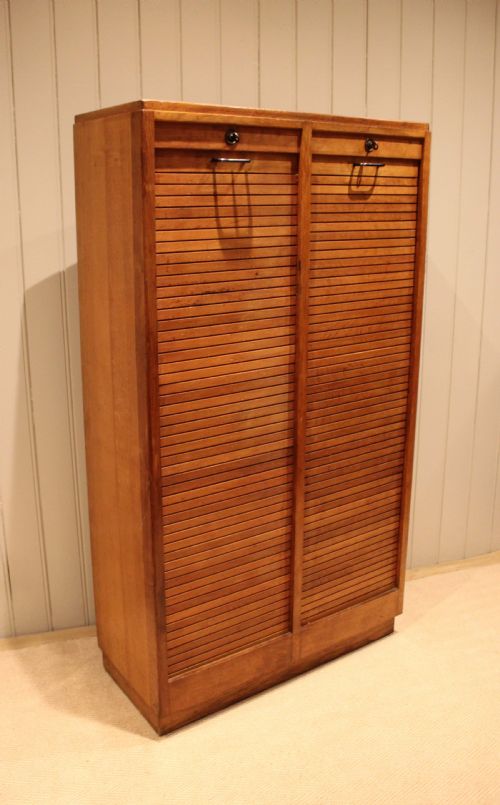


Tambour Roll Top Cabinet
A tambour roll top cabinet brings slatted wooden shutters together with clever joinery to hide papers, books and writing implements out of sight.
Tambour Roll Top Cabinet
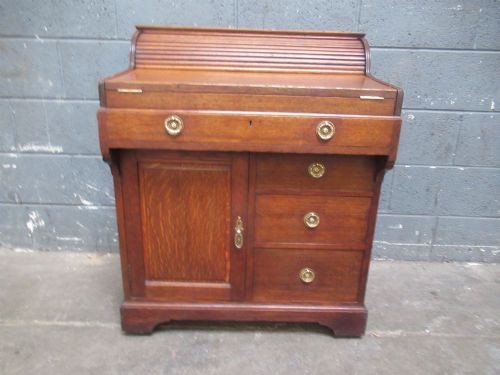
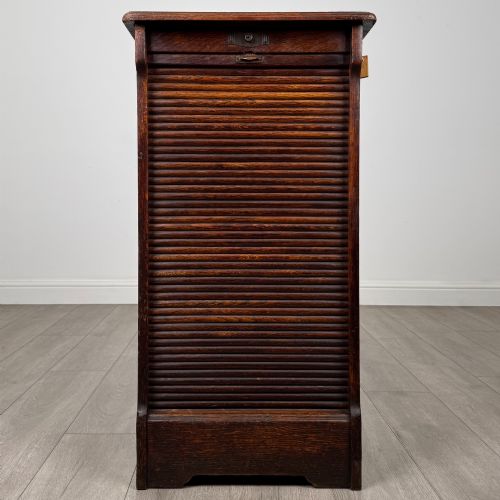
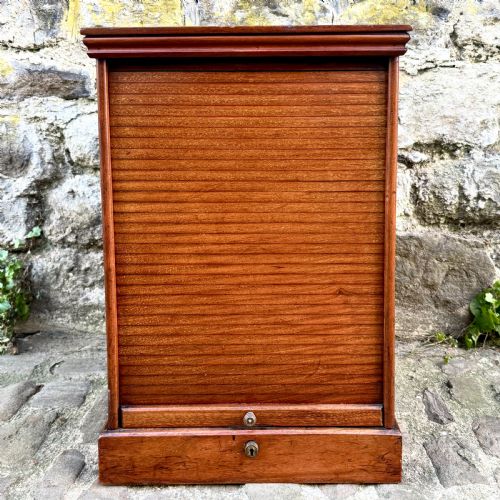
A tambour roll top cabinet relies on sliding slatted shutters that travel along curved tracks to enclose desks, filing chests and stationery holders. These pieces range from compact tabletop boxes and stationary cabinets to large office filing units and writing desks.
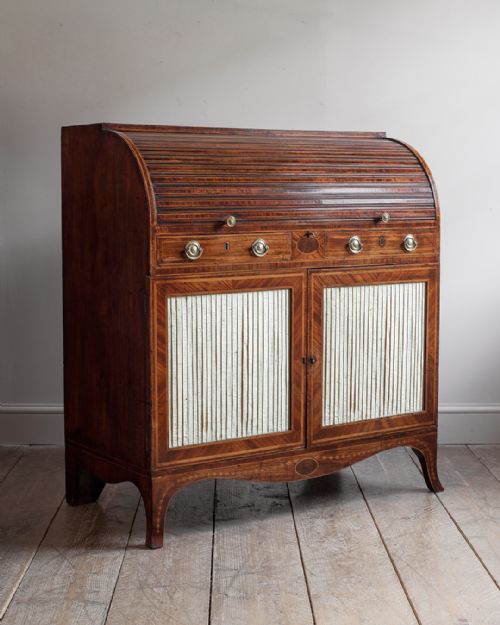
The versions most frequently met on this page date from the Edwardian era and the early twentieth century, constructed largely in oak or mahogany. Alongside these office and study forms appear occasional Georgian and Regency pieces in satinwood and rosewood.
How they were made
Makers built the flexible shutter by gluing narrow vertical slats of timber onto a strong fabric backing, allowing the panel to curve smoothly around tight corners. Solid oak and mahogany formed the structural carcase, while brass hardware and glass doors appeared on select compartments.
Fine examples incorporate marquetry inlay and tailored internal shelving, whereas utilitarian filing units prioritise sturdy panel construction and metal fittings.
Tambour Roll Top Cabinet Retail Price Guide 2026
Typical asking prices for tambour roll top cabinet among the pieces listed under this phrase on Sellingantiques today, from the lower quarter to the upper quarter. They describe what is for sale here now, not the wider market.
Listings span periods from the eighteenth century to the mid-twentieth century, with oak and mahogany appearing alongside brass, glass and rosewood.
What varies in quality
The smoothness of the sliding action distinguishes a superior cabinet, where the slatted tambour runs effortlessly within its tracks without binding or sagging. Finer pieces display carefully chosen timber grains and precise hand-cut dovetails on the internal drawers.
Simpler office filing cabinets focus on heavy-duty construction and practical utility, while refined Georgian and Regency writing furniture displays delicate satinwood veneers and sophisticated mechanical writing slides.
The Tambour Roll Top Cabinet Glossary
- Tambour
- Flexible shutter made of narrow wooden slats attached to canvas or leather, allowing it to slide around a curved track. This clever mechanism conceals storage compartments without requiring clearance for swinging doors.
- Roll top
- Desk or cabinet design featuring a slatted tambour closure that pulls down from the top to cover the writing surface and pigeonholes. It provides secure containment for correspondence and papers.
- Marquetry
- Decorative technique of applying small pieces of veneer to form intricate pictorial patterns or floral designs on furniture surfaces. It appears on select refined writing cabinets.
- Bonheur du jour
- Small light lady's writing desk with an enclosed superstructure, popular during the eighteenth and nineteenth centuries. These delicate pieces often incorporate tambour doors or small drawers.
- Satinwood
- Hard, yellowish timber with a lustrous grain used for fine cabinetry and inlay work during the Georgian and Regency periods. It yields a bright, reflective surface when polished.
Tambour Roll Top Cabinet: Frequently Asked Questions
How do tambour doors work?
The door consists of individual wooden strips glued side by side onto a strong canvas backing. This flexible mat moves smoothly along grooved tracks cut into the sides of the cabinet.
When pushed, the shutter disappears into the body of the furniture, keeping compartments open or closed without protruding into the room.
What were these cabinets used for?
These cabinets served primarily to organise correspondence, account books, stationery and writing materials in offices and private studies. The lockable rolling shutter kept sensitive documents secure from prying eyes.
Smaller tabletop versions held cigars or postage stamps, while larger variants accommodated vertical filing systems.
How do I care for the sliding shutter?
Keep the wooden tracks clean and free from dust so the flexible slats travel without friction. An occasional application of appropriate furniture wax maintains the timber.
Avoid forcing the mechanism if it sticks, as the canvas backing requires gentle alignment along the curved grooves.
How do I distinguish an Edwardian piece from a Georgian one?
Edwardian examples tend to utilise solid oak with robust roll-top mechanisms designed for efficient office use. They often feature simple panel construction and practical internal file dividers.
Georgian and Regency pieces favour mahogany or satinwood, displaying delicate proportions, tapered legs and refined marquetry decoration rather than heavy commercial utility.