

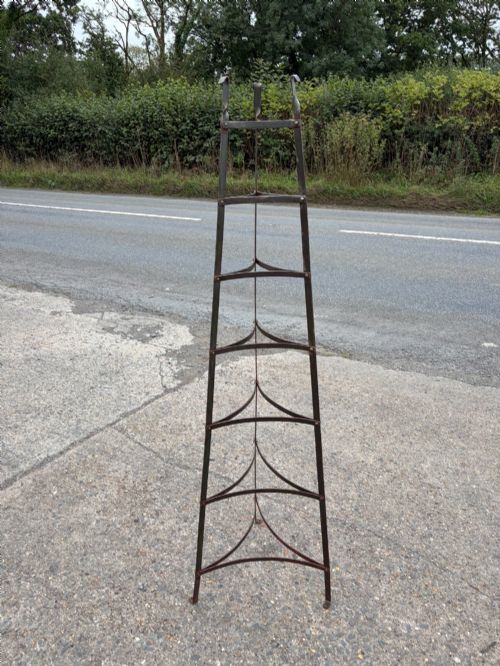

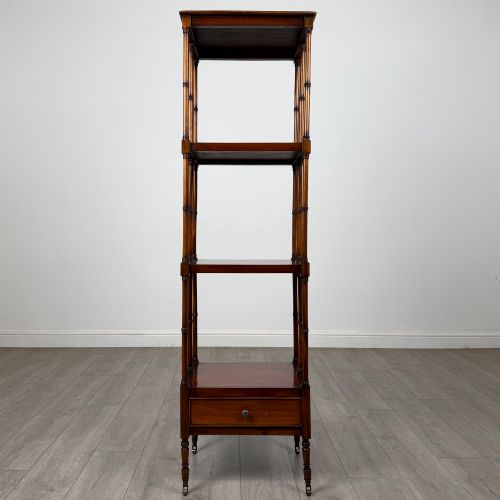


Tall Display Etagere
A tall display etagere stands ready to hold your treasured objects, bringing vertical elegance and tiered storage to any room.
Tall Display Etagere
When you search for a tall display etagere, you are looking at multi-tiered open shelving designed to showcase decorative objects, books and plants without crowding the floor space. These pieces utilise vertical height to create striking focal points in a room, drawing the eye upward while keeping your collection neatly organised.
On this page, you are most likely to meet examples in forms such as whatnots, open bookcases, plant stands and corner units. These variations span periods from the Georgian era through the Victorian and Edwardian periods up to 1920, reflecting centuries of practical display furniture design.
How they were made
Makers constructed these pieces using dense timbers such as mahogany and teak, alongside ebonised wood and softwood. These materials provided the structural integrity required to support multiple tiers of open shelving over a tall footprint.
Metal components also appear in the construction, incorporating brass, wrought iron and cast iron alongside glass elements and painted finishes. Joinery and assembly methods varied from slender pillars supporting tiered shelves to robust industrial frames built for shop or domestic use.
Tall Display Etagere Retail Price Guide 2026
Typical asking prices for tall display etagere among the pieces listed under this phrase on Sellingantiques today, from the lower quarter to the upper quarter. They describe what is for sale here now, not the wider market.
A ship's teak whatnot proves that even at sea, someone needed four separate tiers to keep their maritime curiosities from rolling away.
What varies in quality
The distinction between the top of the range and simpler pieces lies in the choice of materials and the refinement of the design. Dense timbers and careful joinery separate finely proportioned specimens from utility racks.
Detailing in the supports, whether slender turned pillars or decorative ironwork, defines the character of each piece. The execution of painted finishes and the integrity of multi-tiered structures further distinguish the finer examples.
The Tall Display Etagere Glossary
- Etagere
- A piece of furniture consisting of a set of open shelves for displaying small objects or ornaments. This form originated in France and remains popular for vertical storage.
- Whatnot
- A piece of furniture with shelves for small objects, popular in the Victorian and Georgian periods. It functions as a tiered display stand.
- Ebonised
- Wood that has been finished to resemble ebony, typically through staining and polishing. This technique creates a dark, uniform appearance seen on several Victorian pieces.
- Slender pillar
- A thin vertical support column used in furniture construction to hold up individual shelves. These pillars add a sense of lightness to tall shelving units.
Tall Display Etagere: Frequently Asked Questions
What is a tall display etagere used for?
These pieces are designed for displaying decorative items, books, plants and collections across multiple open tiers. Their vertical format allows them to hold numerous objects while taking up minimal floor space.
They serve as both practical storage and focal display furniture in living rooms, hallways and studies. The open shelves ensure that the items placed upon them remain fully visible from all angles.
How do I identify a Victorian whatnot?
Victorian whatnots typically feature multiple tiers supported by turned wooden pillars or posts. They often utilise dark timbers like mahogany or ebonised wood.
Look for period construction details such as hand-cut joints and timber shrinkage that indicate age. These pieces were built primarily for display in nineteenth-century parlours and drawing rooms.
What materials are used in these display pieces?
The listings feature a range of hardwoods including mahogany and teak, alongside softwood, ebonised wood and ebony. These provide the main framework and shelving surfaces.
Metal elements such as brass, cast iron and wrought iron also appear, particularly in industrial or shop display stands. Glass components and painted finishes add further variety to the construction.
Where should I place a tall etagere?
A tall display etagere works well against a blank wall or in an empty corner where its vertical height can be appreciated. Corner units specifically fit into unused room angles to maximise display space.
Ensure the piece is positioned away from excessive moisture and direct sunlight to protect the wood and finish. Because of their height, placing them on level flooring ensures stability.