


Tabletop Wooden Music Box
These tabletop wooden music boxes deliver mechanical melodies through pinned cylinders and steel combs, bringing tangible historical craftsmanship directly into your home.
Tabletop Wooden Music Box
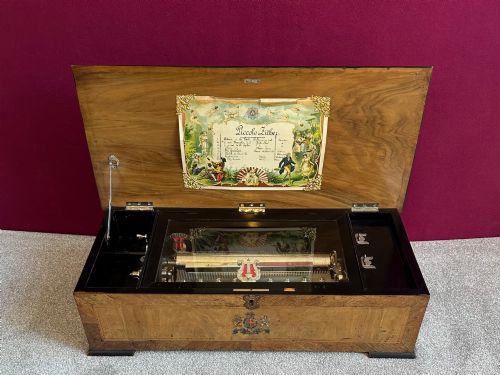
A tabletop wooden music box brings together domestic entertainment and mechanical ingenuity from the Victorian and Edwardian eras. When searching for a tabletop wooden music box, buyers encounter examples originating from the mid-nineteenth century up to the early twentieth century. Most pieces on this page take the form of enclosed wooden cases housing traditional Swiss cylinder movements designed to play multiple airs.
The assortment spans simple cylinder boxes alongside more complex arrangements like mandolin formats and large symphonium disc players. Cases predominantly date from the Victorian period, though Edwardian specimens also appear in walnut. Each item relies on internal brass and steel components to produce acoustic tunes before the arrival of modern recorded sound.
How they were made
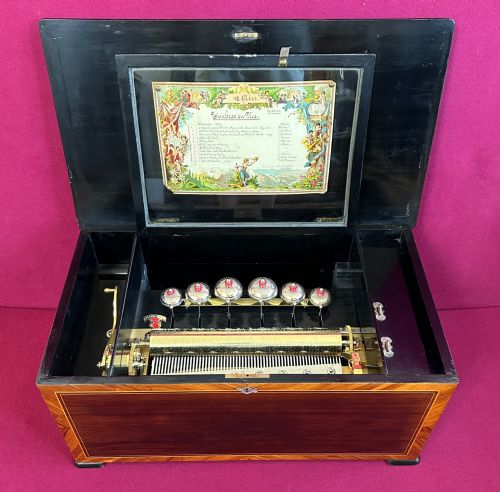
Cases utilise dense hardwoods such as walnut, rosewood, boxwood, and burr walnut, frequently shaped into substantial tabletops. Ebonised wood also appears among the construction materials, providing dark contrasting finishes for the outer enclosures.
Internal mechanisms combine brass cylinders with tuned steel combs, while glass often protects delicate moving parts or serves as secondary viewing lids. Fine brass pins set into the revolving cylinders pluck the teeth of the steel comb to create precise musical notes.
What varies in quality
Quality differentiates through the complexity of the musical arrangement, such as multi-air configurations and specialised mandolin effects. The sophistication of the internal Swiss cylinder works and the degree of historical restoration dictate the overall execution.
Cabinetry selection sets the visual standard, where figured timbers like burr walnut and rosewood elevate the aesthetic presence of the case. Heavier, larger architectural formats and signed works by notable makers represent the upper tier of construction.
B A Bremond·Nicole Freres
The Tabletop Wooden Music Box Glossary
- Cylinder
- A rotating brass barrel set with tiny pins that pluck the teeth of a steel comb. This component dictates the specific tunes played by the mechanism.
- Comb
- A flat piece of tuned steel with multiple individual teeth that vibrate when struck by cylinder pins. Its precision determines the clarity of the acoustic output.
- Air
- A distinct musical tune or melody played during one rotation of the cylinder. Boxes are often described by how many airs they hold.
- Mandolin
- A mechanical arrangement featuring grouped teeth on the comb to mimic the plucked sound of a mandolin string. This style creates a shimmering tremolo effect.
- Symphonium
- A large tabletop disc player utilising flat metal discs rather than pinned cylinders to produce sound. These heavier units represent a distinct mechanical approach.
Tabletop Wooden Music Box: Frequently Asked Questions
How do tabletop wooden music boxes work?
These boxes operate via a spring-driven clockwork motor that turns a pinned brass cylinder. As the cylinder rotates, the brass pins strike tuned steel teeth to produce melodies.
More complex movements incorporate multiple tunes, known as airs, and specialised comb arrangements to alter the acoustic tone.
What is a cylinder music box?
A cylinder music box uses a revolving metal barrel pinned with precise data points to play pre-set musical arrangements. Each rotation corresponds to a specific sequence of notes.
This format dominated nineteenth-century production before interchangeable disc systems gained popularity toward the end of the Victorian era.
Where were these music boxes made?
The majority of the Swiss cylinder movements housed in these wooden cases originated in Switzerland during the nineteenth century. Swiss workshops established global renown for their precision engineering and musical mechanisms.
Cabinet makers then housed these imported movements in local timbers such as walnut, rosewood, and burr walnut.
How should I care for a vintage music box?
Keep the box in a stable environment away from direct sunlight and extreme humidity changes, which can warp wooden cases and affect internal glue. Wind the spring mechanism gently without forcing it beyond its natural stop.
Allow a specialist to handle internal cleaning or mechanical adjustments to preserve the delicate brass pins and steel comb.