
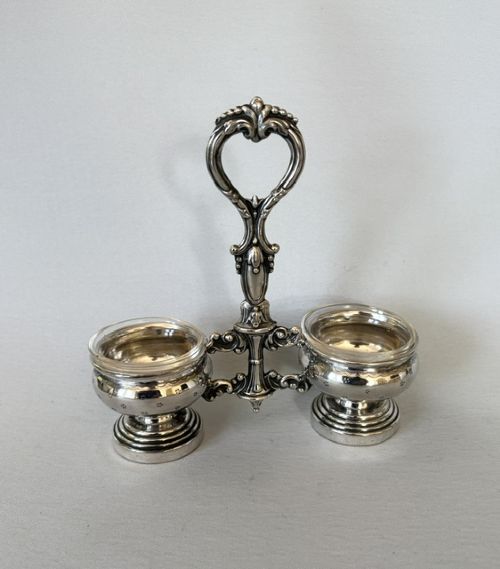
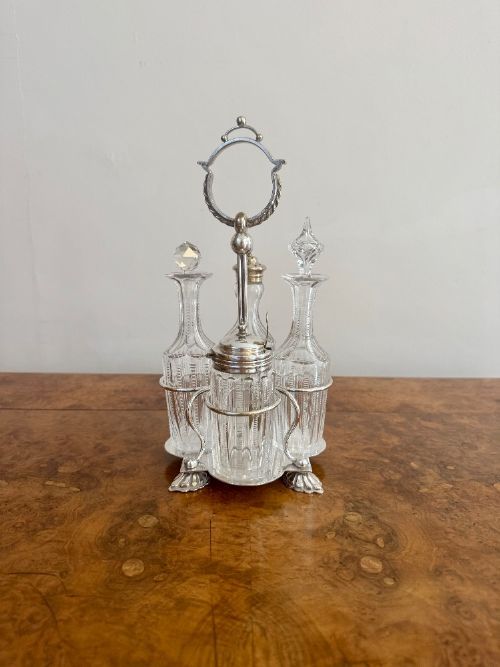
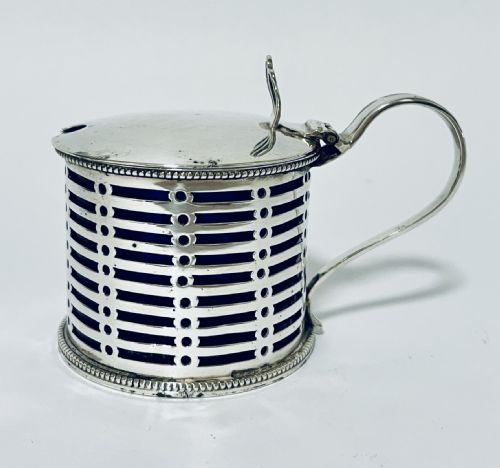
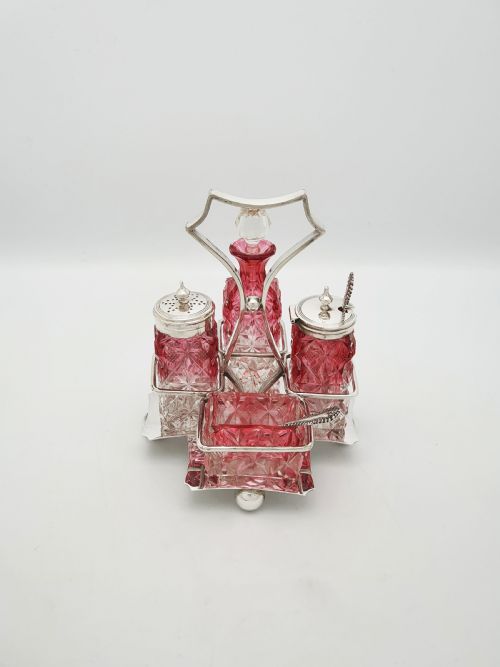


Table Condiment Caddy
A table condiment caddy organises dining essentials into a single framework, combining silver or plate with cut glass.

Table Condiment Caddy
A table condiment caddy gathers bottles, jars and pots for seasonings on a shared stand or frame. These items appear in forms such as cruet sets, condiment vessels and relish caddies, spanning periods from the eighteenth century to the early twentieth century.
The Edwardian era provides the highest concentration of examples on this page, typically formed of silver plate framing multiple cut glass bottles. Alongside these stands, related table pieces include mustard pots, sugar boxes, salt cellars and caviar ice servers in diverse materials.
Origins range across English, French and Scandinavian traditions, encompassing styles from Georgian symmetry through Victorian ornamentation to Art Deco and Scandinavian Modern. A buyer encounters everything from single mustard pots to large eight-piece stands equipped with original glass.
How they were made
Silversmiths and metalworkers formed the frames and mounts using sterling silver or silver plate over a base metal, frequently shaping them with handles and feet for the dining table. Makers utilised techniques of casting, piercing and plating to construct sturdy frameworks that securely hold individual vessels.
Vessels within the caddies rely on glass craftsmanship, specifically cut glass, crystal and cranberry flashed glass. Artisans cut and blew these glass inserts to fit exact frame slots, pairing them with hinged metal lids, spoons and small ceramic or glass components.
Listings feature periods spanning from the 18th Century through the Victorian and Edwardian eras up to the 1920s.
What varies in quality
Quality rests primarily on the integrity of the fitted glass and the preservation of the metal framework. Complete sets retaining their matching original bottles and casters command higher regard than assembled groupings with replacement glassware.
The refinement of the metalwork, from plain George III sterling silver to ornate Victorian or French Rococo cast decoration, dictates the standard of execution. Weight, crispness of cut glass facets and maker attribution further distinguish superior examples from standard production.
Mappin Brothers·Wade Wingfield Wilkins
The Table Condiment Caddy Glossary
- Cruet set
- A fitted stand holding glass bottles or cruets for oil, vinegar, mustard and other seasonings. These sets form a central component of dining table service.
- Cranberry flashed glass
- Glass coated with a thin layer of rich red glass during blowing and then cut to reveal the clear glass beneath. This technique creates high contrast in decorative tableware.
- Castor
- A small tall jar with a perforated top used for sprinkling sugar or dry spices over food. They frequently accompany larger frame stands.
- Silver plate
- A layer of silver fused or electroplated onto a base metal such as copper or Britannia metal. This process provided the appearance of solid silver at a lower cost.
- Relish caddy
- A specialised holder designed for serving pickles, relishes or sauces at the table. They often feature handled frames for passing between diners.
Table Condiment Caddy: Frequently Asked Questions
What is a table condiment caddy?
A table condiment caddy is a structured metal frame or stand designed to hold multiple bottles, pots and jars containing seasonings, sauces and spices for dining.
These pieces keep table dressings organised and portable, allowing hosts to pass mustard, oil, vinegar and relishes easily around the table.
How do I date a cruet set?
Dating relies on stylistic clues, hallmarks stamped on the metal mounts, and the manufacturing techniques used for both the frame and the glass inserts. Georgian pieces show restraint and simple lines, while Victorian and Edwardian examples often display heavier ornamentation or matching cut glass.
Examining screw threads, plating methods and glass cutting styles helps narrow the period of manufacture when hallmarks are absent or rubbed.
Are original glass bottles important?
Original glass bottles that fit the specific frame accurately are crucial for authenticity and completeness. Sets retaining their matching original cut glass or crystal cruets represent higher quality.
Replacement bottles often sit incorrectly in the frame or differ in glass colour and cutting pattern from the metal holder.
How do I clean silver plated caddies?
Cleaning requires a soft cloth and a gentle silver polish formulated specifically for plated items to avoid wearing through the thin silver layer. Glass inserts should be washed separately in warm soapy water.
Harsh abrasive cleaners and prolonged soaking in chemical dips can damage both the metal plating and any applied glass decoration.