


Sussex Landscape Artwork
These sussex landscape artwork pieces capture the countryside, coast and historic towns of the county in oil, watercolour and engraving.
Sussex Landscape Artwork
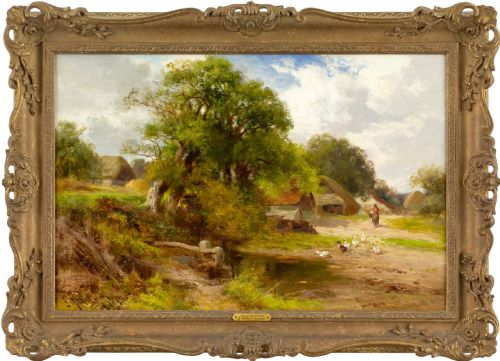
When you search for sussex landscape artwork, you encounter paintings and works on paper recording locations across the county from the Regency period through to the twentieth century. The selection includes rural scenes with sheep, rivers and windmills alongside town views of places such as Arundel, Rye and Chichester.
Most examples date from the Victorian and Edwardian eras, executed in watercolour or oil on canvas. These range from detailed topographical watercolours to broader impressionistic oil paintings and naive eighteenth-century works.
The subjects cover identifiable landmarks and quiet lanes, offering a record of the Sussex landscape as painters viewed it over successive generations. Framed pieces predominate, often retaining their period gilt wood or wooden frames.
Materials and methods
Artists working on sussex landscape artwork utilised traditional painting and drawing materials, predominantly oil on canvas or watercolour on paper, alongside occasional gouache and engravings. Watercolours offer transparent washes that capture light on rivers and downland, while oil paintings build up heavier textures for harvest scenes and coastal views.
Framing forms an integral part of these works, with period pieces often housed in gilt wood frames that complement the painting style. Support structures include stretched canvas for oils and paper protected under glass for watercolours and engravings.
Sheep appear frequently in Sussex lanes, keeping watch over centuries of harvest fields and pastoral watercolours.
Assessing quality in sussex landscape artwork
Quality in sussex landscape artwork rests on the skill of the brushwork and the artist's ability to convey light and atmosphere within the county's specific topography. Stronger compositions demonstrate confident handling of perspective in architectural subjects like bridges and castles, or natural forms in pastoral and marine views.
The condition of the medium also distinguishes pieces, whether that means the preservation of vibrant pigments in watercolours or the stability of the paint surface and canvas in oil paintings. Original period framing that suits the age and scale of the artwork adds further to the integrity of the piece.
Charles Gregory·Stanley Orchart·Arthur Winter Shaw·Henry Charles Fox·Henry John Kinnaird·William Luker Snr
The Sussex Landscape Artwork Glossary
- Topographical
- Depicting a specific real place accurately. These works serve as historical records of Sussex towns and landscapes.
- Watercolour
- A painting method where pigment is mixed with water-soluble binders on paper. It creates luminous, translucent effects common in nineteenth-century landscapes.
- Gouache
- An opaque water-based paint medium similar to watercolour but heavier and more solid. It allows for bright highlights and dense colour application.
- Naïve art
- Work created by an artist without formal academic training, often characterised by flat perspective and charming detail. Eighteenth-century examples show rural settlements in this distinct style.
Sussex Landscape Artwork: Frequently Asked Questions
What periods do these Sussex landscapes cover?
The works span from the Regency era and eighteenth-century naive pieces through to mid-twentieth-century paintings. Victorian and Edwardian artists represent a large portion of the available watercolours and oils.
Later twentieth-century watercolours and gouache works also appear, showing how artists continued to record the Sussex countryside decades later.
How should I care for framed watercolours?
Watercolours on paper require protection from direct sunlight to prevent the fading of delicate pigments. Keeping them in stable humidity conditions safeguards both the paper support and the framing.
Ensure that the glass does not touch the painted surface directly to avoid moisture damage over time.
Are these artworks framed?
Most listings include framing, often featuring period gilt wood or wooden surrounds that match the age of the piece. These frames protect the edges of canvases or the paper sheets of watercolours.
Some buyers choose to retain these historic frames while others update them to suit modern interiors.
What subjects are most common?
Common subjects include pastoral scenes with sheep, harvest fields near downland villages, and river views with bridges or mills. Historic Sussex towns, castles and coastal spots like Rye and Hastings also feature prominently.
Artists frequently recorded recognisable landmarks such as Arundel Castle and Chichester market cross.