
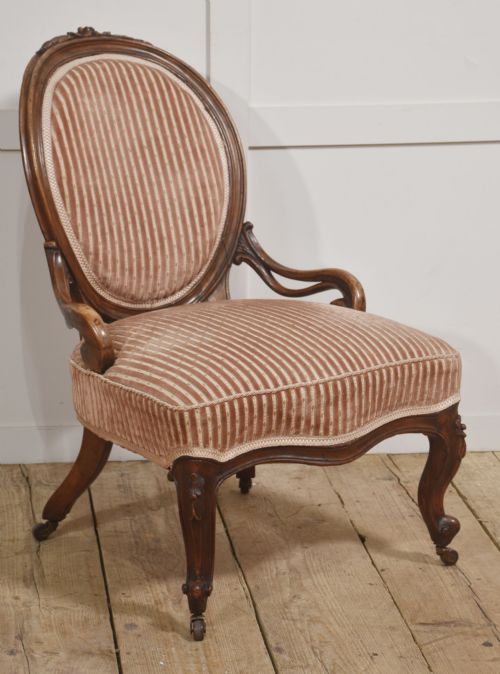


Striped Nursing Chair
A striped nursing chair brings low seating and distinctive upholstery to a room, offering comfortable support through nineteenth and early twentieth century design.
Striped Nursing Chair
A striped nursing chair is a low-seated armchair designed during the nineteenth and early twentieth centuries, appearing in forms such as Victorian ladies chairs, bedroom chairs, and slipper chairs. These pieces generally feature wooden frames paired with upholstered seats and backs, serving domestic spaces with compact proportions.
The versions most commonly met on this page date from the Victorian and Edwardian eras, spanning walnut, mahogany, oak, and ebonised wood frames. They frequently showcase carved details, button backs, and open arms, reflecting the revival and traditional styles of their respective periods.
How they were made
Makers constructed the frames of a striped nursing chair using hardwoods like walnut, mahogany, oak, and ebonised wood, often shaping the timber with carvers and turners. These structural elements provided the durability needed for daily use while supporting elaborate ornamentation.
Upholstery techniques involved securing fabric and textile coverings, occasionally incorporating velvet or button-backed detailing over internal padding. Brass and other metals appeared in castors or structural joinery, completing the construction of the seating.
What varies in quality
The refinement of the woodwork dictates much of the standing of a striped nursing chair, separating heavily carved frames from simpler structures. Crisp detailing on walnut and mahogany highlights the skill of the original maker.
The execution of the upholstery and the choice of textile also influence the overall standard. Pieces retaining sophisticated button backs and high-grade fabrics display a superior level of finish.
CVS
The Striped Nursing Chair Glossary
- Nursing chair
- A low-seated chair historically designed for nursing infants, featuring a compact frame and comfortable upholstery.
- Slipper chair
- A low-seated bedroom chair without arms, originally used for sitting while putting on shoes.
- Ebonised wood
- Timber treated with a dark stain or finish to imitate the appearance of ebony.
- Button back
- An upholstery technique where buttons are pulled deep into the padding to create a quilted, patterned surface.
- Victorian Rococo Revival
- A nineteenth-century design style marked by ornate, asymmetrical carving and scrollwork.
Striped Nursing Chair: Frequently Asked Questions
What is a striped nursing chair?
A striped nursing chair is a low armchair from the nineteenth or early twentieth century, designed with compact dimensions for domestic comfort.
These pieces typically feature timber frames such as walnut or mahogany paired with upholstered textile coverings.
How were these chairs used?
These chairs served primarily in bedrooms and private sitting spaces, offering low seating suited for tasks like feeding infants or dressing.
Their reduced height made them practical additions to domestic interiors of the Victorian and Edwardian periods.
How do I tell Victorian from Edwardian pieces?
Victorian examples often display heavier carving, walnut or rosewood timbers, and revival styles such as Rococo details.
Edwardian pieces tend to show lighter construction, sometimes utilising oak or simplified frames characteristic of the early twentieth century.
What woods are common in these frames?
Makers frequently utilised walnut, mahogany, and ebonised wood during the nineteenth century to build these seating forms.
Solid oak frames also appear in pieces dating from the early twentieth century.