


Padded Spoon Back Chair
A padded spoon back chair offers deep Victorian comfort with a characteristic curved silhouette that supports the sitter.
Padded Spoon Back Chair
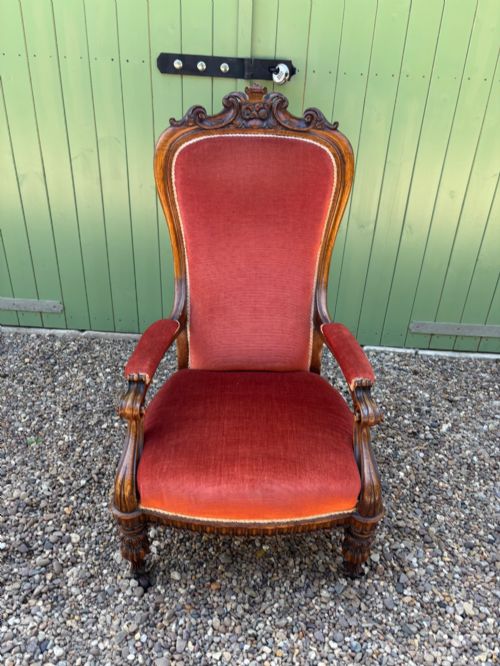
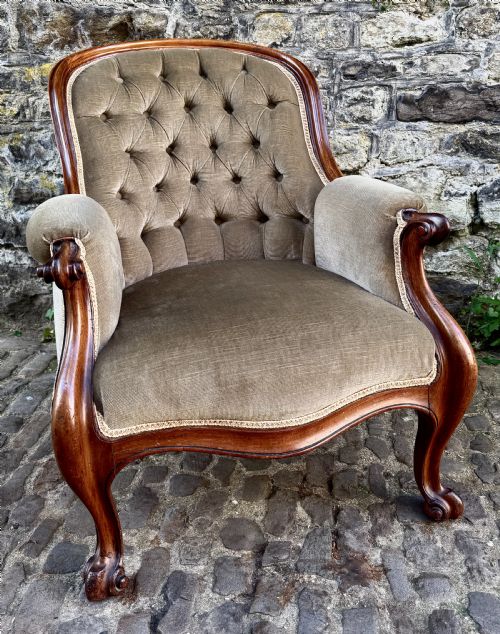
A padded spoon back chair is a form of armchair originating in the Victorian period, designed with a distinctively recessed, oval-shaped backrest resembling a spoon. These pieces range from open arm designs to fireside and library seating, reflecting the domestic comfort sought during the nineteenth century. Most examples found here belong to the Victorian era, spanning decades such as eighteen-fifty, eighteen-sixty, eighteen-seventy, and eighteen-eighty.
The construction typically incorporates rich timbers shaped into flowing curves, paired with upholstered padding designed for parlour and drawing room use. Gentlemen's and ladies' chairs appear frequently, often distinguished by proportions tailored to nineteenth-century seating habits. Buyers will encounter both walnut and mahogany frames, occasionally complemented by oak or painted finishes.
Early Victorian variants demonstrate the transition toward revivalist aesthetics, notably Rococo Revival influences seen in intricate carving and cabriole legs. These chairs survive as functional seating that anchors a traditional interior with period authenticity. The selection leans heavily toward walnut frames paired with textile or velvet upholstery.
How they were made
Cabinetmakers constructed the frames of a padded spoon back chair using dense hardwoods like walnut and mahogany, which allowed for deep carving along the crest rail and cabriole legs. Steam-bending and joinery created the signature curved backrest, while brass components sometimes reinforced structural points or castors.
Upholstery techniques involved layering textiles, velvet, or woven fabric over stuffing secured to a sprung or webbed base. Skilled artisans shaped the padding to follow the concave contour of the wooden frame, ensuring both comfort and a smooth visual transition from wood to fabric.
Victorian cabinetmakers occasionally hid maker's marks beneath the webbing of a spoon back chair, leaving a quiet signature for future restorers.
What varies in quality
The refinement of the wood carving largely dictates the distinction between standard production and superior craftsmanship, particularly on the crest rail and cabriole legs. Crisp, deep relief work indicates a higher degree of artisan skill than softer, simpler moulding.
The choice of primary timber and the execution of the upholstery also separate examples, with figured walnut frames and high-grade velvet or woven textiles representing the upper tier of nineteenth-century production.
The Padded Spoon Back Chair Glossary
- Spoon back
- An upholstered chair back shaped in a concave, oval form resembling the bowl of a spoon. This design emerged during the Victorian period to fit the contours of the human spine.
- Cabriole leg
- A furniture leg that curves outward in a convex arc and then bends inward in a concave arc, ending in a pad or scroll foot. It is frequently seen on Rococo Revival seating.
- Gentleman's chair
- A nineteenth-century armchair featuring a wider frame and padded arms designed for men. These pieces often matched smaller ladies' chairs in a parlour suite.
- Rococo Revival
- A nineteenth-century design movement inspired by eighteenth-century French style. It is characterised by asymmetrical scrolling, naturalistic floral carving, and curved lines.
- Open arm armchair
- A seating form where the arms are left un-upholstered or partially padded, exposing the shaped wooden supports. These contrast with fully upholstered fireside chairs.
Padded Spoon Back Chair: Frequently Asked Questions
What is a spoon back chair?
A spoon back chair is a Victorian seating form defined by its oval, concave backrest that curves inward to cradle the sitter. The wooden frame is typically carved around the perimeter to resemble the bowl of a spoon.
These pieces were designed for drawing rooms and parlours, combining structural hardwood frames with padded upholstery for formal domestic comfort.
How do I date a Victorian chair?
Dating relies on observing specific stylistic shifts, construction methods, and recorded production years within the Victorian era. Earlier examples often display restrained lines, while pieces from eighteen-seventy onward frequently incorporate heavier carving and revivalist motifs.
Material choices also offer context, as walnut and mahogany dominated different phases of nineteenth-century cabinetmaking alongside evolving upholstery techniques.
Where were these chairs used?
Victorian households placed these chairs in reception rooms, parlours, libraries, and fireside settings. Gentleman's and ladies' variants were often paired together to furnish formal entertaining spaces.
The ergonomic curve of the back made them suited for prolonged sitting during reading or conversation.
How do I live with antique seating?
Integrating these pieces into a modern interior involves treating them as focal points that combine historical craftsmanship with everyday utility. Placing them in low-traffic seating areas helps preserve both the wooden frame and the fabric upholstery.
Regular dusting of the carved walnut or mahogany surfaces and careful handling of the textile upholstery maintain their condition over time.