




Spoonback Accent Chair
A spoonback accent chair brings nineteenth-century curves and deep cushioning into a modern room, offering elegant posture and rich timber frames.
Spoonback Accent Chair
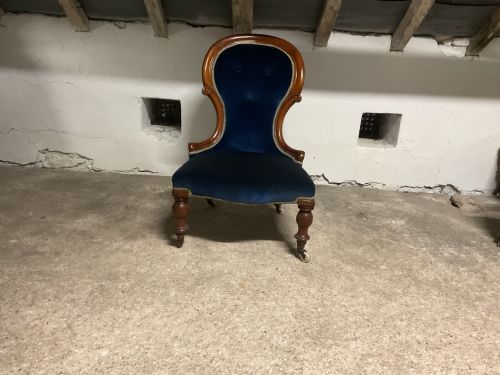
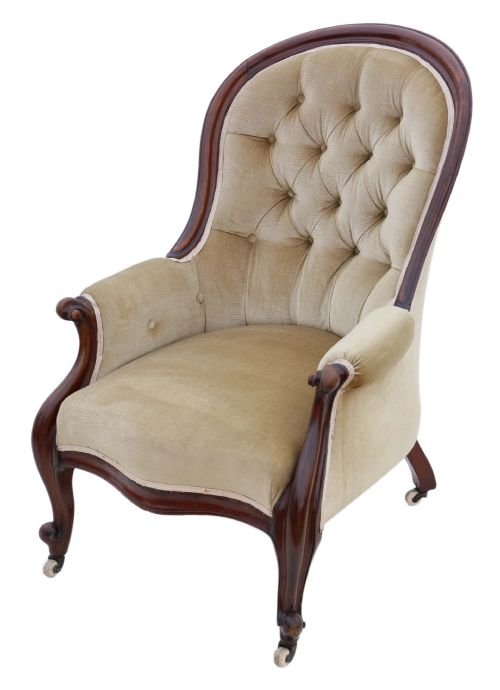
A spoonback accent chair is defined by its recessed, concave backrest that mimics the bowl of a spoon, providing a supportive cradle for the sitter. The examples gathered here emerge primarily from the Victorian era, spanning mid-nineteenth-century decades such as the eighteen-fifties, sixties, and seventies.
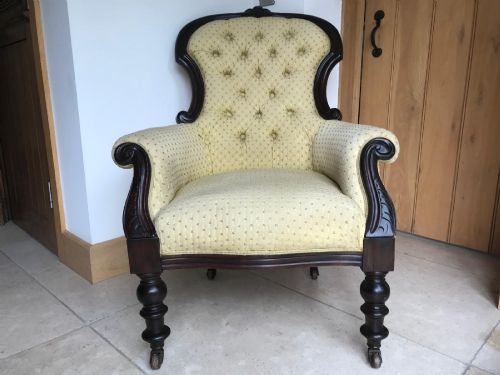
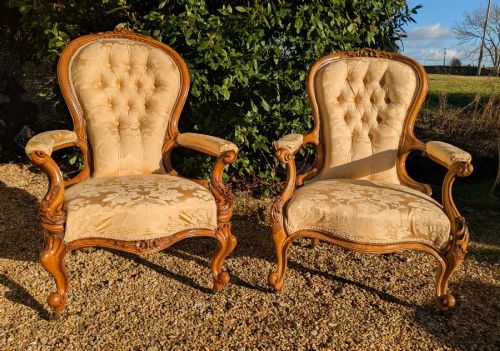
Buyers will encounter various forms within this category, ranging from low-slung ladies' and nursing chairs to taller gentleman's open armchairs and parlour seating. These pieces originate from distinct stylistic phases, including early Victorian designs and the florid curves of Victorian Rococo Revival.
Armchairs and armless occasional seating dominate the selection, often featuring open arms or upholstered showwood frames. They serve as striking focal points in bedrooms, drawing rooms, and sitting rooms alike.
Materials and construction
Cabinetmakers constructed the foundational frames of these chairs from dense hardwoods, predominantly selecting rich mahogany, warm walnut, and occasional rosewood. These timbers allowed craftsmen to steam-bend and carve the characteristic undulating profiles of the backrest.
Upholstery completed the piece, utilising traditional textile coverings such as velvet, damask, and patterned fabric. Artisans frequently secured the padding with deep buttoning, fastening the textile directly into the wooden framework or internal webbing.
Judging quality and craftsmanship
The distinction between standard parlour seating and the finest examples lies in the depth and crispness of the timber carving. Superior chairs display meticulously hand-carved floral motifs, scrolls, and cabriole legs that flow harmoniously into the structural frame.
Showwood preservation also dictates overall merit, where exposed polished timber remains free from excessive wear or clumsy structural repairs. The integrity of the joinery at the arm supports and leg joints ensures the piece retains its structural balance.
The Spoonback Accent Chair Glossary
- Spoonback
- A chair back shaped with a concave oval recession resembling a spoon, designed to fit the human spine.
- Showwood
- Exposed, polished wooden framing around the upholstered portions of a chair, intended to be seen rather than covered.
- Cabriole leg
- A furniture leg that curves outward in a convex arc and tapers inward in a concave arc, ending in a pad or scroll foot.
- Parlour chair
- An occasional seat designed for formal reception rooms, typically lighter in scale than a heavy armchair.
- Buttoning
- A traditional upholstery technique where tufts are pulled deep into the padding and secured with buttons to create geometric folds.
Spoonback Accent Chair: Frequently Asked Questions
What is a spoonback accent chair?
A spoonback accent chair is a nineteenth-century seat featuring a concave, oval-shaped backrest designed to follow the curve of the spine. These pieces typically showcase exposed wooden frames and traditional upholstery.
They function as decorative and functional seating in modern interiors, bringing historical character to bedrooms and living spaces.
How do I date a spoonback chair?
Dating relies on examining the timber species, carved stylistic details, and structural forms present in the piece. Mid-nineteenth-century examples often exhibit Victorian Rococo Revival motifs or early Victorian proportions.
Changes in leg shape, such as cabriole styles versus turned supports, also help narrow down the decade of manufacture between eighteen-fifty and eighteen-seventy.
Where should I place an antique armchair?
These armchairs suit spaces where their sculptural wooden frames and upholstered backs can be viewed from multiple angles. Bedrooms, reading corners, and drawing rooms provide ideal settings for functional use.
Their compact proportions compared to modern armchairs allow them to fit comfortably as accent pieces without overwhelming a room.
What woods were used in Victorian seating?
Cabinetmakers primarily relied on dense, dark hardwoods that could hold intricate hand-carved details. Mahogany and walnut appear most frequently in these listings.
Rosewood is also utilised in select high-status examples, offering a distinct reddish-brown grain and polished finish.