



Statement Aquamarine Jewellery
Statement aquamarine jewellery commands attention through substantial pastel stones set in platinum, white gold, and yellow gold across decades of design.
Statement Aquamarine Jewellery
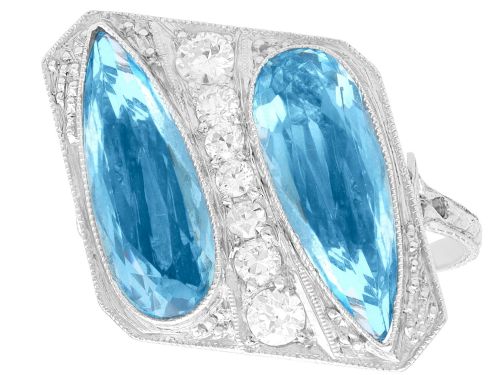
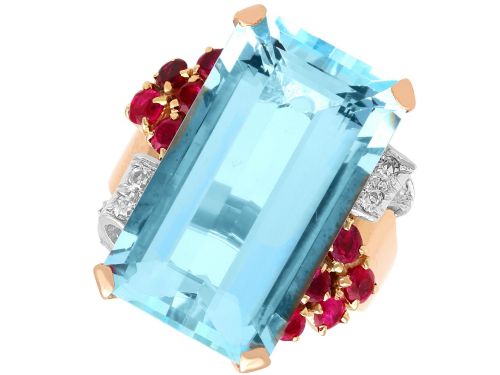
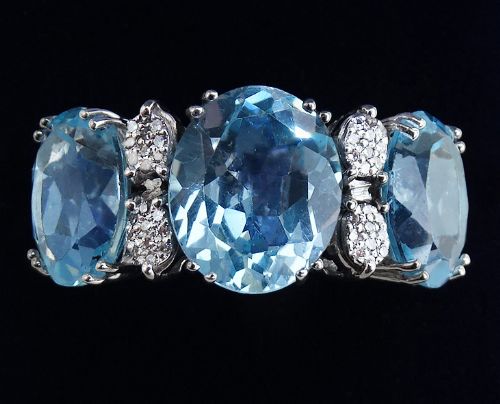
Statement aquamarine jewellery comprises bold rings, brooches, necklaces, and pendants designed to showcase large beryl stones. Pieces span from the 1920s through the 1960s, reflecting shifts from geometric work to sculptural mid-century forms.
The selections available here feature notable centre stones, often exceeding thirty carats, paired with diamonds, onyx, or blue spinel. Cocktail rings and convertible brooch pendants dominate the inventory, rendered in platinum alongside white and yellow gold.
How they were made
Goldsmiths utilised platinum and eighteen-carat white or yellow gold to construct robust settings capable of supporting massive aquamarine crystals. Stones are secured in claw settings or flush mountings, frequently accented with pavé or transitional cut diamonds.
Techniques evolved from the crisp, linear geometry of Art Deco fabrication towards the heavier, architectural volumes seen in Retro and Mid-Century pieces. Expert metalwork ensured substantial carat weights remained wearable as rings, pendants, and brooches.
Statement Aquamarine Jewellery Retail Price Guide 2026
Typical asking prices for statement aquamarine jewellery among the pieces listed under this phrase on Sellingantiques today, from the lower quarter to the upper quarter. They describe what is for sale here now, not the wider market.
Listings span four distinct decades, moving from 1920s platinum and white gold work to 1960s yellow gold pendants.
What varies in quality
Quality rests upon the saturation and clarity of the aquamarine, alongside the architectural integrity of the surrounding metalwork. Superior stones display an intense, uniform blue-green hue without distracting inclusions, commanding visual weight within the mount.
The finesse of the supporting diamond work and the solidity of the platinum or gold chassis distinguish finer examples from standard productions. Maker execution determines whether a heavy stone sits balanced and secure upon the hand or garment.
C'est Laudier
The Statement Aquamarine Jewellery Glossary
- Aquamarine
- A blue-green variety of beryl utilised as the primary gemstone in these pieces. Its name derives from the Latin for seawater, reflecting its characteristic pale aquatic tones.
- Cocktail ring
- A large, prominent ring designed to draw the eye during evening wear. These configurations typically feature oversized central gemstones surrounded by smaller diamonds.
- Platinum
- A dense, durable white metal frequently employed in antique and vintage settings. Its strength allowed makers to fashion secure, delicate-looking claws for enormous stones.
- Art Deco
- A design style spanning the 1920s and 1930s characterised by symmetry, geometric lines, and strong contrasts. In these listings, it appears paired with platinum, onyx, and white gold.
- Retro
- A bold jewellery style from the 1940s and 1950s featuring heavy gold work and tank-style motifs. Pieces from this era often emphasise industrial curves and substantial stone weights.
Statement Aquamarine Jewellery: Frequently Asked Questions
How do I clean large aquamarine rings?
Wash the piece gently using warm water, mild soap, and a soft-bristled brush to remove accumulated oils from beneath the stone.
Avoid harsh chemical dips or ultrasonic cleaners, particularly when the setting incorporates softer accent materials like onyx.
Can these vintage brooches double as pendants?
Certain examples are engineered with integrated loops or hidden bails that allow the piece to transition seamlessly from a lapel pin to a neck ornament.
Examine the reverse of the mounting to identify hinged mechanisms or loops designed for dual functionality.
What defines a cocktail ring from this era?
These rings are defined by an oversized central aquamarine, frequently surpassing twenty or thirty carats, paired with bold metal architecture.
They emerged to project confidence and scale, making them distinct from modest everyday bands.
How do I date a piece of vintage jewellery?
Examine the stylistic cues, such as the geometric platinum lines of the 1920s versus the heavy yellow gold volumes of the 1950s.
Material choices, gemstone cuts, and maker marks further anchor pieces within their specific decades of production.