


Starburst Pearl Pendant
These starburst pearl pendant examples catch the eye instantly, bringing celestial geometry and historic craftsmanship straight to your neckline.
Starburst Pearl Pendant
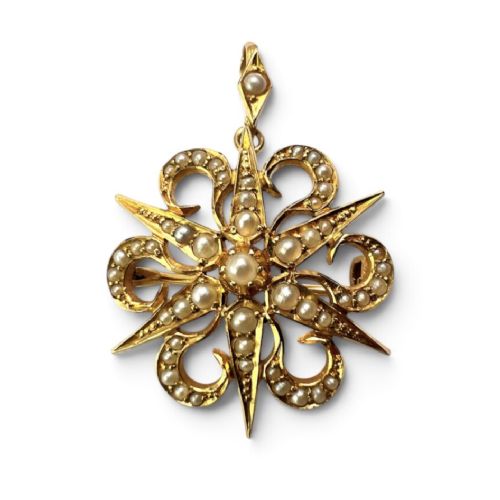
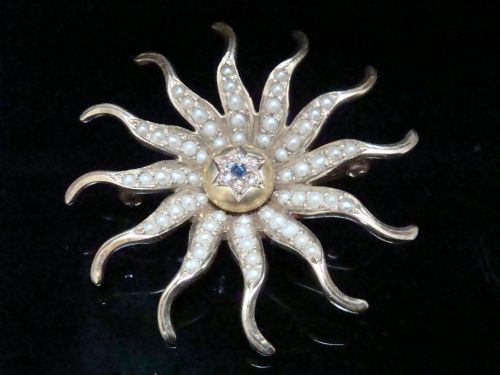
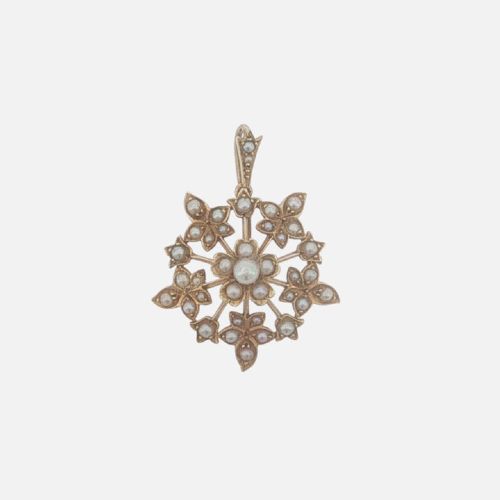
When you search for a starburst pearl pendant, you are looking at celestial jewellery spanning the Victorian, Edwardian, and Art Deco periods. These pieces combine radiating gold rays with central pearls to form distinct starburst, sunburst, or celestial star motifs.
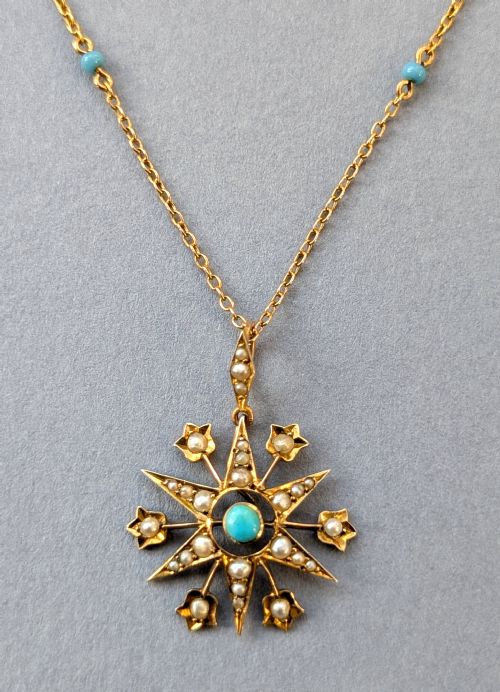
You are most likely to meet 9ct gold or 15ct gold versions on this page, often featuring seed pearls alongside turquoise, diamond, amethyst, or crystal accents. Many items double as pendants and brooches, offering versatile historic wear.
The designs range from small sunburst shapes to oversized lockets and swirling star patterns. Each piece captures the romantic and astronomical fascination of the late nineteenth and early twentieth centuries.
How they were made
Goldsmiths shaped these jewels using 9ct, 15ct, and 18ct gold, sometimes applying a matt finish to the front to contrast with polished highlights. Seed pearls were meticulously hand-set into the radiating metal channels to form the luminous points of the star.
Gemstones such as old cut diamonds, turquoise cabochons, and peridots were integrated alongside the pearls to add colour and focal depth. Artisans also constructed convertible mounts, allowing a single frame to function as both a pendant and a brooch.
The site listings feature gold purities ranging from 9ct up to 18ct, alongside seed pearl, diamond, turquoise, and amethyst materials.
What varies in quality
The standard of a starburst pearl pendant rests on the crispness of the gold rays and the matching consistency of the seed pearls. Superior examples feature well-matched, lustrous pearls and precisely cast or hand-wrought gold work that maintains its symmetry.
Higher tier pieces incorporate superior gemstones, such as old cut diamonds or natural turquoise, secured tightly within intricate multi-tiered settings. The inclusion of convertible mechanisms that remain robust and functional also elevates the standing of the jewellery.
The Starburst Pearl Pendant Glossary
- Seed Pearl
- A very small, naturally formed or cultured pearl used in clusters or pavé settings. These tiny pearls define the delicate outlines of Victorian and Edwardian star motifs.
- Old Cut Diamond
- A hand-faceted diamond style typical of the eighteenth and nineteenth centuries. These stones exhibit smaller tables and broader facets that catch candlelight softly.
- Turquoise
- An opaque, blue-to-green mineral often cut into cabochons. Victorian jewellers frequently paired turquoise with seed pearls to create contrasting celestial designs.
- Convertible Pendant
- A piece of jewellery engineered to be worn both as a necklace pendant and a brooch. This versatility was highly popular in the Edwardian era.
Starburst Pearl Pendant: Frequently Asked Questions
How do I wear a convertible starburst pendant?
You can thread a fine gold chain through the integrated bail to suspend it securely around your neck as a pendant. Alternatively, unclip the chain and use the pin mechanism on the reverse to fasten it to a lapel.
Ensure the pin catch is secure before wearing it as a brooch to prevent loss. Many Edwardian and Victorian pieces were purposefully designed for this dual functionality.
Are these pendants solid gold?
The listings on this page feature gold purities predominantly of 9ct, 15ct, and 18ct gold. Solid gold construction ensures durability across the delicate radiating rays of the starburst design.
Some pieces may highlight specific surface treatments, such as matt gold on the front faces. Hallmarks or carat stamps often help confirm the specific metal standard used by the maker.
How do I date a starburst pearl pendant?
Dating relies on stylistic clues and material combinations spanning the Victorian, Edwardian, and Art Deco periods. Victorian examples often utilise 15ct gold and heavy seed pearl clustering, while Edwardian pieces lean towards lighter 9ct mounts and turquoise accents.
Later 1920s designs introduce crystal elements alongside geometric arrangements. Comparing the construction methods and accompanying gemstones provides a reliable timeline.
How should I care for historic seed pearls?
Seed pearls are organic gems that require gentle handling and protection from harsh chemicals, perfumes, and cosmetics. Wipe them clean with a soft, dry cloth after wearing and store them separately to avoid scratching.
Avoid submerging pearl jewellery in water, as historic settings often rely on adhesives or delicate threading that moisture can weaken over time.