


Starburst Brooch Pendant
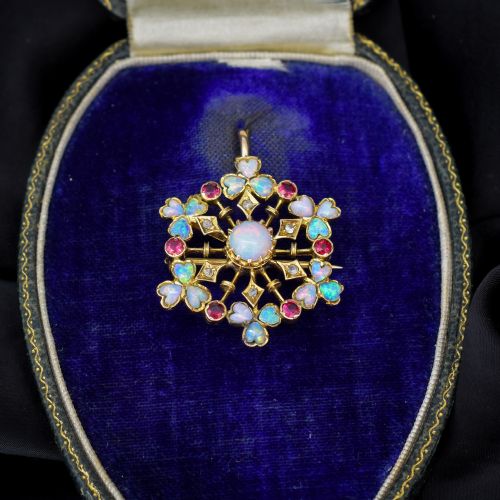
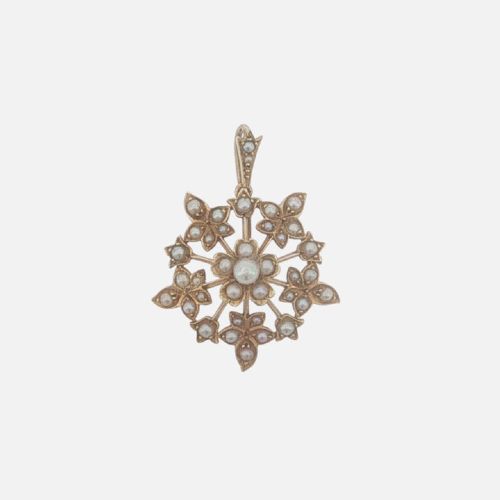
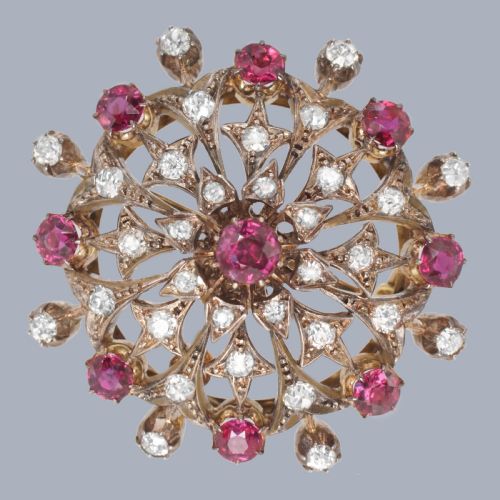
These starburst brooch pendant examples bring together celestial designs and dual-purpose mounts that wear as pins or necklaces.
Starburst Brooch Pendant
A starburst brooch pendant combines the celestial motif of a bursting star with a dual-purpose fitting for pins and necklaces. These convertible items span the Victorian and Edwardian eras, reaching from the mid-nineteenth century into the early twentieth century.
Most entries appearing here belong to the Victorian and Edwardian periods, including specific dates from the 1860s through to 1910. Makers utilised a mix of gold, silver, diamonds, rubies, sapphires, emeralds, opals, peridots, turquoise, and seed pearls to render these astral designs.
Forms cross between traditional brooches and hanging pendants, with several pieces incorporating detachable Bails or pin mechanisms to switch between functions. Alongside geometric starbursts, related floral motifs appear within the selection.
Materials and construction methods
Goldsmiths set stones in combinations of yellow gold, 15ct gold, 9ct gold, and silver-topped gold. Silver was frequently employed on the face of starbursts to showcase diamonds against a bright white metal backdrop.
Gemstones including old cut diamonds, rose cut diamonds, opals, rubies, emeralds, sapphires, peridots, turquoise, and pearls were secured by hand within claw or collet settings. Seed pearls and larger pearls were arranged to trace celestial rays or form floral centres.
Listings feature pieces spanning the Victorian and Edwardian eras, incorporating diamonds, rubies, opals, peridots, turquoise, seed pearls, and gold.
Factors that distinguish examples
The fineness and weight of the precious metals dictate the baseline quality, moving from lower carat gold up to higher carat yellow gold and silver-set fronts. Stone selection also separates pieces, with larger or more matched diamonds and natural untreated rubies marking out superior work.
The complexity of the starburst array influences the standard of the piece, particularly where rays are articulated or layered with swirling diamond points. The presence of original convertible fittings that transition smoothly between a brooch and a pendant adds to the integrity of the design.
The Starburst Brooch Pendant Glossary
- Brooch pendant
- A dual-purpose piece of jewellery featuring both a pin stem for fastening to clothing and a loop for suspension from a chain. This convertible mounting was especially popular in the nineteenth century.
- Old cut diamond
- A hand-faceted diamond shape typical of the Victorian and Edwardian eras, featuring a smaller table, higher crown, and open culet. These stones catch candlelight differently than modern brilliant cuts.
- Rose cut diamond
- A vintage diamond cut with a flat base and a domed crown composed of triangular facets that resemble an unopened rose bud. They possess a subtle, glassy shimmer.
- Seed pearl
- A very small natural or cultured pearl, often undrilled or half-drilled, used in clusters or rows to form delicate floral and celestial patterns. They define much of late Victorian and Edwardian ornamentation.
- Silver set
- A construction technique where silver is applied to the front of a gold mount to hold diamonds. Silver provided a whiter, brighter surface than gold to enhance the sparkle of old cut stones.
Starburst Brooch Pendant: Frequently Asked Questions
How do I wear a starburst brooch pendant?
These pieces include a hidden or detachable loop, known as a bail, alongside a pin mechanism on the reverse. You can thread a chain through the loop to wear the star as a pendant necklace, or fasten the pin securely to a lapel or bodice.
The convertible nature allows you to switch between these two modes depending on your outfit. Ensure the pin safety catch is fully engaged when wearing it as a brooch.
What is the difference between Victorian and Edwardian starbursts?
Victorian starburst pieces often feature heavier gold mounts, sometimes paired with silver fronts to hold old cut diamonds in dramatic, multi-layered ray configurations. These nineteenth-century examples tend to feel substantial and incorporate deep-toned gems like rubies or opals.
Edwardian starbursts transition into the early twentieth century with lighter frameworks, frequently rendered in lower carat yellow gold or finer wirework. They often highlight luminous pearls, turquoise, and peridots alongside brighter, airier diamond arrangements.
How should I care for antique pearl and opal starbursts?
Opals and pearls are softer, more porous gemstones that require gentle handling compared to diamonds. Avoid exposing them to harsh chemicals, ultrasonic cleaners, perfumes, or prolonged direct sunlight which can dry out opals.
Clean them simply by wiping with a soft, damp cloth after wear and store them flat in a lined jewellery box away from harder pieces that might scratch the surface.
Are all starburst pendants also brooches?
While the items listed here are designed to function as both brooches and pendants, historical conversion was common. Many pieces were originally made as brooches and later adapted, or built from the outset with dual-purpose mechanics.
Checking the reverse reveals the hinged pin and the pivoting or fixed suspension loop that makes this dual role possible.